Giorgi Osvaldo, Corda Maria G, Fernández-Teruel Alberto
Department of Life and Environmental Sciences, University of Cagliari, Cagliari, Italy.
Medical Psychology Unit, Department of Psychiatry and Forensic Medicine, School of Medicine, Institute of Neurosciences, Universitat Autónoma de Barcelona, Barcelona, Spain.
Front Behav Neurosci. 2019 Jul 5;13:145. doi: 10.3389/fnbeh.2019.00145. eCollection 2019.
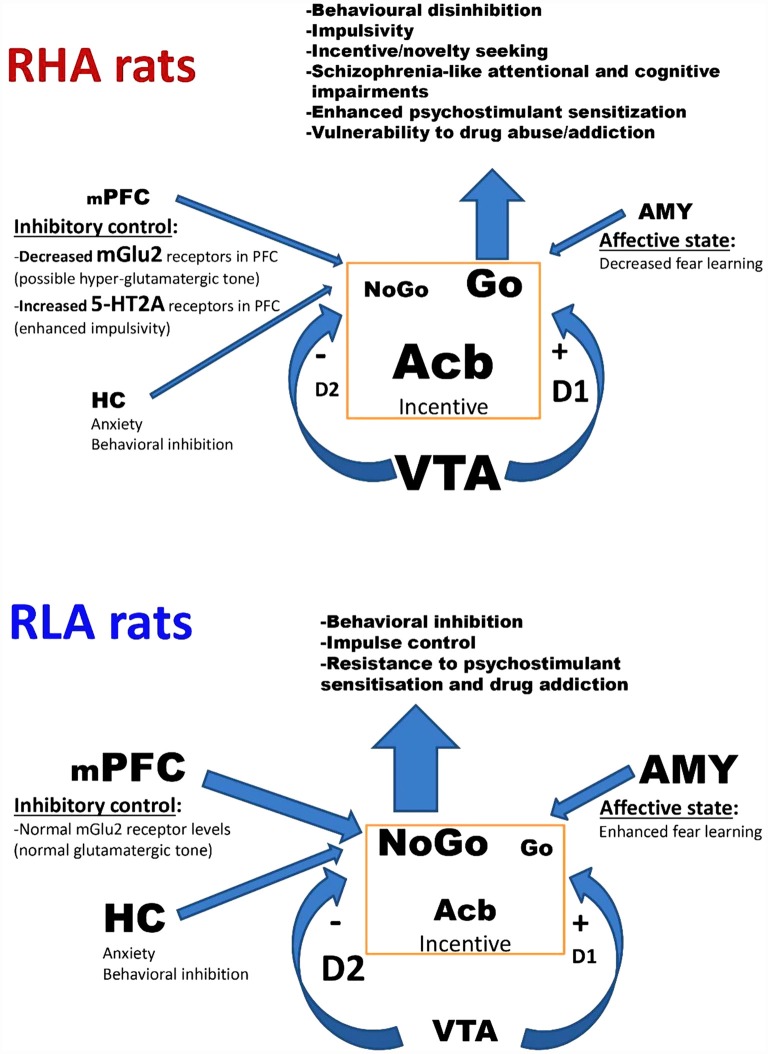
The bidirectional selective breeding of Roman high- (RHA) and low-avoidance (RLA) rats for respectively rapid vs. poor acquisition of active avoidant behavior has generated two lines/strains that differ markedly in terms of emotional reactivity, with RHA rats being less fearful than their RLA counterparts. Many other behavioral traits have been segregated along the selection procedure; thus, compared with their RLA counterparts, RHA rats behave as proactive copers in the face of aversive conditions, display a robust sensation/novelty seeking (SNS) profile, and show high impulsivity and an innate preference for natural and drug rewards. Impulsivity is a multifaceted behavioral trait and is generally defined as a tendency to express actions that are poorly conceived, premature, highly risky or inappropriate to the situation, that frequently lead to unpleasant consequences. High levels of impulsivity are associated with several neuropsychiatric conditions including attention-deficit hyperactivity disorder, obsessive-compulsive disorder, schizophrenia, and drug addiction. Herein, we review the behavioral and neurochemical differences between RHA and RLA rats and survey evidence that RHA rats represent a valid genetic model, with face, construct, and predictive validity, to investigate the neural underpinnings of behavioral disinhibition, novelty seeking, impulsivity, vulnerability to drug addiction as well as deficits in attentional processes, cognitive impairments and other schizophrenia-relevant traits.
对罗马高回避(RHA)和低回避(RLA)大鼠进行双向选择性育种,分别用于快速与缓慢习得主动回避行为,由此产生了两个品系,它们在情绪反应性方面存在显著差异,RHA大鼠比RLA大鼠更不恐惧。在选育过程中还分离出了许多其他行为特征;因此,与RLA大鼠相比,RHA大鼠在面对厌恶条件时表现为主动应对者,表现出强烈的感觉/新奇寻求(SNS)特征,并表现出高冲动性以及对自然奖励和药物奖励的先天偏好。冲动性是一种多方面的行为特征,通常被定义为表现出构思不周、过早、高风险或与情境不符的行为的倾向,这些行为常常会导致不愉快的后果。高冲动性与多种神经精神疾病有关,包括注意力缺陷多动障碍、强迫症、精神分裂症和药物成瘾。在此,我们综述了RHA和RLA大鼠之间的行为和神经化学差异,并审视了相关证据,即RHA大鼠代表了一个有效的遗传模型,具有表面效度、结构效度和预测效度,可用于研究行为抑制解除、新奇寻求、冲动性、药物成瘾易感性以及注意力过程缺陷、认知障碍和其他与精神分裂症相关特征的神经基础。