Paredes-Gallardo Andreu, Dau Torsten, Marozeau Jeremy
Hearing Systems Section, Department of Health Technology, Technical University of Denmark, Lyngby, Denmark.
Front Comput Neurosci. 2019 Jul 3;13:42. doi: 10.3389/fncom.2019.00042. eCollection 2019.
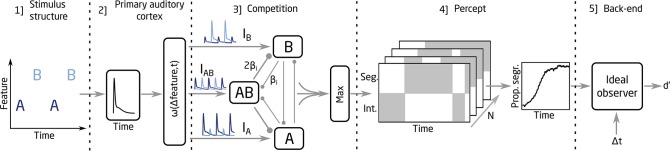
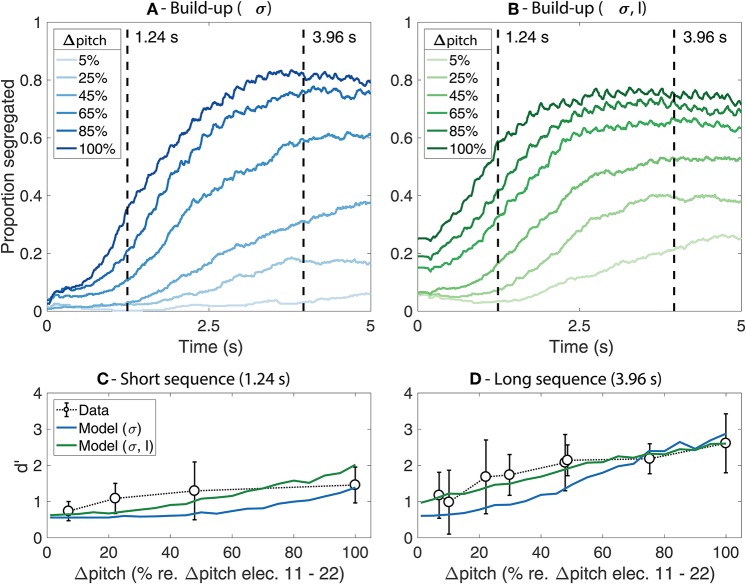
Auditory stream segregation is a perceptual process by which the human auditory system groups sounds from different sources into perceptually meaningful elements (e.g., a voice or a melody). The perceptual segregation of sounds is important, for example, for the understanding of speech in noisy scenarios, a particularly challenging task for listeners with a cochlear implant (CI). It has been suggested that some aspects of stream segregation may be explained by relatively basic neural mechanisms at a cortical level. During the past decades, a variety of models have been proposed to account for the data from stream segregation experiments in normal-hearing (NH) listeners. However, little attention has been given to corresponding findings in CI listeners. The present study investigated whether a neural model of sequential stream segregation, proposed to describe the behavioral effects observed in NH listeners, can account for behavioral data from CI listeners. The model operates on the stimulus features at the cortical level and includes a competition stage between the neuronal units encoding the different percepts. The competition arises from a combination of mutual inhibition, adaptation, and additive noise. The model was found to capture the main trends in the behavioral data from CI listeners, such as the larger probability of a segregated percept with increasing the feature difference between the sounds as well as the build-up effect. Importantly, this was achieved without any modification to the model's competition stage, suggesting that stream segregation could be mediated by a similar mechanism in both groups of listeners.
听觉流分离是一种感知过程,通过该过程,人类听觉系统将来自不同声源的声音分组为具有感知意义的元素(例如,一个声音或一段旋律)。声音的感知分离很重要,例如,对于在嘈杂场景中理解语音而言,这对人工耳蜗(CI)使用者来说是一项特别具有挑战性的任务。有人提出,流分离的某些方面可能可以用皮层水平上相对基本的神经机制来解释。在过去几十年中,已经提出了各种模型来解释正常听力(NH)听众的流分离实验数据。然而,对于CI使用者的相应研究结果却很少受到关注。本研究调查了一个用于描述NH听众中观察到的行为效应而提出的顺序流分离神经模型,是否能够解释CI使用者的行为数据。该模型在皮层水平上对刺激特征进行运算,并且包括一个在编码不同感知的神经元单元之间的竞争阶段。这种竞争源于相互抑制、适应和加性噪声的组合。研究发现,该模型能够捕捉CI使用者行为数据中的主要趋势,例如随着声音之间特征差异的增加,分离感知的概率更大以及累积效应。重要的是,这是在不对模型的竞争阶段进行任何修改的情况下实现的,这表明两组听众中的流分离可能由类似的机制介导。