Yang Yang, Liu Bingru
Key Lab of Restoration and Reconstruction of Degraded Ecosystem in Northwest China of Ministry of Education, Ningxia University, Yinchuan, China.
State Key Laboratory of Loess and Quaternary Geology, Institute of Earth Environment, Chinese Academy of Sciences, Xi'an, China.
PeerJ. 2019 Jul 10;7:e7239. doi: 10.7717/peerj.7239. eCollection 2019.
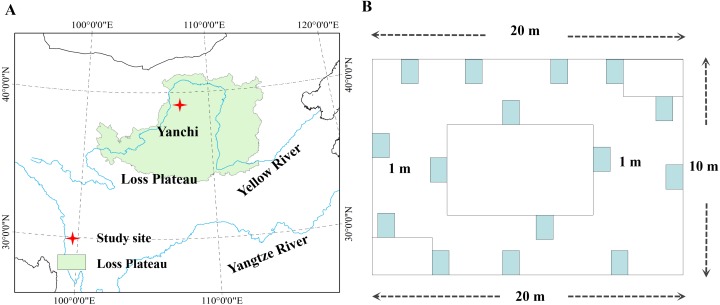
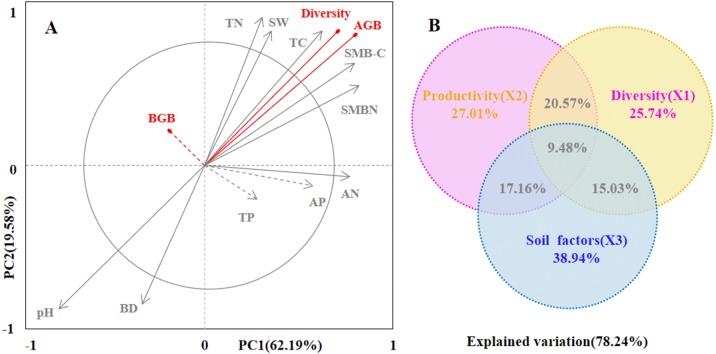
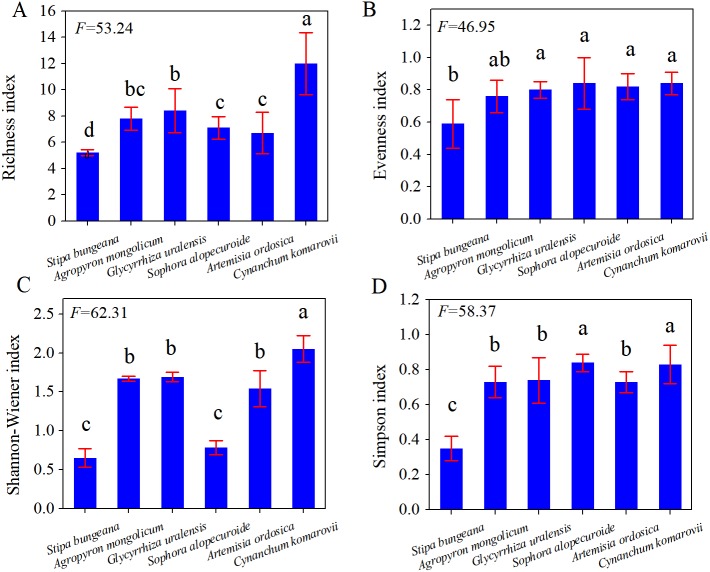
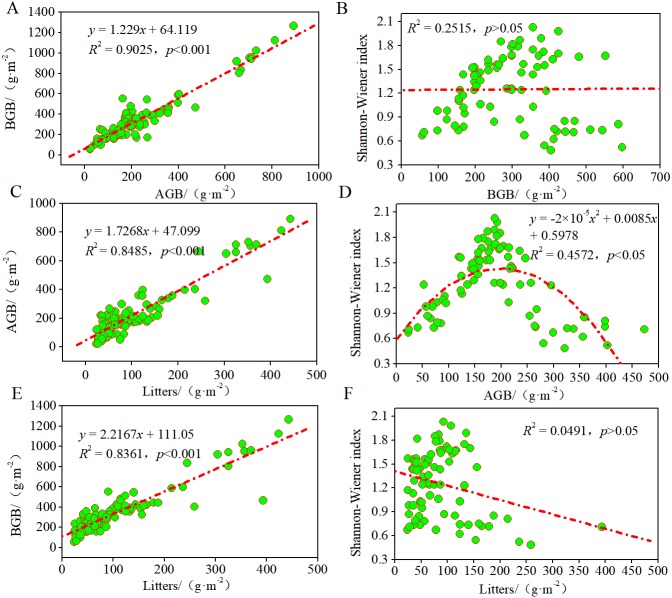
The rapid global plant diversity and productivity loss has resulted in ecosystem functional degeneration in recent decades, and the relationship between plant diversity and productivity is a pressing issue around the world. Here, we sampled six plant communities that have not been grazed for 20 years, i.e., , , , , , , located in a desertified steppe, northwestern China, and tested the relationship between plant diversity and productivity in this region. We found a positive linear relationship between AGB (above-ground biomass) and BGB (below-ground biomass), and the curves between plant diversity and AGB were unimodal ( = 0.4572, < 0.05), indicating that plant productivity increased at a low level of diversity but decreased at a high level of diversity. However, there was no significant relationship between BGB and plant diversity ( > 0.05). Further, RDA (redundancy analysis) indicated that soil factors had a strong effect on plant diversity and productivity. Totally, GAMs (generalized additive models) showed that soil factors (especially total nitrogen TN, total carbon TC, soil microbial biomass nitrogen SMB-N, soil microbial biomass carbon SMB-C) explained more variation in plant diversity and productivity (78.24%), which can be regarded as the key factors driving plant diversity and productivity. Therefore, strategies aiming to increase plant productivity and protect plant diversity may concentrate on promoting soil factors (e.g., increasing TC, TN, SMB-N and SMB-C) and plant species, which can be regarded as an effective and simple strategy to stabilize ecosystems to mitigate aridity in desertified steppes in northwestern China.
近几十年来,全球植物多样性和生产力迅速丧失,导致生态系统功能退化,植物多样性与生产力之间的关系是全球面临的紧迫问题。在此,我们对位于中国西北荒漠草原、20年未放牧的6个植物群落(即 、 、 、 、 、 )进行了采样,并测试了该地区植物多样性与生产力之间的关系。我们发现地上生物量(AGB)与地下生物量(BGB)之间呈正线性关系,植物多样性与AGB之间的曲线呈单峰型( = 0.4572, < 0.05),这表明植物生产力在低多样性水平时增加,而在高多样性水平时下降。然而,BGB与植物多样性之间没有显著关系( > 0.05)。此外,冗余分析(RDA)表明土壤因素对植物多样性和生产力有很强的影响。总体而言,广义相加模型(GAMs)显示土壤因素(特别是全氮TN、总碳TC、土壤微生物生物量氮SMB-N、土壤微生物生物量碳SMB-C)解释了植物多样性和生产力中更多的变异(78.24%),可被视为驱动植物多样性和生产力的关键因素。因此,旨在提高植物生产力和保护植物多样性的策略可能集中在促进土壤因素(如增加TC、TN、SMB-N和SMB-C)和植物物种上,这可被视为稳定生态系统以缓解中国西北荒漠草原干旱的有效且简单的策略。