Ogawa Akiko, Ogawa Yoko, Mukai Shin, Shimizu Eisuke, Kuwana Masataka, Kawakami Yutaka, Tsubota Kazuo
Department of Ophthalmology, Keio University School of Medicine, Tokyo, Japan.
Center for Interdisciplinary Cardiovascular Sciences, Brigham and Women's Hospital, Harvard Medical School, Massachusetts.
Medicine (Baltimore). 2019 Jul;98(29):e16390. doi: 10.1097/MD.0000000000016390.
Sjögren's syndrome (SS) often causes lymphoproliferative disorders such as malignant lymphoma and macroglobrinemia. Approximately 5% of long-term follow-up SS patients develop malignant lymphoma. Recently, the tumor necrosis factor receptor superfamily cluster of differentiation 30 (CD30) has been thought to be implicated in malignant cells in organs affected by Hodgikin lymphoma or in a prognostic marker of diffuse large B cell lymphoma. In this study, we investigated CD30 expression in lacrimal gland and conjunctiva in patients with SS.
We examined lacrimal gland and conjunctival tissues for the diagnosis from 3 female SS patients with a median age of 51 and 3 female chronic graft-versus-host disease (cGVHD) patients with a median age of 41. Histological analysis of these tissues of the remaining samples was conducted by methods including immunohistochemistry and electron microscopy (#20090277). We analyzed the expression and localization of cluster of differentiation 4 (CD4), cluster of differentiation 8 (CD8), cluster of differentiation 20 (CD20), CD30, and Interferon-γ in tissue sections prepared from lacrimal glands and conjunctiva in 3 each of SS and cGVHD patients.
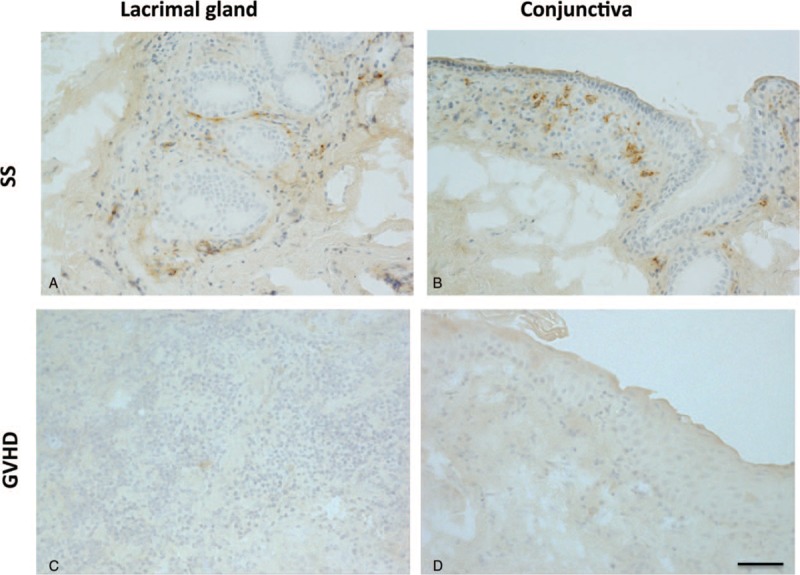
There were more B cells and plasma cells in lobules of SS-affected lacrimal glands than in those of their cGVHD-affected counterparts. Interferon-γ was expressed on endothelia of capillaries in SS-affected lacrimal gland and conjunctival tissues whereas it was expressed on fibroblasts in their GVHD-affected equivalents. Furthermore, lacrimal glands and conjunctiva disordered by SS had a greater number of CD30 cells than those disordered by cGVHD.
Our results suggest that CD30 cells are increased in lacrimal glands and conjunctiva affected by SS and that a subset of SS patients are thereby at risk of development malignant lymphoma.
干燥综合征(SS)常引发淋巴增殖性疾病,如恶性淋巴瘤和巨球蛋白血症。约5%的长期随访SS患者会发展为恶性淋巴瘤。近来,肿瘤坏死因子受体超家族分化抗原30(CD30)被认为与霍奇金淋巴瘤累及器官中的恶性细胞或弥漫性大B细胞淋巴瘤的预后标志物有关。在本研究中,我们调查了SS患者泪腺和结膜中CD30的表达情况。
我们检查了3名年龄中位数为51岁的女性SS患者以及3名年龄中位数为41岁的女性慢性移植物抗宿主病(cGVHD)患者用于诊断的泪腺和结膜组织。通过免疫组织化学和电子显微镜等方法(#20090277)对其余样本的这些组织进行组织学分析。我们分析了3例SS患者和3例cGVHD患者泪腺和结膜制备的组织切片中分化抗原4(CD4)、分化抗原8(CD8)、分化抗原20(CD20)、CD30和干扰素-γ的表达及定位。
受SS影响的泪腺小叶中的B细胞和浆细胞比受cGVHD影响的泪腺小叶中的更多。干扰素-γ在受SS影响的泪腺和结膜组织的毛细血管内皮上表达,而在受GVHD影响的相应组织的成纤维细胞上表达。此外,与受cGVHD影响的组织相比,受SS影响的泪腺和结膜中有更多的CD30细胞。
我们的结果表明,受SS影响的泪腺和结膜中CD30细胞增多,因此一部分SS患者有发展为恶性淋巴瘤的风险。