Department of Neurosurgery, Severance Hospital, Yonsei University College of Medicine, Seoul, Korea.
Department of Radiology, Ilsan Paik Hospital, Inje University College of Medicine, Goyang, Korea.
Korean J Radiol. 2019 Aug;20(8):1285-1292. doi: 10.3348/kjr.2019.0127.
To evaluate the safety and efficacy of the coil-protected technique for liquid embolization in neurovascular malformations.
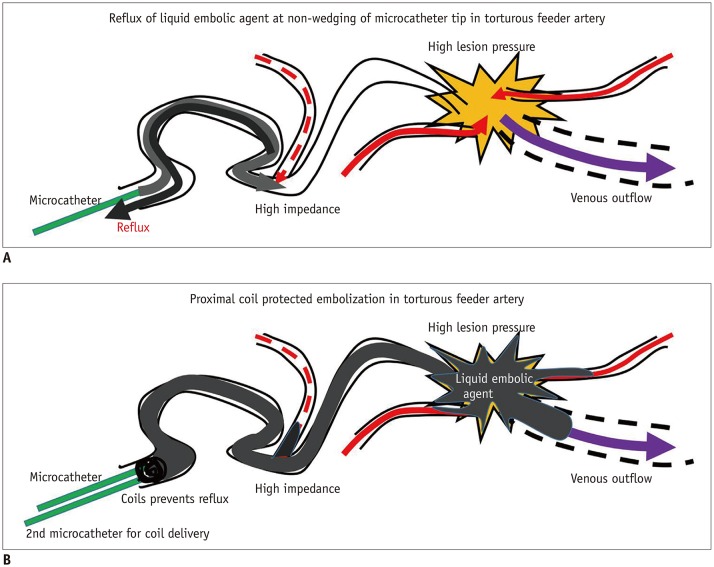
Twenty-two patients who underwent coil-protected liquid embolization for symptomatic cranial (n = 13) and spinal (n = 9) arteriovenous fistula (AVF) or arteriovenous malformations (AVMs) were identified. A total of 36 target feeder vessels were embolized with N-butyl cyanoacrylate and/or Onyx (Medtronic). This technique was used to promote delivery of a sufficient amount of liquid embolic agent into the target shunt or nidus in cases where tortuous feeding arteries preclude a microcatheter wedging techniqu and/or to prevent reflux of the liquid embolic agent in cases with a short safety margin. The procedure was considered technically successful if the target lesion was sufficiently filled with liquid embolic agent without unintentional reflux. Angiographic and clinical outcomes were retrospectively evaluated.
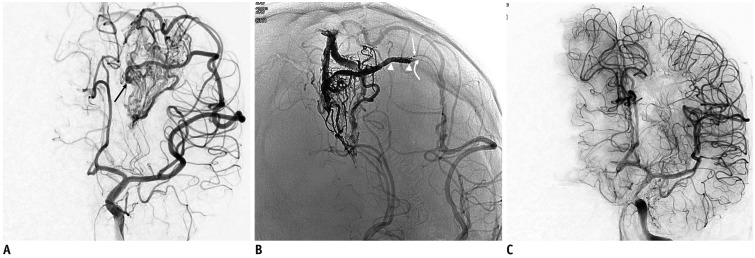
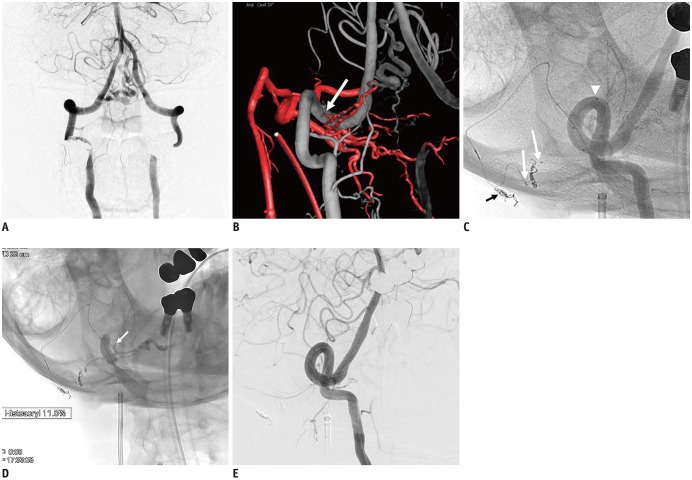
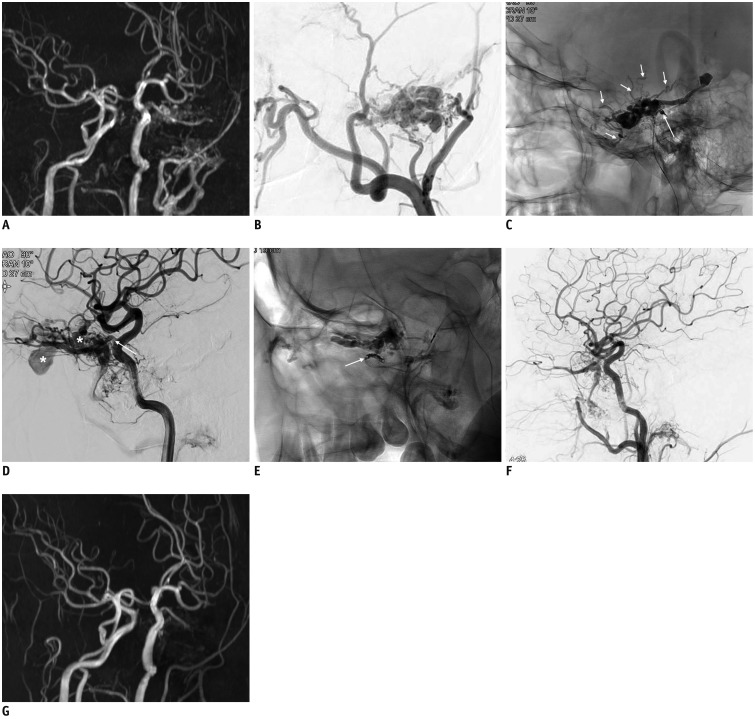
Technical success was achieved for all 36 target feeders. Post-embolization angiographies revealed complete occlusion in 16 patients and near-complete and partial occlusion in three patients each. There were no treatment-related complications. Of the six patients who showed near-complete or partial occlusion, five received additional treatments: two received stereotactic radiosurgery for cerebral AVM, two underwent surgical removal of cerebral AVM, and one underwent additional embolization by direct puncture for a mandibular AVM. Finally, all patients showed complete (n = 19) or near-complete (n = 3) occlusion of the target AVF or AVM on follow-up angiographies. The presenting neurological symptoms improved completely in 15 patients (68.2%) and partially in seven patients (31.8%).
The coil-protected technique is a safe and effective method for liquid embolization, especially in patients with various neurovascular shunts or malformations who could not be successfully treated with conventional techniques.
评估线圈保护技术在神经血管畸形中的液体栓塞的安全性和有效性。
共确定了 22 例因症状性颅(n = 13)和脊柱(n = 9)动静脉瘘(AVF)或动静脉畸形(AVM)而行线圈保护液体栓塞的患者。共有 36 个靶供血动脉用 N-丁基氰基丙烯酸酯和/或 Onyx(美敦力)栓塞。在迂曲的供血动脉妨碍微导管楔入技术的情况下,该技术用于将足够量的液体栓塞剂输送到目标分流或病灶中,或在安全裕度较短的情况下防止液体栓塞剂反流,以促进将足够量的液体栓塞剂输送到目标分流或病灶中。如果目标病变被液体栓塞剂充分填充而没有意外反流,则认为该过程在技术上是成功的。回顾性评估了血管造影和临床结果。
所有 36 个靶供血动脉均达到技术成功。栓塞后血管造影显示 16 例患者完全闭塞,3 例患者接近完全和部分闭塞。无治疗相关并发症。在显示接近完全或部分闭塞的 6 例患者中,5 例接受了额外的治疗:2 例接受了脑 AVM 的立体定向放射外科治疗,2 例接受了脑 AVM 的手术切除,1 例接受了下颌 AVM 的直接穿刺额外栓塞。最后,所有患者在随访血管造影中均显示靶 AVF 或 AVM 完全(n = 19)或接近完全(n = 3)闭塞。15 例患者(68.2%)的症状完全改善,7 例患者(31.8%)部分改善。
线圈保护技术是一种安全有效的液体栓塞方法,特别是在无法通过传统技术成功治疗的具有各种神经血管分流或畸形的患者中。