Department of Health Sciences and Health Policy, University of Lucerne, 6002 Lucerne, Switzerland.
Int J Environ Res Public Health. 2019 Jul 23;16(14):2614. doi: 10.3390/ijerph16142614.
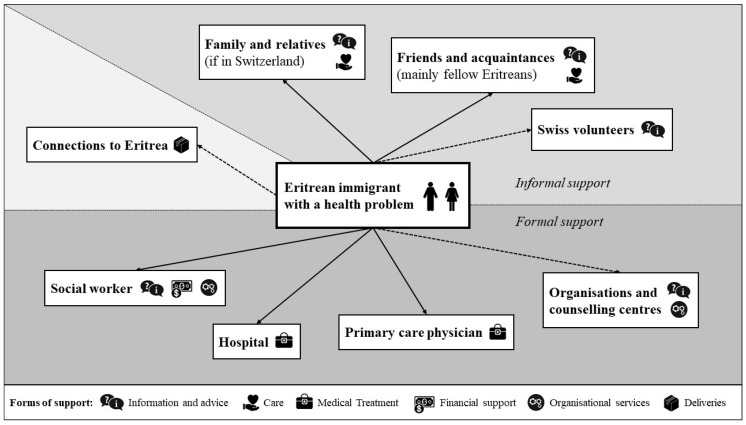
Growing migration in European countries has simultaneously increased cultural diversity in health care. Migrants' equal access to health care systems and migrant friendly health care have therefore become relevant topics. Findings gathered in recent years have mainly focussed on the perspective of care providers, whereas this study includes migrant perspectives. It explores the primary care network of Eritrean immigrants in Switzerland as well as their experiences of interacting with health professionals. Semi-structured face-to-face interviews with intercultural interpreters from Eritrea were conducted. On the basis of a thematic analysis, the study identified the important informal and formal contacts in these Eritrean immigrants' primary care networks and the specific forms of support each actor provides. In this network, encounters with health professionals were predominately expressed positively. The main barriers reported were language difficulties and intercultural understanding. On the basis of the participants' statements, six key lessons for practice have been derived. These lessons are specifically important for facilitating Eritrean immigrants' access to the Swiss health care system. Nevertheless, they are also relevant for other groups of migrants in European countries.
欧洲国家日益增长的移民潮同时增加了医疗保健领域的文化多样性。因此,移民平等获得医疗保健系统和对移民友好的医疗保健已成为相关话题。近年来收集的研究结果主要集中在护理提供者的角度,而本研究则包括移民的观点。它探讨了瑞士厄立特里亚移民的初级保健网络以及他们与卫生专业人员互动的经验。通过使用来自厄立特里亚的跨文化口译员进行半结构化的面对面访谈。基于主题分析,本研究确定了这些厄立特里亚移民初级保健网络中重要的非正式和正式联系,以及每个参与者提供的具体支持形式。在这个网络中,与卫生专业人员的接触主要是积极的。报告的主要障碍是语言困难和跨文化理解。根据参与者的陈述,得出了实践的六个关键要点。这些要点对于促进厄立特里亚移民获得瑞士医疗保健系统特别重要。然而,它们对于欧洲国家的其他移民群体也具有相关性。