An W B, Liu C, Wan Y, Chen X Y, Guo Y, Chen X J, Yang W Y, Chen Y M, Zhang Y C, Zhu X F
Pediatric Blood Diseases Centre, Institute of Hematology and Blood Diseases Hospital, CAMS & PUMC, Tianjin 300020, China; State Key Laboratory of Experimental Hematology, Tianjin 300020, China.
Pediatric Blood Diseases Centre, Institute of Hematology and Blood Diseases Hospital, CAMS & PUMC, Tianjin 300020, China.
Zhonghua Xue Ye Xue Za Zhi. 2019 Jun 14;40(6):477-483. doi: 10.3760/cma.j.issn.0253-2727.2019.06.006.
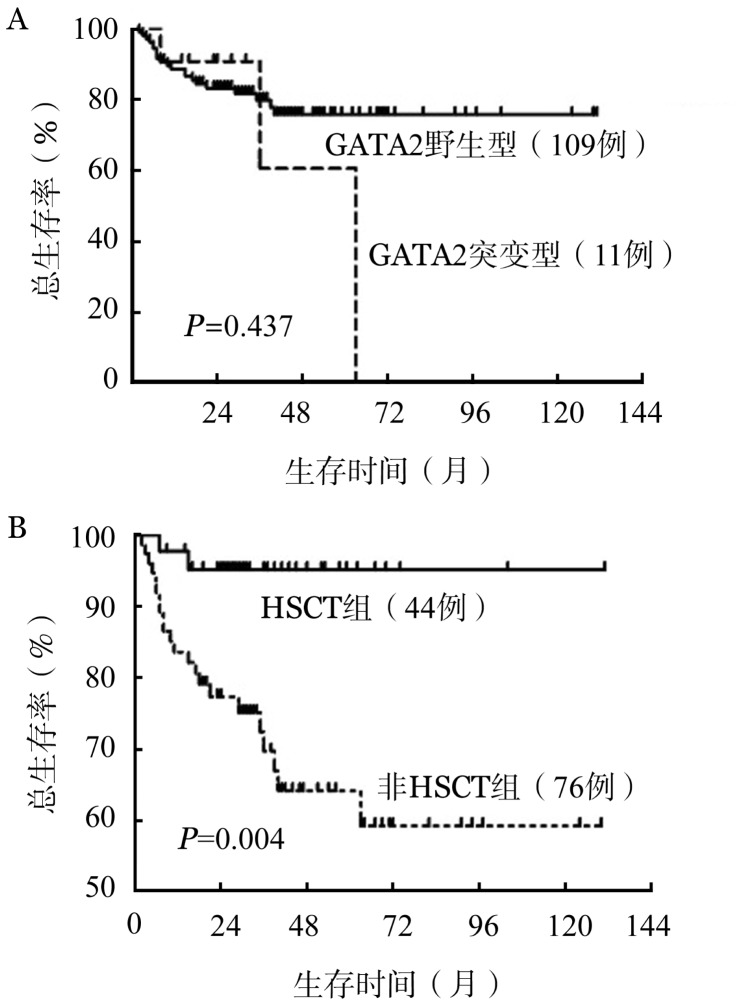
To clarify the prevalence, clinical features and molecular characteristics of germline GATA2 mutations in pediatric primary myelodysplastic syndromes (MDS) . Next-generation sequencing technology was used to detect mutations in GATA2 and other myeloid malignancy genes in 129 children with primary MDS from Jan. 2007 to Jan. 2018. The relationship between genotypes and phenotypes was analyzed. Germline GATA2 mutations accounted for 8.5% (11/129) of all primary MDS cases, and 14.0% (11/50) of MDS with excess blasts (MDS-EB) and acute myeloid leukaemia with myelodysplasia-related changes (AML-MRC) . Compared with GATA2 wild-type patients, GATA2 mutated patients were older at diagnosis[8 (1-16) years old vs 6 years old (range: 1 month old-18 years old) , =0.035]and higher risk of monosomy 7 (72.7% 5.2%, <0.001) and classified into MDS-EB and AML-MRC compared with refractory cytopenia of childhood (RCC) (63.6% 36.4%, =0.111) . The multivariate analysis showed SETBP1 mutation (=0.041, =9.003, 95% 1.098-73.787) and isolated monosomy 7 (=0.002, =24.835, 95% 3.305-186.620) were significantly associated with germline mutated GATA2. Overall survival (OS) and outcomes of hematopoietic stem cell transplantation (HSCT) were not influenced by GATA2 mutational status. Our data identify germline GATA2 mutations have a high prevalence in older pediatric patients with monosomy 7, and high risk of progression into advanced MDS subtypes. GATA2 mutation status does not affect OS in pediatric primary MDS.
为明确儿童原发性骨髓增生异常综合征(MDS)中胚系GATA2突变的患病率、临床特征及分子特征。采用二代测序技术检测了2007年1月至2018年1月期间129例原发性MDS患儿GATA2及其他髓系恶性肿瘤相关基因的突变情况,并分析了基因型与表型之间的关系。胚系GATA2突变占所有原发性MDS病例的8.5%(11/129),在骨髓原始细胞增多的MDS(MDS-EB)和伴有骨髓增生异常相关改变的急性髓系白血病(AML-MRC)中占14.0%(11/50)。与GATA2野生型患者相比,GATA2突变患者诊断时年龄较大[8(1 - 16)岁 vs 6岁(范围:1个月至18岁),P = 0.035],7号染色体单体的风险更高(72.7%对5.2%,P < 0.001),与儿童难治性血细胞减少症(RCC)相比,更多被分类为MDS-EB和AML-MRC(63.6%对36.4%,P = 0.111)。多因素分析显示SETBP1突变(P = 0.041,HR = 9.003,95%CI 1.098 - 73.787)和孤立性7号染色体单体(P = 0.002,HR = 24.835,95%CI 3.305 - 186.620)与胚系GATA2突变显著相关。总生存(OS)及造血干细胞移植(HSCT)结局不受GATA2突变状态的影响。我们的数据表明,胚系GATA2突变在年龄较大、伴有7号染色体单体的儿童患者中患病率较高,进展为高级别MDS亚型的风险高。GATA2突变状态不影响儿童原发性MDS的OS。