Department of Public Health Medicine, School of Nursing and Public Health, University of KwaZulu-Natal, Durban, South Africa.
Faculty of Health and Allied Sciences, Catholic University College of Ghana, Fiapre, Sunyani, Ghana.
BMC Health Serv Res. 2019 Jul 24;19(1):519. doi: 10.1186/s12913-019-4351-3.
World Health Organization (WHO) has created an essential list of in-vitro diagnostics. Supply chain management (SCM) is said to be the vehicle that ensures that developed point-of-care (POC) tests reach their targeted settings for use. We therefore, mapped evidence on SCM of and accessibility to POC testing (availability and use of POC tests) in low- and middle-income countries (LMICs).
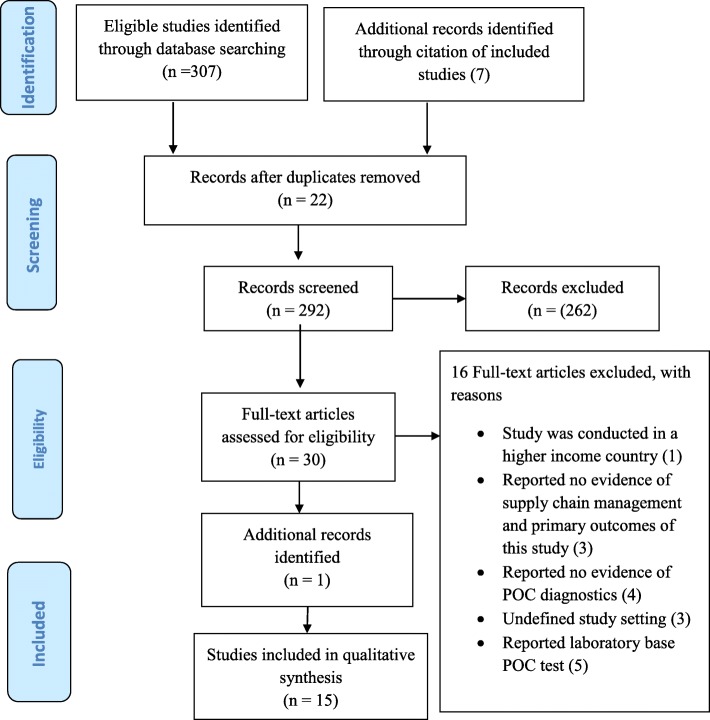
We conducted a systematic scoping review using Arksey and O'Malley's framework as a guide. We searched PubMed; CINAHL; MEDLINE; WEB of Science; Science Direct; and Google Scholar databases for studies that focused on POC diagnostic tests and SCM. The review included studies that were undertaken in 140 countries defined by the World Bank as LMICs published up to August 2017. Two reviewers independently screened the abstracts and full articles against the eligibility criteria. The study used the mixed methods appraisal tool version 2011 to assess the risk of bias for the included studies. NVivo version 11 was employed to extract themes from all included studies and results presented using a narrative approach.
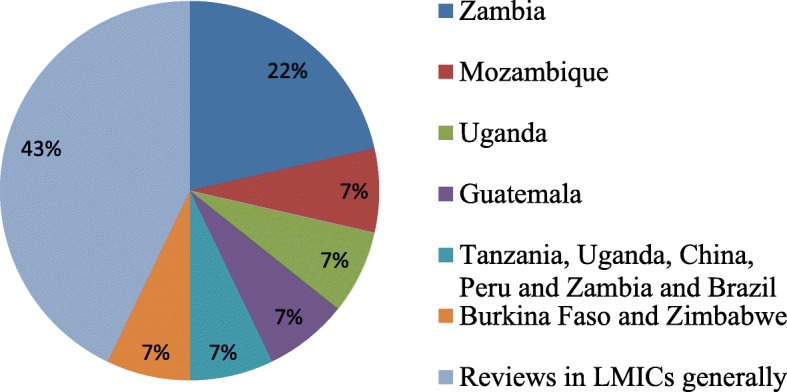
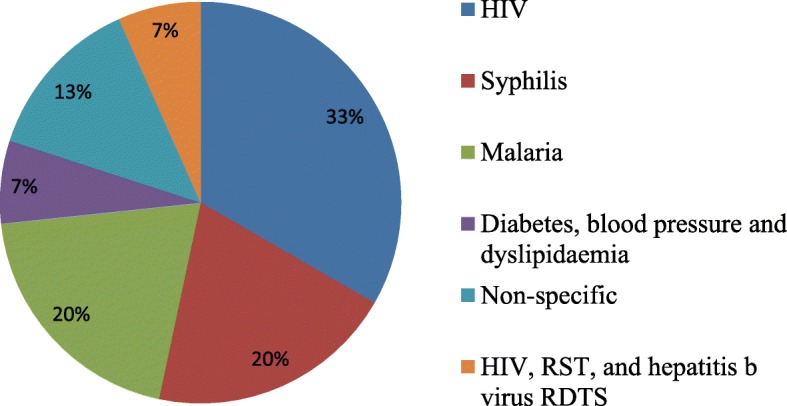
Of 292 studies identified in this review, only 15 published between 2009 and 2017 included evidence on POC diagnostics and SCM. Of the 15 studies, three were conducted in Zambia, one each in Mozambique, Uganda, Guatemala; South Africa, one in Burkina Faso, Zimbabwe, and one multi-country study (Tanzania, Uganda, China, Peru and Zambia and Brazil). Six studies were not country specific since they were not primary studies. Majority of the studies reported stock-outs of HIV, syphilis, and malaria POC tests. There was a moderate to substantial level of agreement between the reviewers' responses at full article screening stage (Kappa statistic = 0.80, p < 0.01). Nine studies underwent methodological quality appraisal and all, scored between 90 and 100%.
The results demonstrated limited published research on SCM of and accessibility to POC testing in LMICs. Further studies aimed at investigating SCM of POC tests in resource-limited settings to identify the barriers/challenges and provide a context-specific evidence-based solutions for policy/decision makers, implementers, and POC developers, funders, and development partners would be essential.
CRD42016043711.
世界卫生组织(WHO)创建了一份基本的体外诊断清单。供应链管理(SCM)据称是确保开发的即时检测(POC)测试到达其目标使用环境的手段。因此,我们绘制了关于中低收入国家(LMIC)中 POC 检测的 SCM 及可及性(POC 检测的可用性和使用)的证据图。
我们使用 Arksey 和 O'Malley 的框架作为指南进行了系统的范围界定审查。我们在 PubMed;CINAHL;MEDLINE;WEB of Science;Science Direct;和 Google Scholar 数据库中搜索了专注于 POC 诊断测试和 SCM 的研究。该审查包括在世界银行定义的 140 个 LMIC 国家进行的、截至 2017 年 8 月发表的研究。两名审查员独立根据入选标准筛选摘要和全文。该研究使用混合方法评估工具版本 2011 评估纳入研究的偏倚风险。使用 NVivo 版本 11 从所有纳入的研究中提取主题,并使用叙述性方法呈现结果。
在本次审查中确定的 292 项研究中,只有 15 项发表于 2009 年至 2017 年期间,包含有关 POC 诊断和 SCM 的证据。在这 15 项研究中,有 3 项在赞比亚进行,1 项在莫桑比克、乌干达、危地马拉;南非,1 项在布基纳法索、津巴布韦,以及 1 项多国研究(坦桑尼亚、乌干达、中国、秘鲁和赞比亚以及巴西)。6 项研究不是针对特定国家的,因为它们不是主要研究。大多数研究报告称 HIV、梅毒和疟疾 POC 检测出现缺货。在全文筛选阶段,审查员的反应有中度至高度一致性(Kappa 统计量=0.80,p<0.01)。有 9 项研究进行了方法学质量评估,所有研究的评分均在 90-100 分之间。
结果表明,关于 LMIC 中 POC 检测的 SCM 和可及性,发表的研究有限。进一步研究旨在调查资源有限环境中的 POC 检测的 SCM,以确定障碍/挑战,并为政策/决策者、实施者和 POC 开发者、资助者和发展伙伴提供基于具体情况的循证解决方案,这将是必要的。
PROSPERO 注册号:CRD42016043711。