Graham Tiffany, Adams-Huet Beverley, Gilbert Nicole, Witthoff Kirsten, Gregory Terran, Walsh Mary
Health Care Sciences, Prosthetics-Orthotics Program, University of Texas Southwestern Medical Center, 6011 Harry Hines Blvd, Dallas, TX 75390-9091, USA.
Population and Data Sciences, University of Texas Southwestern Medical Center, 5323 Harry Hines Blvd, Dallas, TX 75390-8822, USA.
J Clin Med. 2019 Jul 24;8(8):1097. doi: 10.3390/jcm8081097.
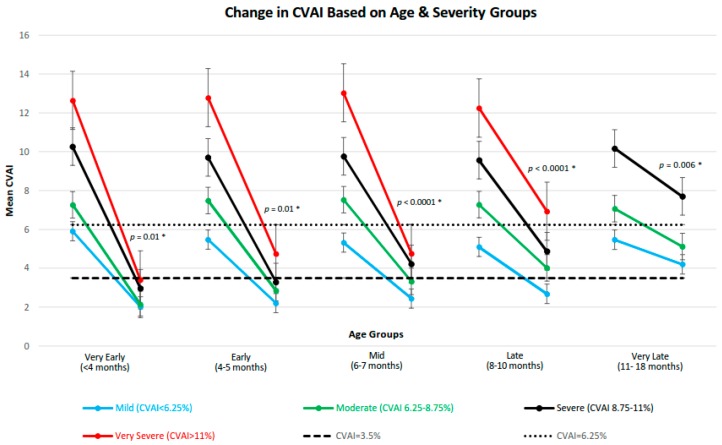
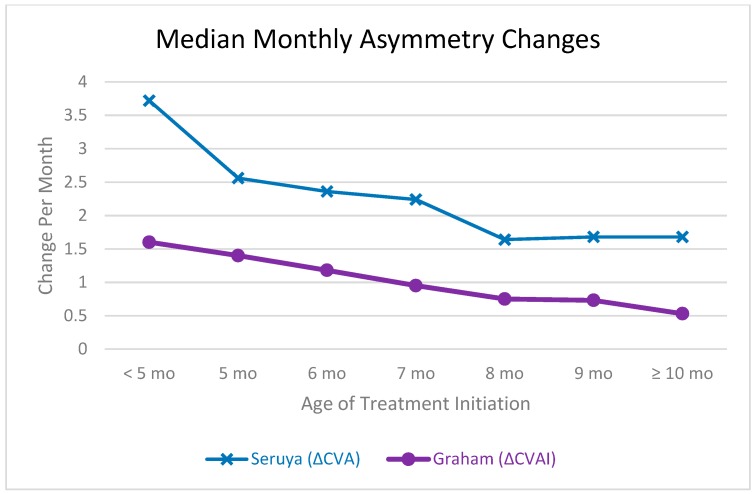
The aim of this study is to review the effects of an infant's presenting age and severity of deformation on cranial remolding orthotic (CRO) treatment outcomes for patients with deformational plagiocephaly. This study is a retrospective chart review of 499 infants with non-synostotic plagiocephaly who completed CRO treatment. Data collected included age at start of treatment, head shape measurements before and after treatment, total months of CRO treatment, and other factors such as presence/absence of prematurity. The infants were divided into subgroups according to age and severity at initiation of treatment and data for subgroups was analyzed to track the change in head shape over the course of treatment, review overall treatment duration, and discuss the rate of change of cranial deformation. Overall, treatment times tended to statistically increase with increasing initial severity and age. Posttreatment asymmetry measurements statistically trended to greater residual deformation in infants who began treatment in the older or more severe subcategories. This indicates that younger and less severe infants have shorter treatment durations and less residual cranial deformation after CRO treatment. Therefore, clinical consideration may need to be taken to treat infants at younger ages or prior to progression of the cranial deformity.
本研究的目的是回顾婴儿的就诊年龄和畸形严重程度对变形性斜头畸形患者颅骨重塑矫形器(CRO)治疗效果的影响。本研究是对499例完成CRO治疗的非综合征性斜头畸形婴儿进行的回顾性病历审查。收集的数据包括治疗开始时的年龄、治疗前后的头型测量值、CRO治疗的总月数以及其他因素,如是否早产。根据治疗开始时的年龄和严重程度将婴儿分为亚组,并分析亚组数据以跟踪治疗过程中的头型变化、回顾总体治疗持续时间并讨论颅骨变形的变化率。总体而言,治疗时间在统计学上倾向于随着初始严重程度和年龄的增加而增加。在年龄较大或病情较严重的亚组中开始治疗的婴儿,治疗后不对称测量在统计学上倾向于有更大的残余变形。这表明年龄较小、病情较轻的婴儿在CRO治疗后的治疗持续时间较短,颅骨残余变形较少。因此,可能需要临床考虑在婴儿较小时或颅骨畸形进展之前进行治疗。