Shang Heli, Zhang Zewen, Feng Alei, Yang Xiaowei, Zhang Shuisheng, Zhao Yi, Zhu Qingshan, Mao Yantao, Liu Kun, Tian Yuan
Department of Radiotherapy Oncology, Shandong Provincial Qianfoshan Hospital, The First Hospital Affiliated with Shandong First Medical University.
Department of Imaging and Nuclear Medicine, Qilu Medical College, Shandong University.
Medicine (Baltimore). 2019 Jul;98(30):e16439. doi: 10.1097/MD.0000000000016439.
We performed the meta-analysis to evaluate the overall safety of programmed cell death-1 (PD-1) or ligand 1 (PD-L1) inhibitor treatment for lung cancer patients.
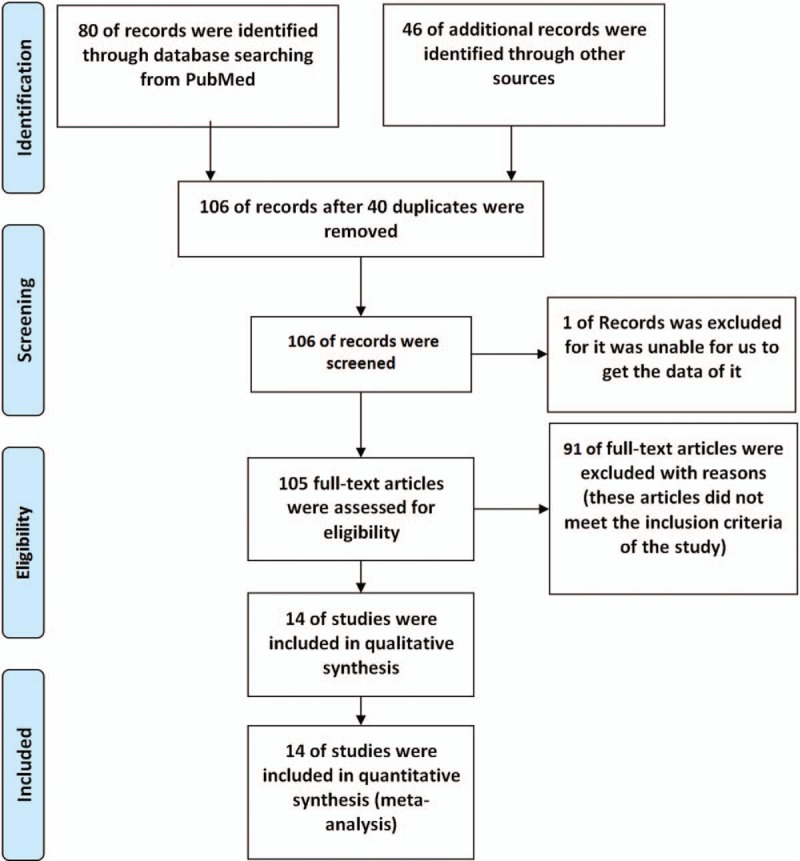
Randomized controlled trials were collected according to the Preferred Reporting Items for Systematic Reviews and Meta-analyses (PRISMA) guidelines. Risk ratio (RR) of PD-1/PD-L1 inhibitor treatment-related death, treatment-related adverse events, any serious events, and any events leading to discontinuation were all taken into account for the final evaluation.
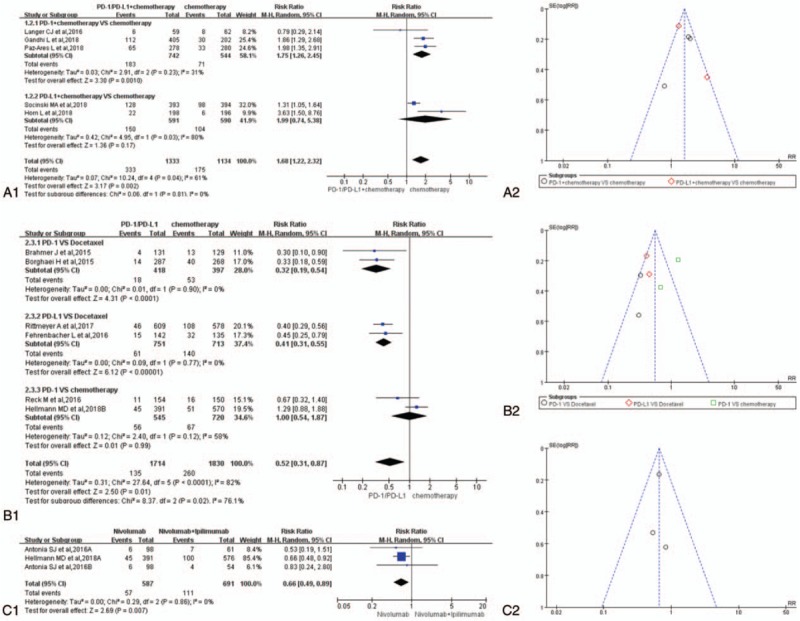
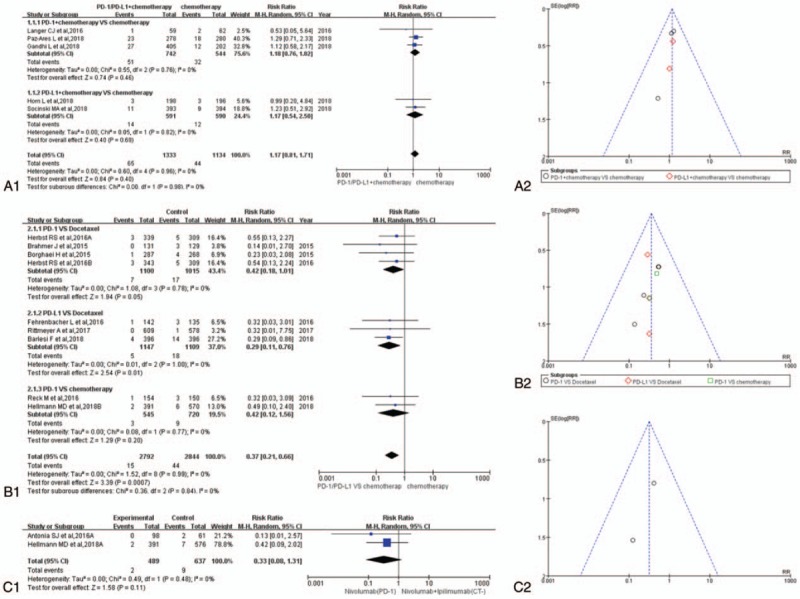
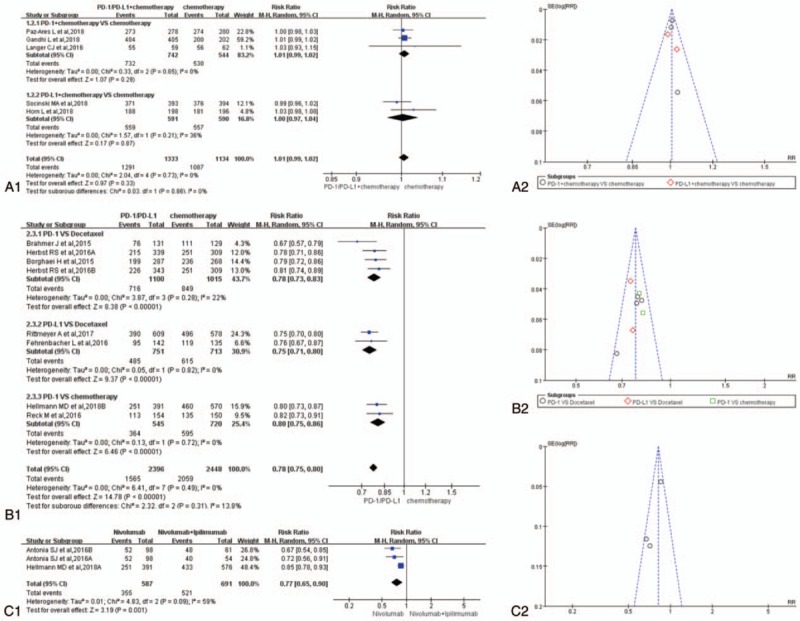
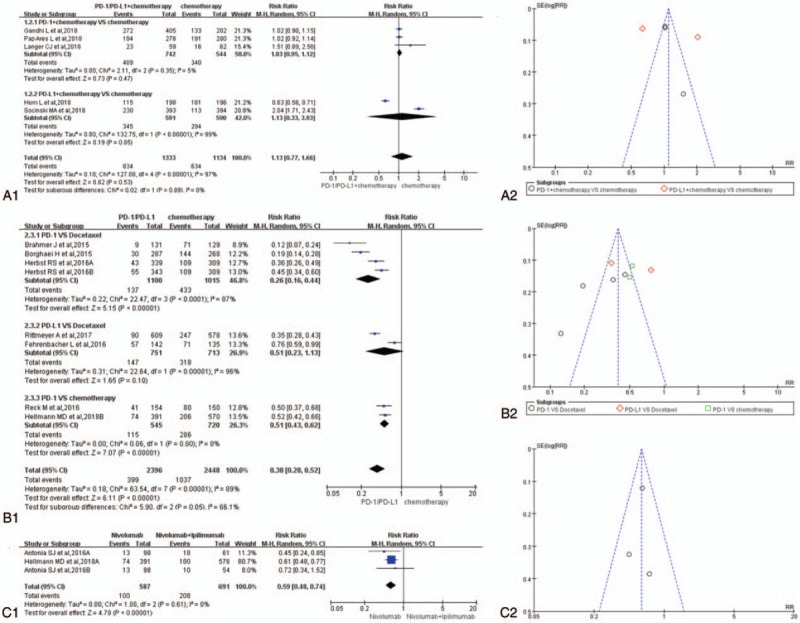
Fourteen studies were collected for the meta-analysis. The RR of treatment-related death for PD-1/PD-L1 was significantly lower than that of the control group (RR = 0.37, 95% confidence interval, CI: [0.21, 0.66]). Similar analysis results could also be seen for the RR of treatment-related adverse events and adverse events leading to discontinuation. When PD-1/PD-L1 was combined with chemotherapy, it increased the RR of adverse events leading to discontinuation (RR = 1.68, 95% CI: [1.22, 3.32]). The RR of overall treatment-related adverse events was lower in nivolumab (PD-1) than that of the control group (nivolumab + ipilimumab) (RR = 0.77, 95% CI: [0.65, 0.90]). Similar analysis results could also be seen in the RR of treatment-related adverse events for grade 3 to 5 and adverse events leading to discontinuation.
Compared with chemotherapy, RR of the treatment-related deaths associated with PD-1/PD-L1 inhibitor was significantly lower than that of the chemotherapy group, while it did not increase the RR when they were combined with chemotherapy or other drugs. When PD-1/PD-L1 was combined with chemotherapy, it increased the RR of adverse events leading to discontinuation.
我们进行了荟萃分析,以评估程序性细胞死亡蛋白1(PD-1)或配体1(PD-L1)抑制剂治疗肺癌患者的总体安全性。
根据系统评价和荟萃分析的首选报告项目(PRISMA)指南收集随机对照试验。最终评估考虑了PD-1/PD-L1抑制剂治疗相关死亡、治疗相关不良事件、任何严重事件以及任何导致停药的事件的风险比(RR)。
收集了14项研究进行荟萃分析。PD-1/PD-L1治疗相关死亡的RR显著低于对照组(RR = 0.37,95%置信区间,CI:[0.21,0.66])。治疗相关不良事件和导致停药的不良事件的RR也有类似的分析结果。当PD-1/PD-L1与化疗联合使用时,导致停药的不良事件的RR增加(RR = 1.68,95%CI:[1.22,3.32])。纳武单抗(PD-1)总体治疗相关不良事件的RR低于对照组(纳武单抗+伊匹木单抗)(RR = 0.77,95%CI:[0.65,0.90])。3至5级治疗相关不良事件和导致停药的不良事件的RR也有类似的分析结果。
与化疗相比,PD-1/PD-L1抑制剂相关的治疗相关死亡的RR显著低于化疗组,而与化疗或其他药物联合使用时RR并未增加。当PD-1/PD-L1与化疗联合使用时,导致停药的不良事件的RR增加。