Olarewaju Sunday O, Oyekunle Emmanuel O, Bamiro Adebukola O
University of Osun, Osogbo, Nigeria.
University College Hospital, Ibadan, Nigeria.
J Glob Oncol. 2019 Jul;5:1-8. doi: 10.1200/JGO.19.00108.
Breast cancer (BC has the highest mortality rate among women with any form of cancer in developing countries. Unfortunately, patients with BC in Nigeria commonly present with late-stage disease. The current study examined the types and magnitude of delay in BC diagnosis at the foremost hospital in Nigeria and also identified the influencing factors.
This cross-sectional study involved questionnaires given to 275 patients with BC at University College Hospital, Ibadan, Nigeria, from August to October 2018. Sociodemographic characteristics and information relevant to management of their health problem were obtained after ethical committee approval. Data collected were analyzed by SPSS (version 23; SPSS, Chicago, IL) to assess the types and magnitude of delay experienced by patients, as well as identify related determinants using the appropriate statistical test with = .05.
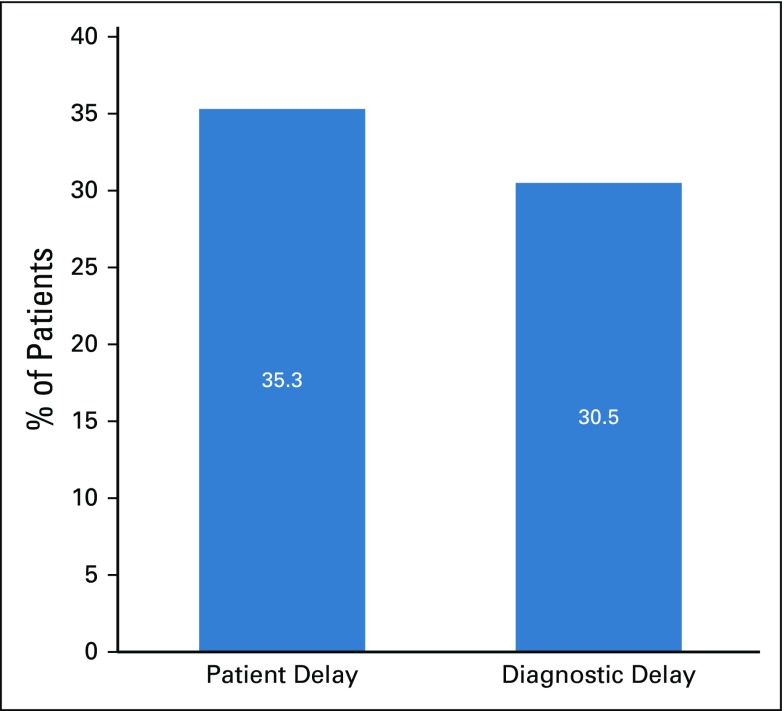
The mean age of respondents was 49 (± 11.9) years with the majority being Yoruba (n = 154; 56%), Christians (n = 211; 76.7%), married (n = 193; 70.2%), employed (n = 151; 54.9%), having tertiary education (n = 142; 51.6%) and an average income of more than 18,000 naira (n = 176; 64%). Patient delay and diagnostic delay were observed among 97 respondents (35.3%) and 84 respondents (30.5%), respectively. Although patient delay was significantly associated with age, ethnicity, and marital status, the only variable significantly associated with diagnostic delay was marital status ( < .05). Level of income, education, employment status, and religion did not significantly ( > .05) contribute to either of these delays.
BC management at the pioneer Nigerian teaching hospital is challenged by both delays in patient presentation at clinics and delays in the process of being diagnosed. Such delays need to be addressed to achieve favorable outcome of patients with BC in Nigeria.
在发展中国家,乳腺癌(BC)在所有癌症女性患者中的死亡率最高。不幸的是,尼日利亚的乳腺癌患者通常在疾病晚期才就诊。本研究调查了尼日利亚主要医院乳腺癌诊断延迟的类型和程度,并确定了影响因素。
这项横断面研究涉及2018年8月至10月在尼日利亚伊巴丹大学学院医院对275例乳腺癌患者进行问卷调查。在伦理委员会批准后,获取了社会人口学特征以及与其健康问题管理相关的信息。收集的数据通过SPSS(版本23;SPSS,伊利诺伊州芝加哥)进行分析,以评估患者经历的延迟类型和程度,并使用适当的统计检验(α = 0.05)确定相关决定因素。
受访者的平均年龄为49(±11.9)岁,大多数是约鲁巴人(n = 154;56%)、基督徒(n = 211;76.7%)、已婚(n = 193;70.2%)、就业(n = 151;54.9%)、接受过高等教育(n = 142;51.6%)且平均收入超过18,000奈拉(n = 176;64%)。分别在97名受访者(35.3%)和84名受访者(30.5%)中观察到患者延迟和诊断延迟。虽然患者延迟与年龄、种族和婚姻状况显著相关,但与诊断延迟显著相关的唯一变量是婚姻状况(P < 0.05)。收入水平、教育程度、就业状况和宗教信仰对这两种延迟均无显著贡献(P > 0.05)。
尼日利亚首家教学医院的乳腺癌管理面临着患者到诊所就诊延迟和诊断过程延迟的挑战。需要解决这些延迟问题,以实现尼日利亚乳腺癌患者的良好预后。