Zhao Hongbo, Wu Sentang, Wen Yongming, Liu Wenlei, Wu Xiongjun
School of Automation Science and Electrical Engineering, Beihang University, Beijing 100191, China.
Science and Technology on Information Systems Engineering Laboratory, Beijing Institute of Control & Electronics Technology, Beijing 100038, China.
Sensors (Basel). 2019 Jul 25;19(15):3278. doi: 10.3390/s19153278.
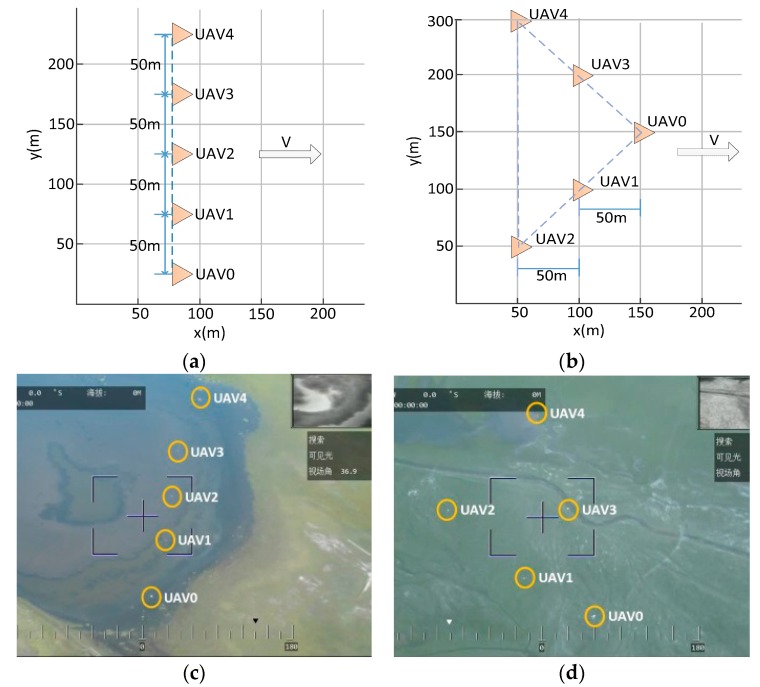
UAV Swarm with high dynamic configuration at a large scale requires a high-precision mathematical model to fully exploit its boundary performance. In order to instruct the engineering application with high confidence, uncertainties induced from either systematic measurement or the environment cannot be ignored. This paper investigates the I t o ^ stochastic model of the UAV Swarm system with multiplicative noises. By combining the cooperative kinematic model with a simplified individual dynamic model of fixed-wing-aircraft for the first time, the configuration control model is derived. Considering the uncertainties in actual flight, multiplicative noises are introduced to complete the I t o ^ stochastic model. Following that, the estimator and controller are designed to control the formation. The mean-square uniform boundedness condition of the proposed stochastic system is presented for the closed-loop system. In the simulation, the stochastic robustness analysis and design (SRAD) method is used to optimize the properties of the formation. More importantly, the effectiveness of the proposed model is also verified using real data of five unmanned aircrafts collected in outfield formation flight experiments.
大规模高动态配置的无人机集群需要高精度数学模型来充分发挥其边界性能。为了高置信度地指导工程应用,系统测量或环境引起的不确定性不容忽视。本文研究了具有乘性噪声的无人机集群系统的伊藤随机模型。首次将协同运动学模型与固定翼飞机的简化个体动力学模型相结合,推导了构型控制模型。考虑到实际飞行中的不确定性,引入乘性噪声以完善伊藤随机模型。在此基础上,设计了估计器和控制器来控制编队。给出了所提出随机系统的闭环系统均方一致有界条件。在仿真中,采用随机鲁棒性分析与设计(SRAD)方法优化编队性能。更重要的是,还利用在外场编队飞行实验中收集的五架无人机的实际数据验证了所提模型的有效性。