Mesquita Marceli M A, Santos Marta S, Vasconcelos Alan B S, de Sá Clodoaldo A, Pereira Luana C D, da Silva-Santos Ínea B M, da Silva Junior Walderi M, de Matos Dihogo G, Fontes Alan Dos S, Oliveira Paulo M P, Aidar Felipe J, DeSantana Josimari M, Fernandes Iohanna G S, Da Silva-Grigoletto Marzo E
Department of Physical Education, Federal University of Sergipe, São Cristóvão, Brazil.
Department of Physiology, Federal University of Sergipe, São Cristóvão, Brazil.
J Aging Res. 2019 Jul 1;2019:9061839. doi: 10.1155/2019/9061839. eCollection 2019.
The aim of this study was to analyze the reproducibility of a protocol using the maximal isometric strength test of the trunk in elderly women aged above 60 years, without low back pain.
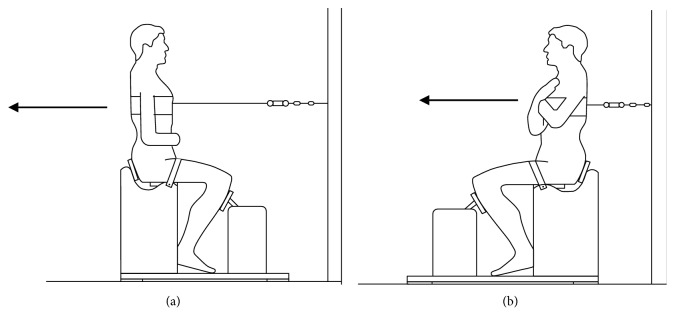
Twenty-one physically inactive elderly women, who had not engaged in any activity or exercise program in the past three months, participated in the cross-sectional study that consisted of two days of evaluations for the maximal isometric strength of the extensor and flexor muscles of the trunk, with a 48 h interval between the sessions. A platform with fixed seating was used, which allowed the fixation of the hip and lower limbs, with a load cell connected to a linear encoder. To verify the reliability of the test, the interclass correlation coefficient, variation coefficient, minimum detectable difference (MDD), standard error of measurement, and Bland-Altman graphs were calculated.
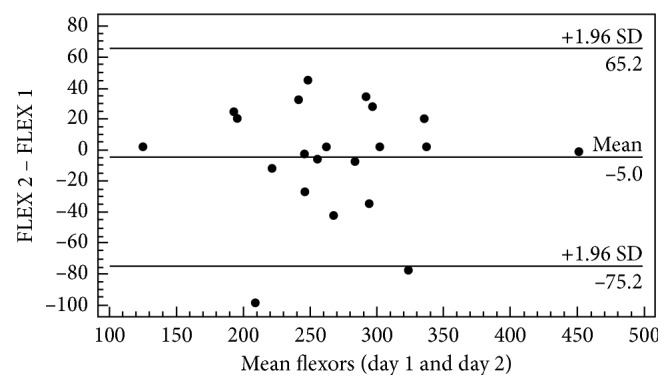
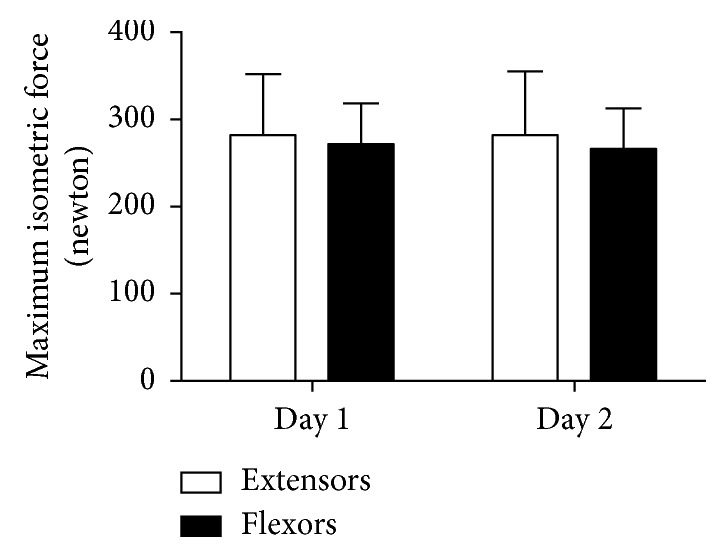
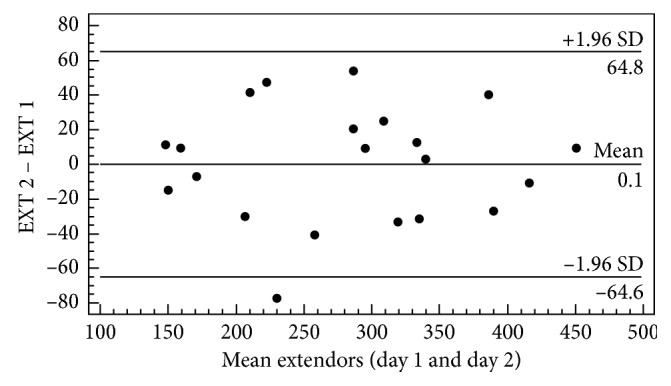
No statistical difference was observed between the first and second evaluation, which indicates that there was no learning effect. Interclass correlation coefficient values were classified as very high and high for extensor (0.98) and flexor (0.86) muscles, respectively, besides low variation (9% for both muscle groups) and acceptable values for minimum detectable difference (extensors = 51.1 N, flexors = 48.9 N). In addition, the Bland-Altman analysis revealed low bias and values within the limits of agreement.
It is concluded that the test of maximum isometric strength of the trunk in healthy and trained elderly people presents high reliability. These values proved to be reliable if performed in at least two evaluation sessions, which confirms the hypothesis of the authors by the consistency of the measurement test.
本研究旨在分析一种使用60岁以上无下背痛老年女性躯干最大等长肌力测试方案的可重复性。
21名身体不活跃的老年女性参与了这项横断面研究,她们在过去三个月内未参加任何活动或锻炼计划。研究包括对躯干伸肌和屈肌最大等长肌力进行为期两天的评估,两次评估之间间隔48小时。使用带有固定座位的平台,该平台可固定髋部和下肢,并连接一个与线性编码器相连的测力传感器。为验证测试的可靠性,计算了组内相关系数、变异系数、最小可检测差异(MDD)、测量标准误差和Bland-Altman图。
第一次和第二次评估之间未观察到统计学差异,这表明不存在学习效应。伸肌(0.98)和屈肌(0.86)的组内相关系数值分别被归类为非常高和高,此外变异较低(两组肌肉均为9%)且最小可检测差异值可接受(伸肌=51.1 N,屈肌=48.9 N)。此外,Bland-Altman分析显示偏差较低且值在一致性界限内。
得出结论,健康且经过训练的老年人躯干最大等长肌力测试具有较高的可靠性。如果在至少两次评估中进行,这些值被证明是可靠的,这通过测量测试的一致性证实了作者的假设。