Wang Yu
Department of Chemistry, University of Louisiana at Lafayette, Lafayette, LA 70504, USA.
Polymers (Basel). 2019 Jul 26;11(8):1238. doi: 10.3390/polym11081238.
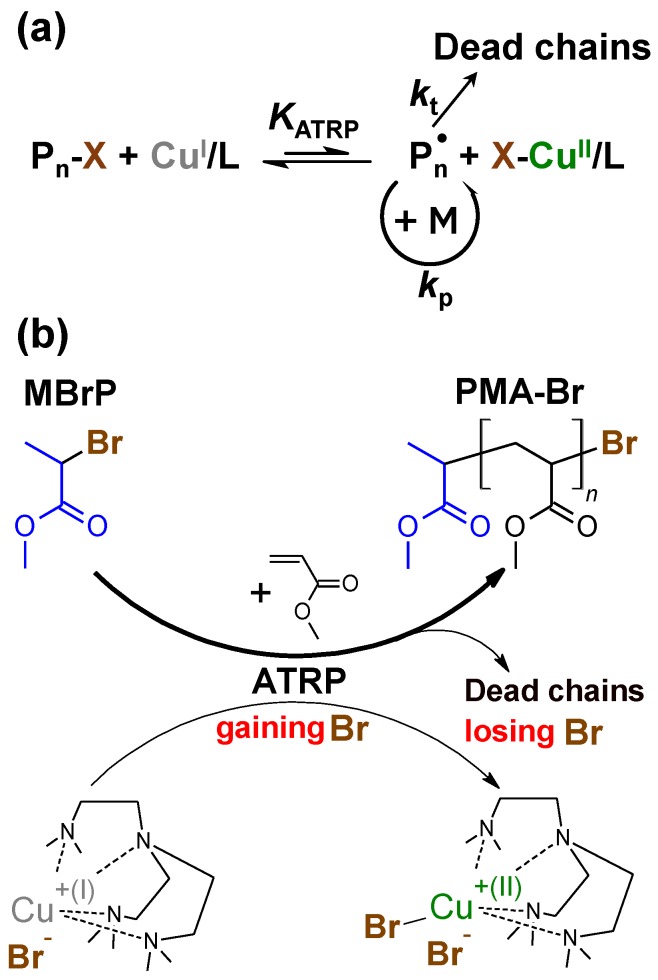
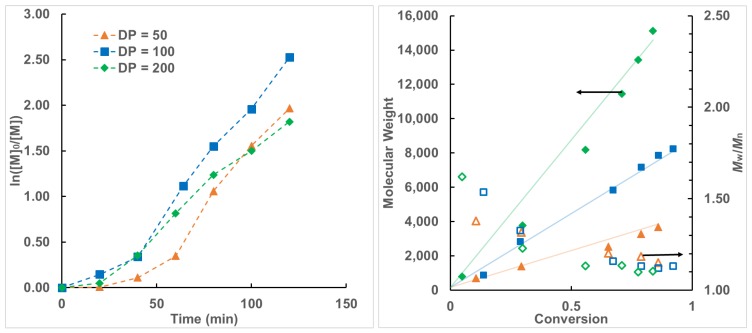
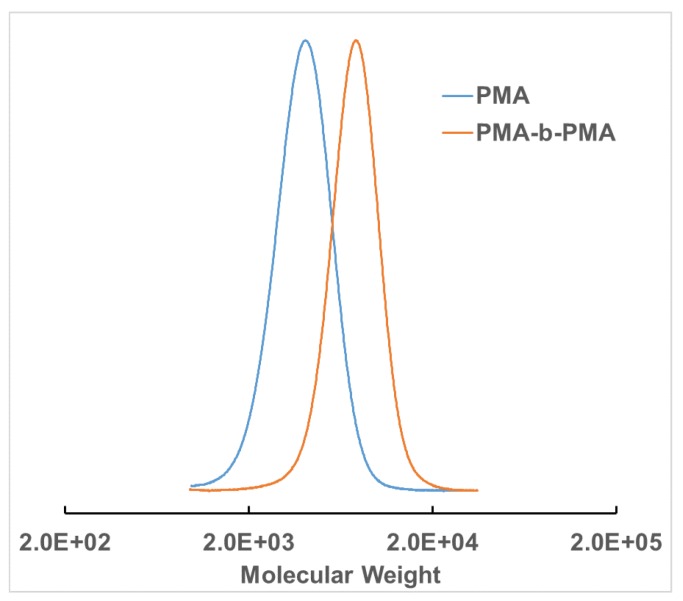
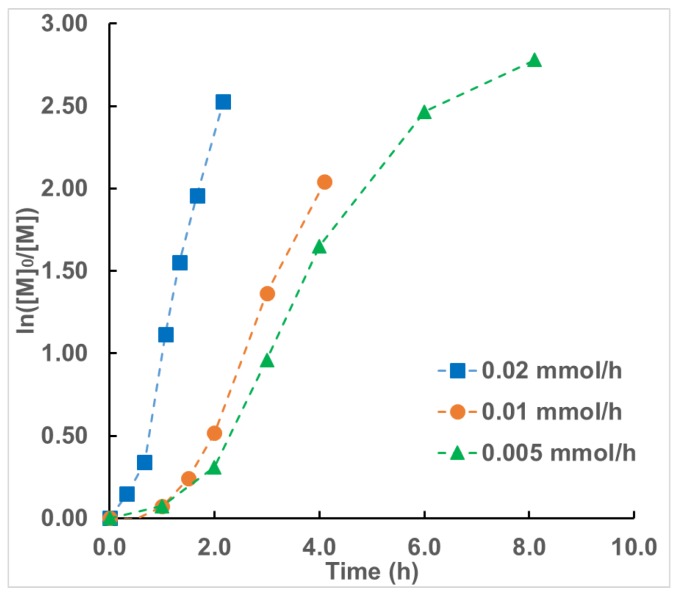
Atom transfer radical polymerization (ATRP) of methyl acrylate (MA) was carried out by continuous feeding of Cu(I) activators. Typically, the solvent, the monomer, the initiator, and the CuBr/MeTREN deactivator are placed in a Schlenk flask (MeTREN: tris[2-(dimethylamino)ethyl]amine), while the CuBr/MeTREN activator is placed in a gas-tight syringe and added to the reaction mixture at a constant addition rate by using a syringe pump. As expected, the polymerization started when Cu(I) was added and stopped when the addition was completed, and polymers with a narrow molecular weight distribution were obtained. The polymerization rate could be easily adjusted by changing the activator feeding rate. More importantly, the loss of chain end-groups could be precisely predicted since each loss of Br from the chain end resulted in the irreversible oxidation of one Cu(I) to Cu(II). The Cu(I) added to the reaction system may undergo many oxidation/reduction cycles in ATRP equilibrium, but would finally be oxidized to Cu(II) irreversibly. Thus, the loss of chain end-groups simply equals the total amount of Cu(I) added. This technique provides a neat way to synthesize functional polymers with known end-group fidelity.
通过连续加入Cu(I)活化剂进行丙烯酸甲酯(MA)的原子转移自由基聚合(ATRP)。通常,将溶剂、单体、引发剂和CuBr/MeTREN失活剂置于Schlenk烧瓶中(MeTREN:三[2-(二甲氨基)乙基]胺),而将CuBr/MeTREN活化剂置于气密注射器中,并使用注射泵以恒定的添加速率加入到反应混合物中。正如预期的那样,加入Cu(I)时聚合反应开始,添加完成时聚合反应停止,从而得到了具有窄分子量分布的聚合物。通过改变活化剂的进料速率可以轻松调节聚合速率。更重要的是,链端基的损失可以精确预测,因为链端每次失去一个Br会导致一个Cu(I)不可逆地氧化为Cu(II)。添加到反应体系中的Cu(I)在ATRP平衡中可能会经历许多氧化/还原循环,但最终会不可逆地氧化为Cu(II)。因此,链端基的损失仅仅等于所添加Cu(I)的总量。该技术为合成具有已知端基保真度的功能聚合物提供了一种简洁的方法。