Frickenstein Alex N, Hagood Jordan M, Britten Collin N, Abbott Brandon S, McNally Molly W, Vopat Catherine A, Patterson Eian G, MacCuaig William M, Jain Ajay, Walters Keisha B, McNally Lacey R
Stephenson School of Biomedical Engineering, University of Oklahoma, Norman, OK 73019, USA.
Stephenson Cancer Center, University of Oklahoma, Oklahoma City, OK 73104, USA.
Pharmaceutics. 2021 Apr 17;13(4):570. doi: 10.3390/pharmaceutics13040570.
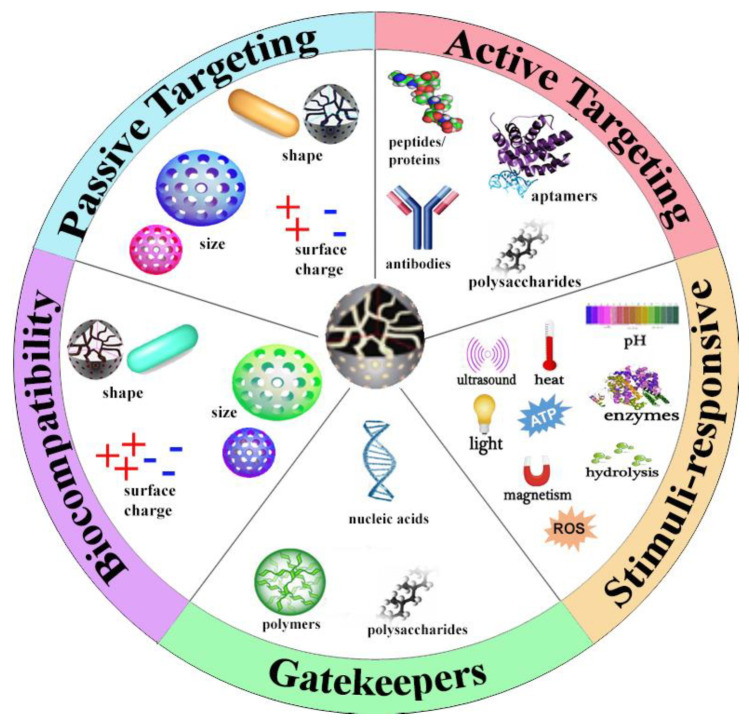
Due to the theragnostic potential of mesoporous silica nanoparticles (MSNs), these were extensively investigated as a novel approach to improve clinical outcomes. Boasting an impressive array of formulations and modifications, MSNs demonstrate significant in vivo efficacy when used to identify or treat myriad malignant diseases in preclinical models. As MSNs continue transitioning into clinical trials, a thorough understanding of the characteristics of effective MSNs is necessary. This review highlights recent discoveries and advances in MSN understanding and technology. Specific focus is given to cancer theragnostic approaches using MSNs. Characteristics of MSNs such as size, shape, and surface properties are discussed in relation to effective nanomedicine practice and projected clinical efficacy. Additionally, tumor-targeting options used with MSNs are presented with extensive discussion on active-targeting molecules. Methods for decreasing MSN toxicity, improving site-specific delivery, and controlling release of loaded molecules are further explained. Challenges facing the field and translation to clinical environments are presented alongside potential avenues for continuing investigations.
由于介孔二氧化硅纳米颗粒(MSNs)具有诊疗潜力,因此作为一种改善临床结果的新方法受到了广泛研究。MSNs拥有一系列令人印象深刻的制剂和修饰,在临床前模型中用于识别或治疗多种恶性疾病时,显示出显著的体内疗效。随着MSNs不断向临床试验过渡,全面了解有效MSNs的特性是必要的。本综述重点介绍了MSN认识和技术方面的最新发现和进展。特别关注使用MSNs的癌症诊疗方法。讨论了MSNs的尺寸、形状和表面性质等特性与有效的纳米医学实践及预期临床疗效的关系。此外,还介绍了与MSNs一起使用的肿瘤靶向选择,并对主动靶向分子进行了广泛讨论。进一步解释了降低MSN毒性、改善位点特异性递送以及控制负载分子释放的方法。文中还介绍了该领域面临的挑战以及向临床环境转化的情况,同时也指出了持续研究的潜在途径。