IRCCS-Fondazione Don Carlo Gnocchi, 20121 Milan, Italy.
Department of Experimental Medicine, Sapienza University of Rome, 00161 Roma, Italy.
Nutrients. 2019 Jul 28;11(8):1742. doi: 10.3390/nu11081742.
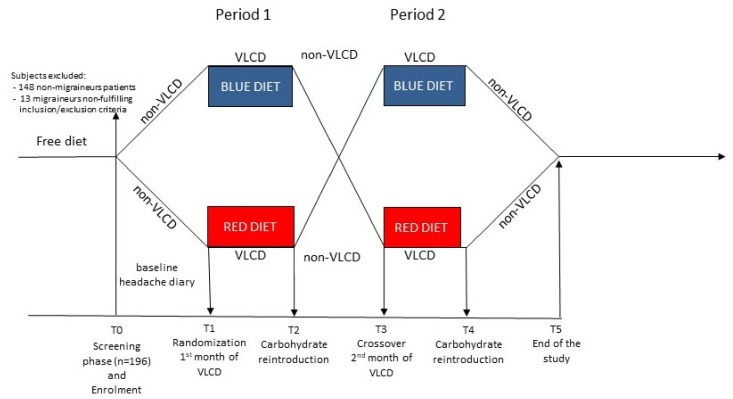
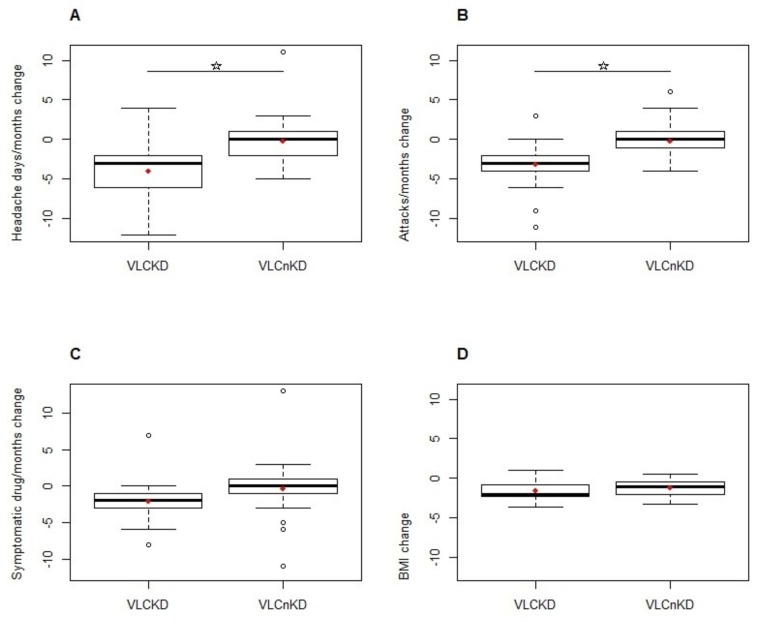
Here we aimed at determining the therapeutic effect of a very low-calorie diet in overweight episodic migraine patients during a weight-loss intervention in which subjects alternated randomly between a very low-calorie ketogenic diet (VLCKD) and a very low-calorie non-ketogenic diet (VLCnKD) each for one month. In a nutritional program, 35 overweight obese migraine sufferers were allocated blindly to 1-month successive VLCKD or VLCnKD in random order (VLCKD-VLCnKD or VLCnKD-VLCD). The primary outcome measure was the reduction of migraine days each month compared to a 1-month pre-diet baseline. Secondary outcome measures were 50% responder rate for migraine days, reduction of monthly migraine attacks, abortive drug intake and body mass index (BMI) change. Only data from the intention-to-treat cohort ( = 35) will be presented. Patients who dropped out ( = 6) were considered as treatment failures. Regarding the primary outcome, during the VLCKD patients experienced -3.73 (95% CI: -5.31, -2.15) migraine days respect to VLCnKD ( < 0.0001). The 50% responder rate for migraine days was 74.28% (26/35 patients) during the VLCKD period, but only 8.57% (3/35 patients) during VLCnKD. Migraine attacks decreased by -3.02 (95% CI: -4.15, -1.88) during VLCKD respect to VLCnKD ( < 0.00001). There were no differences in the change of acute anti-migraine drug consumption ( = 0.112) and BMI ( = 0.354) between the 2 diets. A VLCKD has a preventive effect in overweight episodic migraine patients that appears within 1 month, suggesting that ketogenesis may be a useful therapeutic strategy for migraines.
我们旨在确定极低卡路里饮食在超重发作性偏头痛患者中的治疗效果,在减肥干预中,患者随机交替接受极低卡路里生酮饮食(VLCKD)和极低卡路里非生酮饮食(VLCnKD),每种饮食持续一个月。在营养计划中,35 名超重肥胖偏头痛患者被盲目分配到连续 1 个月的 VLCKD 或 VLCnKD 中,顺序随机(VLCKD-VLCnKD 或 VLCnKD-VLCD)。主要观察指标是与 1 个月的饮食前基线相比每月偏头痛天数的减少。次要观察指标为偏头痛天数的 50%应答率、每月偏头痛发作次数的减少、止吐药摄入和体重指数(BMI)的变化。仅呈现意向治疗队列(=35)的数据。退出的患者(=6)被视为治疗失败。关于主要结局,在 VLCKD 期间,患者经历了 -3.73(95%CI:-5.31,-2.15)的偏头痛天数,与 VLCnKD 相比(<0.0001)。在 VLCKD 期间,偏头痛天数的 50%应答率为 74.28%(26/35 名患者),但在 VLCnKD 期间仅为 8.57%(3/35 名患者)。与 VLCnKD 相比,VLCKD 期间偏头痛发作减少了-3.02(95%CI:-4.15,-1.88)(<0.00001)。两种饮食之间急性抗偏头痛药物消耗的变化(=0.112)和 BMI 的变化(=0.354)没有差异。VLCKD 对超重发作性偏头痛患者具有预防作用,这种作用在 1 个月内显现,提示酮生成可能是偏头痛的一种有用治疗策略。