School of Environment, Northeast Normal University, No. 2555 Jing-Yue Street, Changchun, Jilin Province, 130117, People's Republic of China.
Institute of Agro-food Technology, Jilin Academy of Agricultural Sciences, No. 1363 Sheng-Tai Street, Changchun, Jilin Province, 130033, People's Republic of China.
BMC Microbiol. 2019 Jul 29;19(1):170. doi: 10.1186/s12866-019-1525-4.
Probiotics play an important role in the human and animal defense against liver damage. However, the protective mechanism of Lactobacillus plantarum C88 on chronic liver injury induced by mycotoxin remains unclear.
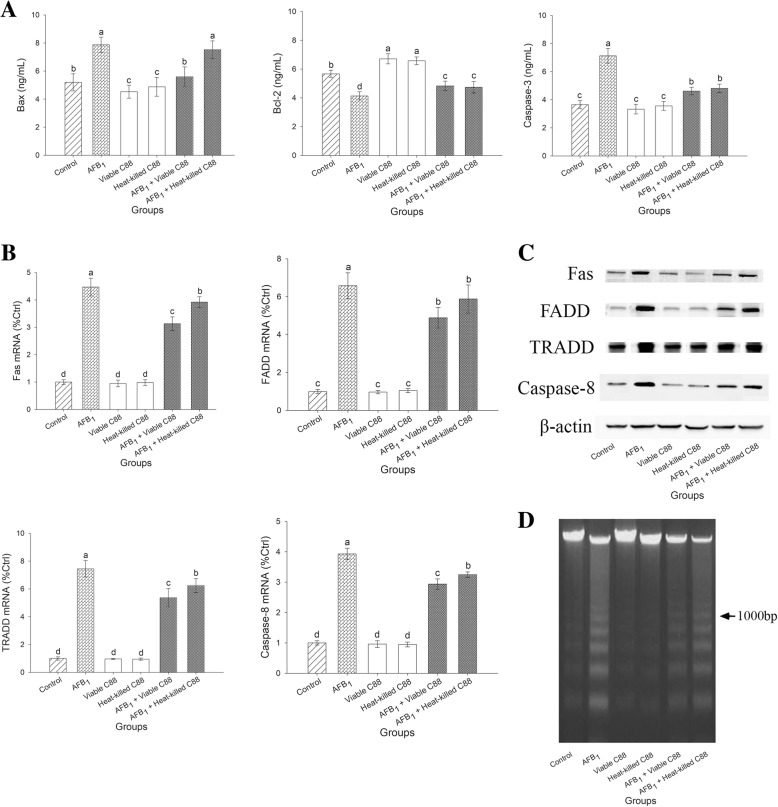
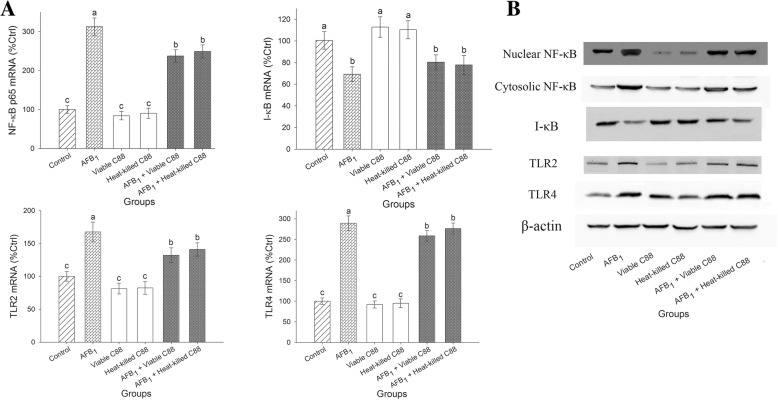
In this study, the addition of L. plantarum C88 obviously ameliorated the increased contents of alanine aminotransferase (ALT), aspartate aminotransferase (AST), alkaline phosphatase (ALP), total cholesterol and triglyceride, the diminish contents of total protein and albumin in serum of mice challenged with AFB. Simultaneously, L. plantarum C88 attenuated the inflammatory response via significantly reducing the levels of pro-inflammatory factors, including interleukin-1β (IL-1β), IL-6, IL-8, interferon-γ (IFN-γ) and tumor necrosis factor-α (TNF-α) in serum. Furthermore, L. plantarum C88 remarkably down-regulated the nuclear factor kappa B (NF-κB) signaling pathways by weakening the expression of toll-like receptor 2 (TLR2) and TLR4, and inhibited NF-κB nuclear translocation through enhancing the expression of NF-κB inhibitor (IκB). Neutralization experiments confirmed that L. plantarum C88 decreased the levels of some pro-inflammatory factors due to the suppression of the NF-κB signaling pathways. Besides, L. plantarum C88 decreased the levels of Bax and Caspase-3, elevated the level of Bcl-2, and reduced mRNA expressions of Fatty acid synthetase receptor (Fas), FAS-associated death domain (FADD), TNF receptor associated death domain (TRADD) and Caspase-8 in the liver.
Probiotic L. plantarum C88 prevented AFB-induced secretion of pro-inflammatory cytokines by modulating TLR2/NF-κB and TLR4/NF-κB pathways. The molecular mechanisms of L. plantarum C88 in ameliorating AFB-induced excessive apoptosis included regulating the mitochondrial pathway and cell death receptor pathways.
益生菌在人类和动物防御肝损伤中起着重要作用。然而,植物乳杆菌 C88 对霉菌毒素引起的慢性肝损伤的保护机制尚不清楚。
在这项研究中,添加植物乳杆菌 C88 明显改善了 AFB 攻毒小鼠血清中丙氨酸氨基转移酶(ALT)、天冬氨酸氨基转移酶(AST)、碱性磷酸酶(ALP)、总胆固醇和甘油三酯含量的升高,总蛋白和白蛋白含量的降低。同时,植物乳杆菌 C88 通过显著降低血清中促炎因子白细胞介素-1β(IL-1β)、IL-6、IL-8、干扰素-γ(IFN-γ)和肿瘤坏死因子-α(TNF-α)的水平,减轻炎症反应。此外,植物乳杆菌 C88 通过减弱 Toll 样受体 2(TLR2)和 TLR4 的表达,显著下调核因子 kappa B(NF-κB)信号通路,并通过增强 NF-κB 抑制剂(IκB)的表达抑制 NF-κB 核易位。中和实验证实,植物乳杆菌 C88 通过抑制 NF-κB 信号通路降低了一些促炎因子的水平。此外,植物乳杆菌 C88 降低了 Bax 和 Caspase-3 的水平,提高了 Bcl-2 的水平,并降低了肝组织中脂肪酸合成酶受体(Fas)、FAS 相关死亡结构域(FADD)、肿瘤坏死因子受体相关死亡结构域(TRADD)和 Caspase-8 的 mRNA 表达。
益生菌植物乳杆菌 C88 通过调节 TLR2/NF-κB 和 TLR4/NF-κB 途径,防止 AFB 诱导的促炎细胞因子分泌。植物乳杆菌 C88 改善 AFB 诱导的过度细胞凋亡的分子机制包括调节线粒体途径和细胞死亡受体途径。