Morillas Carlos, Escalada Javier, Palomares Rafael, Bellido Diego, Gómez-Peralta Fernando, Pérez Antonio
Hospital Universitario Doctor Peset, Valencia, Spain.
Clínica Universidad de Navarra, Pamplona, Spain.
Diabetes Ther. 2019 Oct;10(5):1893-1907. doi: 10.1007/s13300-019-0671-x. Epub 2019 Jul 29.
The aim of this Delphi study is to unveil the management of patients with type 2 diabetes (T2D) and different levels of complexity in the clinical practice in Spain.
Based on the common management practices of T2D profiles reported by Spanish endocrinologists, a Delphi questionnaire of 55 statements was developed and responded to by a national panel (n = 101).
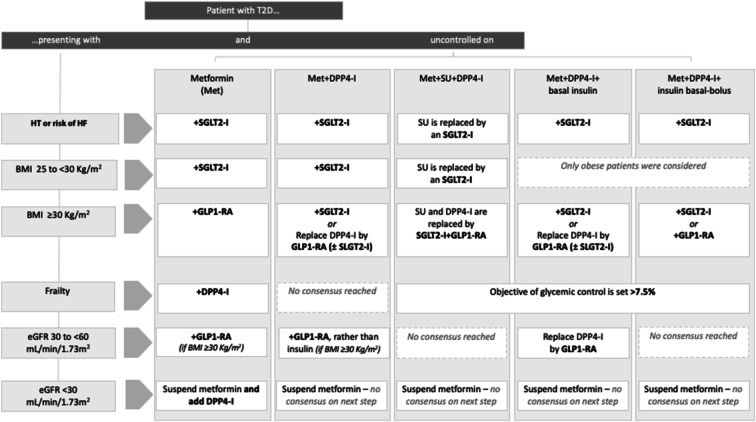
A consensus was reached for 30 of the 55 statements. Regarding overweight patients inadequately controlled with metformin, treatment with a sodium-glucose transport protein 2 inhibitor (SGLT2-I) is preferred over treatment with a dipeptidyl peptidase-4 inhibitor (DPP4-I). If the patient is already being treated with a DPP4-I, an SGLT2-I is added on to the treatment regimen rather than replacing the DPP4-I. Conversely, if the treatment regimen includes a sulfonylurea, it is usually replaced by other antihyperglycemic agents. Current treatment trends in uncontrolled obese patients include the addition of an SGLT2-I or a glucagon-like peptide-1 receptor agonist (GLP1-RA) to background therapy. When the glycated hemoglobin target is not reached, triple therapy with metformin + GLP1-RA + SGLT2-I is initiated. Although SGLT2-Is are the treatment of choice in patients with T2D and heart failure or uncontrolled hypertension, no consensus was reached regarding the preferential use of SGLT2-Is or GLP1-RAs in patients with established cardiovascular disease.
Consensus has been reached for a variety of statements regarding the management of several T2D profiles. Achieving a more homogeneous management of complex patients with T2D may require further evidence and a better understanding of the key drivers for treatment choice.
Logistic support was provided by ESTEVE Pharmaceuticals S.A Spain.
本德尔菲研究旨在揭示西班牙临床实践中2型糖尿病(T2D)患者及不同复杂程度的管理情况。
基于西班牙内分泌学家报告的T2D患者常见管理实践,制定了一份包含55条陈述的德尔菲问卷,并由一个全国性专家小组(n = 101)进行回复。
55条陈述中有30条达成了共识。对于使用二甲双胍控制不佳的超重患者,使用钠-葡萄糖协同转运蛋白2抑制剂(SGLT2-I)治疗优于二肽基肽酶-4抑制剂(DPP4-I)治疗。如果患者已经在接受DPP4-I治疗,则在治疗方案中添加SGLT2-I,而不是更换DPP4-I。相反,如果治疗方案中包括磺脲类药物,通常会用其他降糖药物替代。目前,未得到控制的肥胖患者的治疗趋势包括在基础治疗中添加SGLT2-I或胰高血糖素样肽-1受体激动剂(GLP1-RA)。当糖化血红蛋白目标未达成时,启动二甲双胍+GLP1-RA+SGLT2-I三联疗法。尽管SGLT2-I是T2D合并心力衰竭或未控制高血压患者的首选治疗药物,但对于已确诊心血管疾病的患者,在优先使用SGLT2-I还是GLP1-RA方面未达成共识。
对于多种T2D患者管理的陈述已达成共识。实现对复杂T2D患者更统一的管理可能需要更多证据以及对治疗选择关键驱动因素的更好理解。
西班牙ESTEVE制药公司提供后勤支持。