School of Kinesiology, Shanghai University of Sport, Shanghai, China.
Shanghai Punan Hospital of Pudong New District, Shanghai, China.
Brain Behav. 2019 Sep;9(9):e01370. doi: 10.1002/brb3.1370. Epub 2019 Jul 30.
Acupuncture at Zusanli (ST36) is often used to facilitate motor recovery after stroke. However, the effect of acupuncture at ST36 on motor cortical excitation and inhibition remains unclear. This study aimed to explore the effect of acupuncture at ST36 on motor cortical excitation and inhibition.
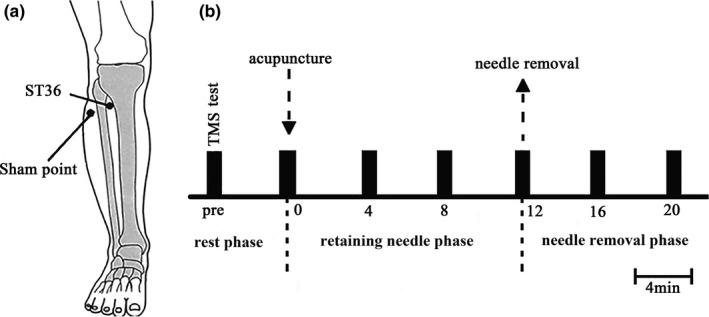
Twenty healthy volunteers were recruited to receive acupuncture treatment. We selected the acupoint ST36 and its respective sham point as the experimental acupoint. Transcranial magnetic stimulation (TMS) was used to measure motor-evoked potentials (MEP) at 7 time points-before acupuncture (Pre), acupuncture (T0), 4 and 8 min after acupuncture (T4; T8), needle removal (T12), 4 and 8 min after needle removal (T16; T20). Simultaneously, paired TMS (pTMS) was employed to measure short- and long-interval intracortical inhibition (SICI [short latency intracortical inhibition]; LICI [long latency intracortical inhibition]), respectively, at three time points-before acupuncture (Pre), acupuncture (T0), needle removal (T12). After removing the acupuncture needle, all subjects were asked to quantify their Deqi sensation using a Gas table.
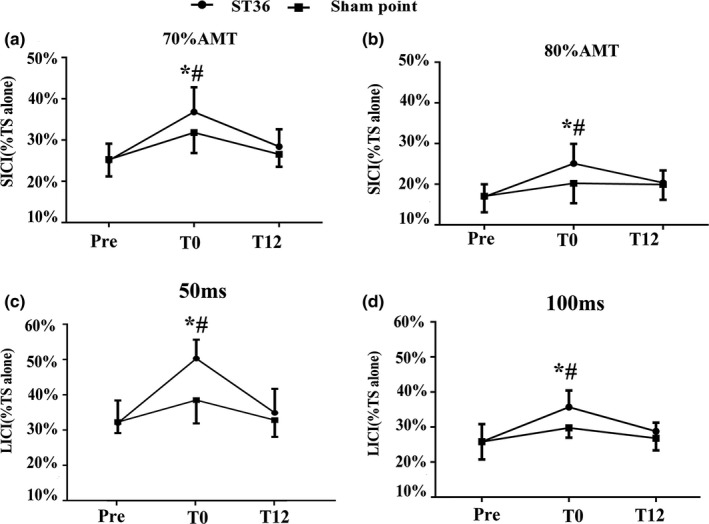
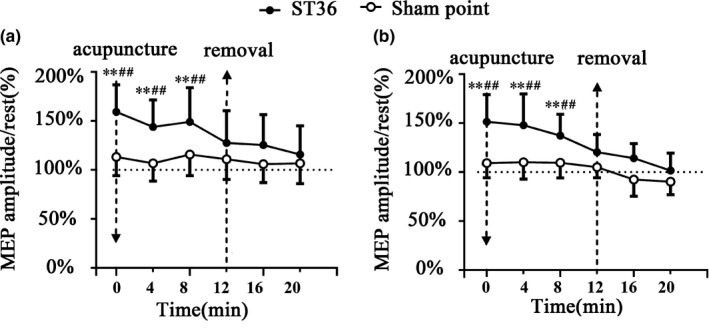
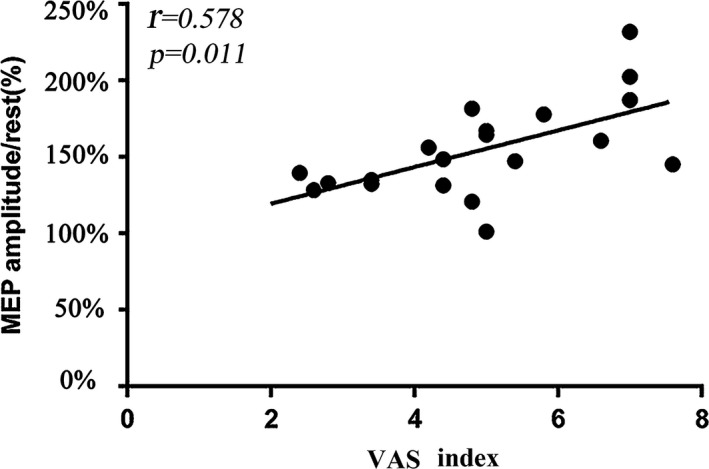
The average Deqi sensation score of all subjects during acupuncture at ST36 was higher than that observed at the sham point. With acupuncture at ST36, the MEP amplitude was higher at three time points (T0, T4, T8) than at Pre, although the MEP amplitude tended toward Pre after needle removal. The MEP amplitude was also higher at the same time points (T0, T4, T8) than at the sham point. Furthermore, the Deqi sensation score was correlated with MEP amplitude. With acupuncture at ST36, SICI and LICI at T0 were higher than those at Pre, and SICI and LICI at T0 were higher than those at the sham point.
Acupuncture at ST36 increased motor cortical excitation and had an effect on the remaining needle phase. Deqi sensation was correlated with MEP amplitude. Acupuncture at ST36 also decreased motor cortical inhibition.
针刺足三里(ST36)常用于促进中风后的运动恢复。然而,针刺 ST36 对运动皮质兴奋和抑制的影响尚不清楚。本研究旨在探讨针刺 ST36 对运动皮质兴奋和抑制的影响。
招募了 20 名健康志愿者接受针刺治疗。我们选择了穴位 ST36 及其相应的假穴作为实验穴位。使用经颅磁刺激(TMS)在 7 个时间点测量运动诱发电位(MEP)-针刺前(Pre)、针刺时(T0)、针刺后 4 分钟和 8 分钟(T4;T8)、拔针时(T12)、拔针后 4 分钟和 8 分钟(T16;T20)。同时,在三个时间点(针刺前(Pre)、针刺时(T0)、拔针时(T12))使用成对 TMS(pTMS)测量短潜伏期和长潜伏期皮质内抑制(SICI[短潜伏期皮质内抑制];LICI[长潜伏期皮质内抑制])。拔针后,所有受试者均使用 Gas 表对其得气感进行量化。
所有受试者在针刺 ST36 时的平均得气感评分均高于针刺假穴时的评分。针刺 ST36 时,MEP 振幅在三个时间点(T0、T4、T8)均高于针刺前(Pre),但拔针后 MEP 振幅趋于针刺前。MEP 振幅在同一时间点(T0、T4、T8)也高于假穴。此外,得气感评分与 MEP 振幅呈正相关。针刺 ST36 时,T0 时 SICI 和 LICI 高于针刺前(Pre),T0 时 SICI 和 LICI 高于假穴。
针刺 ST36 可增加运动皮质兴奋,并对留针期产生影响。得气感与 MEP 振幅相关。针刺 ST36 还可降低运动皮质抑制。