University of Oxford, Mathematical Ecology Research Group, Department of Zoology, Oxford, OX1 3SZ, UK.
University of Oxford, Future of Humanity Institute, Faculty of Philosophy, Oxford, OX1 1PT, UK.
Sci Rep. 2019 Jul 30;9(1):11054. doi: 10.1038/s41598-019-47540-7.
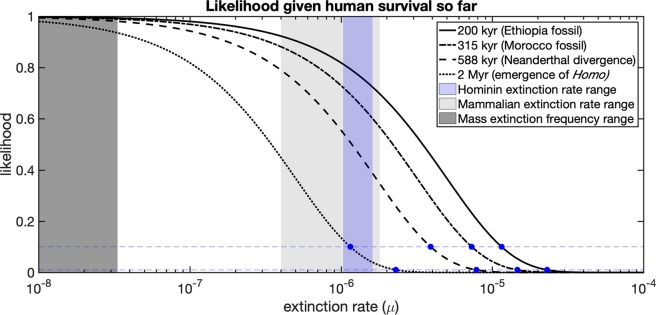
We evaluate the total probability of human extinction from naturally occurring processes. Such processes include risks that are well characterized such as asteroid impacts and supervolcanic eruptions, as well as risks that remain unknown. Using only the information that Homo sapiens has existed at least 200,000 years, we conclude that the probability that humanity goes extinct from natural causes in any given year is almost guaranteed to be less than one in 14,000, and likely to be less than one in 87,000. Using the longer track record of survival for our entire genus Homo produces even tighter bounds, with an annual probability of natural extinction likely below one in 870,000. These bounds are unlikely to be affected by possible survivorship bias in the data, and are consistent with mammalian extinction rates, typical hominin species lifespans, the frequency of well-characterized risks, and the frequency of mass extinctions. No similar guarantee can be made for risks that our ancestors did not face, such as anthropogenic climate change or nuclear/biological warfare.
我们评估了由自然发生的过程导致人类灭绝的总概率。这些过程包括已被充分描述的风险,如小行星撞击和超级火山爆发,以及一些仍未知的风险。仅根据人类已经存在了至少 20 万年这一信息,我们得出结论,人类在任何给定年份因自然原因灭绝的概率几乎肯定小于 14000 分之一,而很可能小于 87000 分之一。利用我们整个人类属的更长生存记录,产生了更严格的界限,每年自然灭绝的概率可能低于 870 万分之一。这些界限不太可能受到数据中可能存在的幸存偏差的影响,并且与哺乳动物灭绝率、典型人类物种寿命、已知风险的频率以及大规模灭绝的频率一致。对于我们的祖先没有面临的风险,如人为气候变化或核/生物战争,我们无法做出类似的保证。