Lewis Katz School of Medicine at Temple University, Philadelphia, Pennsylvania.
Institut Universitaire de Cardiologie et de Pneumologie de Québec, Hôpital Laval, Quebec, Quebec, Canada.
Am J Respir Crit Care Med. 2019 Dec 1;200(11):1354-1362. doi: 10.1164/rccm.201902-0383OC.
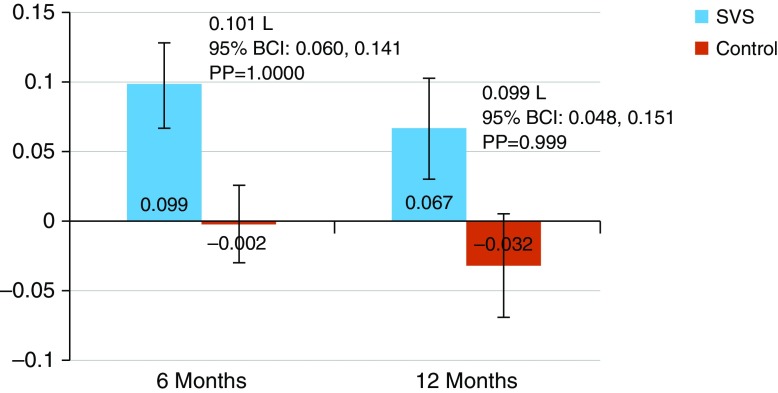
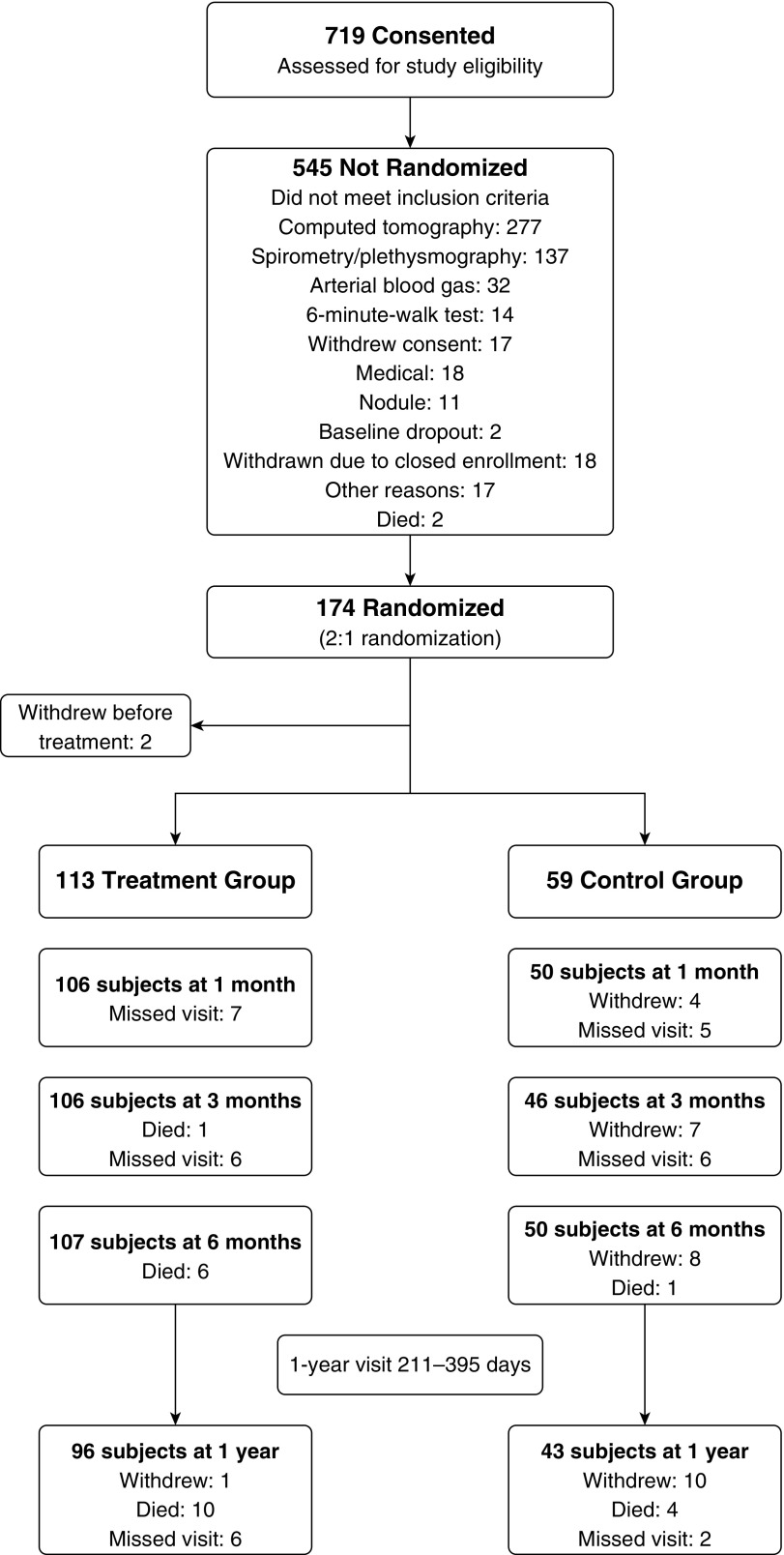
Less invasive, nonsurgical approaches are needed to treat severe emphysema. To evaluate the effectiveness and safety of the Spiration Valve System (SVS) versus optimal medical management. In this multicenter, open-label, randomized, controlled trial, subjects aged 40 years or older with severe, heterogeneous emphysema were randomized 2:1 to SVS with medical management (treatment) or medical management alone (control). The primary efficacy outcome was the difference in mean FEV from baseline to 6 months. Secondary effectiveness outcomes included: difference in FEV responder rates, target lobe volume reduction, hyperinflation, health status, dyspnea, and exercise capacity. The primary safety outcome was the incidence of composite thoracic serious adverse events. All analyses were conducted by determining the 95% Bayesian credible intervals (BCIs) for the difference between treatment and control arms. Between October 2013 and May 2017, 172 participants (53.5% male; mean age, 67.4 yr) were randomized to treatment ( = 113) or control ( = 59). Mean FEV showed statistically significant improvements between the treatment and control groups-between-group difference at 6 and 12 months, respectively, of 0.101 L (95% BCI, 0.060-0.141) and 0.099 L (95% BCI, 0.048-0.151). At 6 months, the treatment group had statistically significant improvements in all secondary endpoints except 6-minute-walk distance. Composite thoracic serious adverse event incidence through 6 months was greater in the treatment group (31.0% vs. 11.9%), primarily due to a 12.4% incidence of serious pneumothorax. In patients with severe heterogeneous emphysema, the SVS shows significant improvement in multiple efficacy outcomes, with an acceptable safety profile.Clinical trial registered with www.clinicaltrials.gov (NCT01812447).
需要采用创伤较小的非手术方法来治疗严重肺气肿。评估 Spiration 阀系统(SVS)与最佳药物治疗相比的疗效和安全性。在这项多中心、开放标签、随机、对照试验中,年龄在 40 岁或以上、患有严重、异质性肺气肿的受试者按 2:1 随机分为 SVS 联合药物治疗(治疗)或单独药物治疗(对照)。主要疗效终点是从基线到 6 个月时平均 FEV 的差异。次要有效性结果包括:FEV 应答率、目标肺叶容积减少、过度充气、健康状况、呼吸困难和运动能力的差异。主要安全性结果是复合胸部严重不良事件的发生率。所有分析均通过确定治疗组和对照组之间差异的 95%贝叶斯可信区间(BCI)来进行。2013 年 10 月至 2017 年 5 月,共 172 名参与者(53.5%为男性;平均年龄 67.4 岁)被随机分配至治疗组(n=113)或对照组(n=59)。治疗组和对照组的平均 FEV 均显示出统计学上的显著改善,分别在 6 个月和 12 个月时的组间差异为 0.101L(95%BCI,0.060-0.141)和 0.099L(95%BCI,0.048-0.151)。在 6 个月时,治疗组除 6 分钟步行距离外,所有次要终点均有统计学意义上的改善。治疗组在 6 个月时的复合胸部严重不良事件发生率更高(31.0%比 11.9%),主要是由于严重气胸的发生率为 12.4%。在严重异质性肺气肿患者中,SVS 在多个疗效指标上均有显著改善,安全性可接受。该临床试验已在 www.clinicaltrials.gov 注册(NCT01812447)。