Emergency Medicine Department, Muhimbili University of Health and Allied Sciences, P.O. Box 65001, Dar es salaam, Tanzania.
Emergency Medicine Department, Muhimbili National Hospital, Dar es Salaam, Tanzania.
BMC Med Educ. 2019 Jul 31;19(1):294. doi: 10.1186/s12909-019-1729-1.
Emergency Medicine (EM) is a rapidly developing specialty in Africa with several emergency medicine residency-training programs (EMRPs) established across the continent over the past decade. Despite rapid proliferation of the specialty, little is known about emergency care curriculum structure and content. We provide an overview of Africa's EMRPs.
This was a descriptive cross-sectional survey conducted of EMRPs in Africa between January 2017 and December 2017. Data were prospectively collected using a structured survey that was developed and administered through online data capture software, REDCap (Version 7.2.2, Vanderbilt, Nashville, TN, USA). Survey questions focused on curriculum structure and design, including clinical rotations, didactics, research, and evaluation. Data are summarized with descriptive statistics.
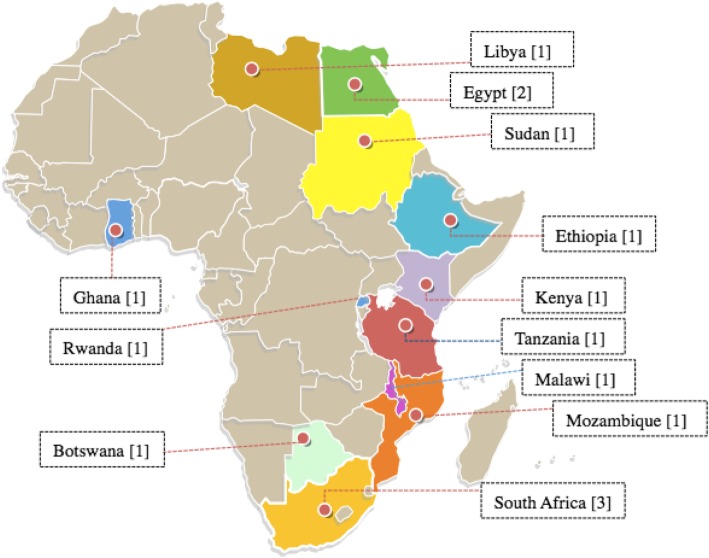
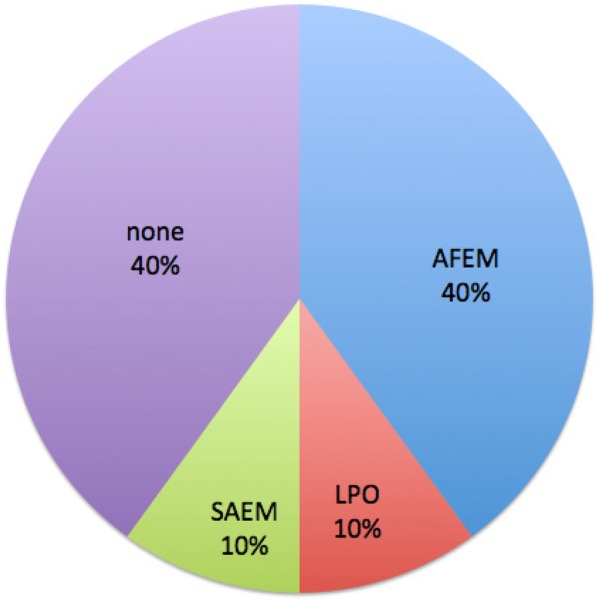
The survey was sent to the leadership of 15 EMRPs in 12 different African countries and 11 (73%) responded. Five (46%) of the responding programs were started by local non-EM trained faculty, two (18%) were started by international partners, and the remainder by a combination of local non-EM faculty and international partners. Overall, Seven (64%) of the countries offer a 4-year EMRP. In General, 40% of curriculums are influenced the contents developed by African Federation for Emergency Medicine. All programs offer resident led-didactics, with a median of 12 h (Interquartile range 9-6 h) per month. All EMRPs have a mandatory research requirement. All EMRPs offer clinical rotations in the ED, Paediatrics, and Obstetrics and Gynaecology, while only 2 programs offer rotations in radiology and neonatal intensive care units. Only 46% of EMRPs have in-ED clinical supervision by specialist.
The EMRPs in Africa were started by non-EM trained local faculty alone or collaboration with international partners. The curriculum offers most exposure to ED, and less exposure in radiology and neonatal intensive care. Residents are highly involved in leading didactics and less than half of the programs have in-ED specialist supervision of patient care.
急诊医学(EM)是非洲一个快速发展的专业,在过去十年中,非洲大陆建立了多个急诊医学住院医师培训计划(EMRPs)。尽管该专业迅速发展,但对急诊护理课程结构和内容知之甚少。我们提供了非洲 EMRPs 的概述。
这是一项在 2017 年 1 月至 2017 年 12 月期间对非洲 EMRPs 进行的描述性横断面调查。使用针对课程结构和设计的结构化调查,前瞻性地收集数据,该调查是通过在线数据捕获软件 REDCap(版本 7.2.2,田纳西州纳什维尔市范德比尔特大学)开发和管理的。调查问题侧重于课程结构和设计,包括临床轮转、教学、研究和评估。使用描述性统计数据总结数据。
向 12 个非洲国家的 15 个 EMRP 领导层发送了调查,其中 11 个(73%)做出了回应。5 个(46%)的回应计划是由当地非急诊医学培训的教师发起的,2 个(18%)是由国际合作伙伴发起的,其余的是由当地非急诊医学教师和国际合作伙伴共同发起的。总体而言,7 个(64%)国家提供 4 年制 EMRP。一般来说,40%的课程受到非洲急诊医学联合会制定的内容的影响。所有计划都提供以住院医师为主导的教学,每月中位数为 12 小时(四分位间距为 9-6 小时)。所有 EMRP 都有强制性的研究要求。所有 EMRP 都提供急诊科、儿科和妇产科的临床轮转,而只有 2 个计划提供放射科和新生儿重症监护室的轮转。只有 46%的 EMRP 有专科医生在急诊科进行临床监督。
非洲的 EMRP 是由非急诊医学培训的当地教师单独或与国际合作伙伴合作建立的。课程提供了对急诊科的大部分接触,而在放射科和新生儿重症监护方面的接触较少。住院医师高度参与主导教学,不到一半的计划在急诊科有专家监督患者护理。