College of Medicine Clinical Translational Science Graduate Program, University of Arizona, Tucson, AZ 85721, USA.
Department of Chemistry & Biochemistry, Northern Arizona University, P.O. Box 5698, Flagstaff, AZ 86011, USA.
Int J Environ Res Public Health. 2019 Jul 31;16(15):2727. doi: 10.3390/ijerph16152727.
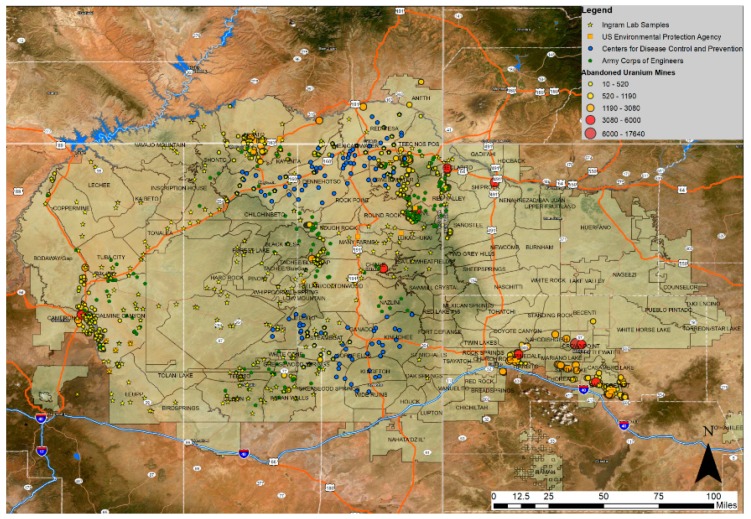
The geologic profile of the western United States lends itself to naturally elevated levels of arsenic and uranium in groundwater and can be exacerbated by mining enterprises. The Navajo Nation, located in the American Southwest, is the largest contiguous Native American Nation and has over a 100-year legacy of hard rock mining. This study has two objectives, quantify the arsenic and uranium concentrations in water systems in the Arizona and Utah side of the Navajo Nation compared to the New Mexico side and to determine if there are other elements of concern. Between 2014 and 2017, 294 water samples were collected across the Arizona and Utah side of the Navajo Nation and analyzed for 21 elements. Of these, 14 elements had at least one instance of a concentration greater than a national regulatory limit, and six of these (V, Ca, As, Mn, Li, and U) had the highest incidence of exceedances and were of concern to various communities on the Navajo Nation. Our findings are similar to other studies conducted in Arizona and on the Navajo Nation and demonstrate that other elements may be a concern for public health beyond arsenic and uranium.
美国西部的地质剖面导致地下水砷和铀的自然含量升高,矿业企业则可能使情况恶化。纳瓦霍族保留地位于美国西南部,是最大的连续的美国原住民保留地,拥有超过 100 年的硬岩采矿业历史。本研究有两个目标,一是量化亚利桑那州和犹他州纳瓦霍族保留地与新墨西哥州纳瓦霍族保留地的水系统中砷和铀的浓度,并确定是否存在其他关注的元素。在 2014 年至 2017 年间,在亚利桑那州和犹他州的纳瓦霍族保留地采集了 294 个水样,并对 21 种元素进行了分析。在这些元素中,有 14 种元素的浓度至少有一次超过国家监管限值,其中 6 种(钒、钙、砷、锰、锂和铀)的超标情况最为严重,这些元素引起了纳瓦霍族保留地各个社区的关注。我们的研究结果与在亚利桑那州和纳瓦霍族保留地进行的其他研究相似,表明除砷和铀之外,其他元素也可能对公共健康构成威胁。