Howarth Alison, Simms Claire, Kerai Nitesh, Allen Olivia, Mihajluk Karina, Madureira Patricia A, Sokratous Giannis, Cragg Simon, Lee Sang Y, Morley Andy D, Ashkan Keyoumars, Cox Paul A, Pilkington Geoffrey J, Hill Richard
Brain Tumour Research Centre, Institute of Biomedical and Biomolecular Sciences, University of Portsmouth, PO1 2DT, United Kingdom.
Department of Natural Sciences, Mathematics and Statistics, Furtwangen University, 78120, Germany.
Transl Oncol. 2019 Oct;12(10):1375-1385. doi: 10.1016/j.tranon.2019.07.007. Epub 2019 Jul 30.
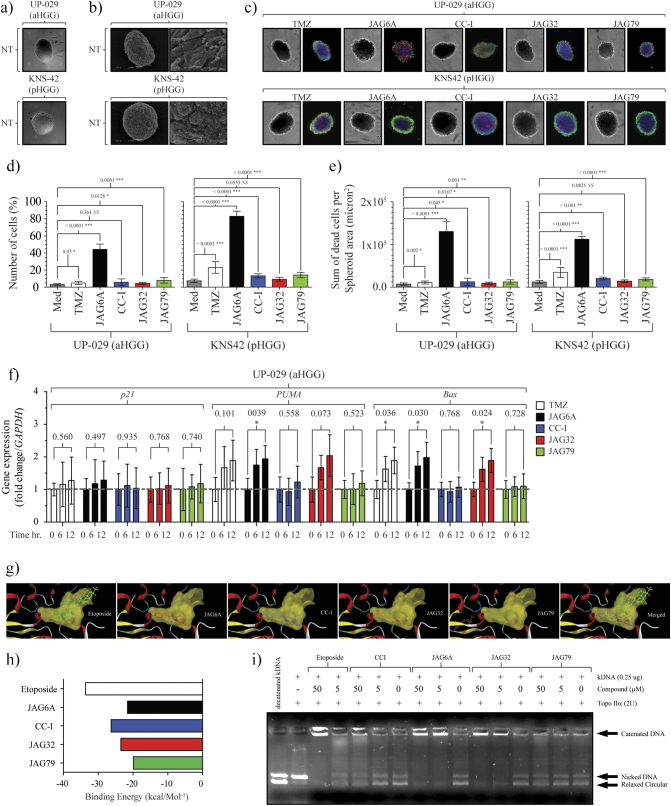
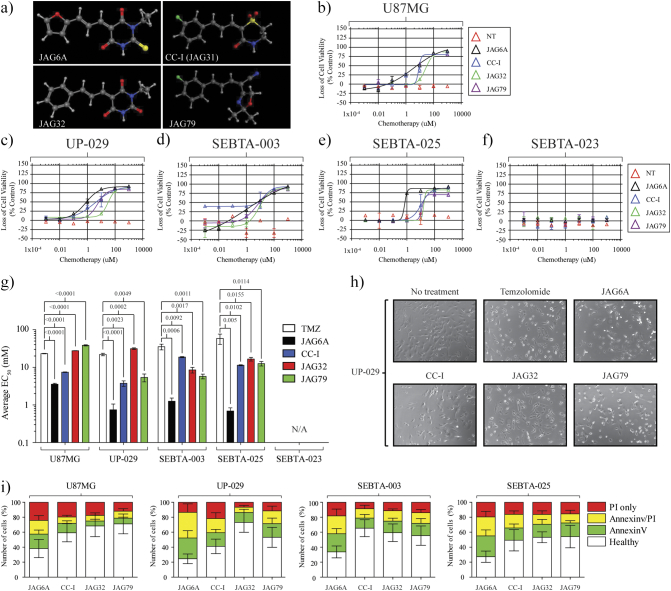
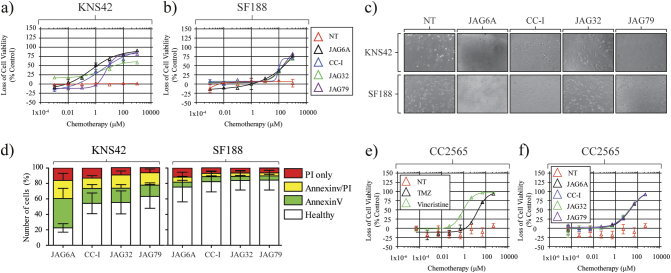
High-grade gliomas (HGGs) are aggressive primary brain tumors with local invasive growth and poor clinical prognosis in both adult and pediatric patients. Clinical response is compounded by resistance to standard frontline antineoplastic agents, an absence of novel therapeutics, and poor in vitro models to evaluate these. We screened a range of recently identified anticancer compounds in conventional adult, pediatric, and new biopsy-derived HGG models. These in vitro lines showed a range of sensitivity to standard chemotherapeutics, with varying expression levels of the prognostic markers hypoxia-induced factor (HIF) 1α and p53. Our evaluation of lead DIVERSet library compounds identified that JAG-6A, a compound that was significantly more potent than temozolomide or etoposide, was effective against HGG models in two-dimensional and three-dimensional systems; mediated this response by the potent inhibition of topoisomerase Iiα; remained effective under normoxic and hypoxic conditions; and displayed limited toxicity to non-neoplastic astrocytes. These data suggest that JAG-6A could be an alternative topoisomerase IIα inhibitor and used for the treatment of HGG.
高级别胶质瘤(HGGs)是侵袭性原发性脑肿瘤,在成人和儿童患者中均具有局部侵袭性生长且临床预后较差。对标准一线抗肿瘤药物的耐药性、缺乏新型治疗方法以及用于评估这些情况的体外模型欠佳,使得临床反应更加复杂。我们在传统的成人、儿童以及新的活检来源的HGG模型中筛选了一系列最近鉴定出的抗癌化合物。这些体外细胞系对标准化疗药物表现出不同程度的敏感性,预后标志物缺氧诱导因子(HIF)1α和p53的表达水平也各不相同。我们对DIVERSet先导化合物库中的化合物进行评估后发现,JAG - 6A这种化合物比替莫唑胺或依托泊苷的效力显著更强,在二维和三维系统中对HGG模型均有效;通过强力抑制拓扑异构酶Iiα介导这种反应;在常氧和缺氧条件下均保持有效;并且对非肿瘤性星形胶质细胞显示出有限的毒性。这些数据表明JAG - 6A可能是一种替代性的拓扑异构酶IIα抑制剂,可用于治疗HGG。