Shanghai Public Health Clinical Center and School of Basic Medical Sciences, Key Laboratory of Medical Molecular Virology (MOE/NHC/CAMS), Fudan University, Shanghai 200032, China.
Lindsley F. Kimball Research Institute, New York Blood Center, New York, NY 10065, USA.
Viruses. 2019 Aug 1;11(8):705. doi: 10.3390/v11080705.
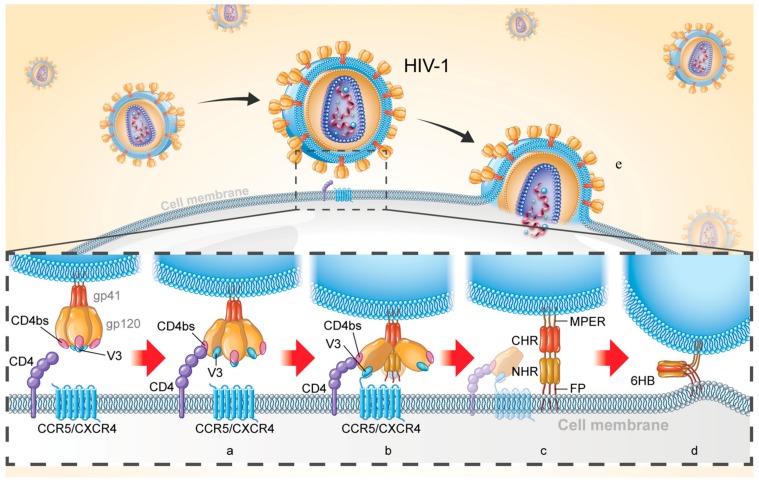
Application of highly active antiretroviral drugs (ARDs) effectively reduces morbidity and mortality in HIV-infected individuals. However, the emergence of multiple drug-resistant strains has led to the increased failure of ARDs, thus calling for the development of anti-HIV drugs with targets or mechanisms of action different from those of the current ARDs. The first peptide-based HIV entry inhibitor, enfuvirtide, was approved by the U.S. FDA in 2003 for treatment of HIV/AIDS patients who have failed to respond to the current ARDs, which has stimulated the development of several series of protein- and peptide-based HIV entry inhibitors in preclinical and clinical studies. In this review, we highlighted the properties and mechanisms of action for those promising protein- and peptide-based HIV entry inhibitors targeting the HIV-1 gp120 or gp41 and discussed their advantages and disadvantages, compared with the current ARDs.
高效抗逆转录病毒药物(ARV)的应用有效降低了 HIV 感染者的发病率和死亡率。然而,多种耐药株的出现导致 ARV 治疗失败的几率增加,因此需要开发作用靶点或作用机制与现有 ARV 不同的抗 HIV 药物。第一个基于肽的 HIV 进入抑制剂恩夫韦肽于 2003 年获得美国 FDA 批准,用于治疗对现有 ARV 无反应的 HIV/AIDS 患者,这刺激了多个基于蛋白和肽的 HIV 进入抑制剂在临床前和临床研究中的开发。在这篇综述中,我们重点介绍了针对 HIV-1 gp120 或 gp41 的有前途的基于蛋白和肽的 HIV 进入抑制剂的特性和作用机制,并讨论了它们与现有 ARV 相比的优缺点。