Department of Pediatrics, Kobe University Graduate School of Medicine, 7-5-1 Kusunoki-cho, Chuo-ku, Kobe, Hyogo, 650-0017, Japan.
Division for Clinical Trials, Department of Clinical Research Promotion, Clinical Research Center, National Center for Child Health and Development, Tokyo, Japan.
BMC Nephrol. 2019 Aug 2;20(1):293. doi: 10.1186/s12882-019-1470-3.
Eighty percent of children with idiopathic nephrotic syndrome respond well to steroid therapy, but up to 50% of patients with steroid-sensitive nephrotic syndrome exhibit frequently relapsing (FRNS) or steroid-dependent nephrotic syndrome (SDNS). Several studies identified the chimeric anti-CD20 monoclonal antibody rituximab as an effective treatment for patients with complicated FRNS/SDNS. Recent studies suggested that rituximab could also be a first-line treatment for early-stage uncomplicated FRNS/SDNS, although further studies are required to confirm its efficacy and safety.
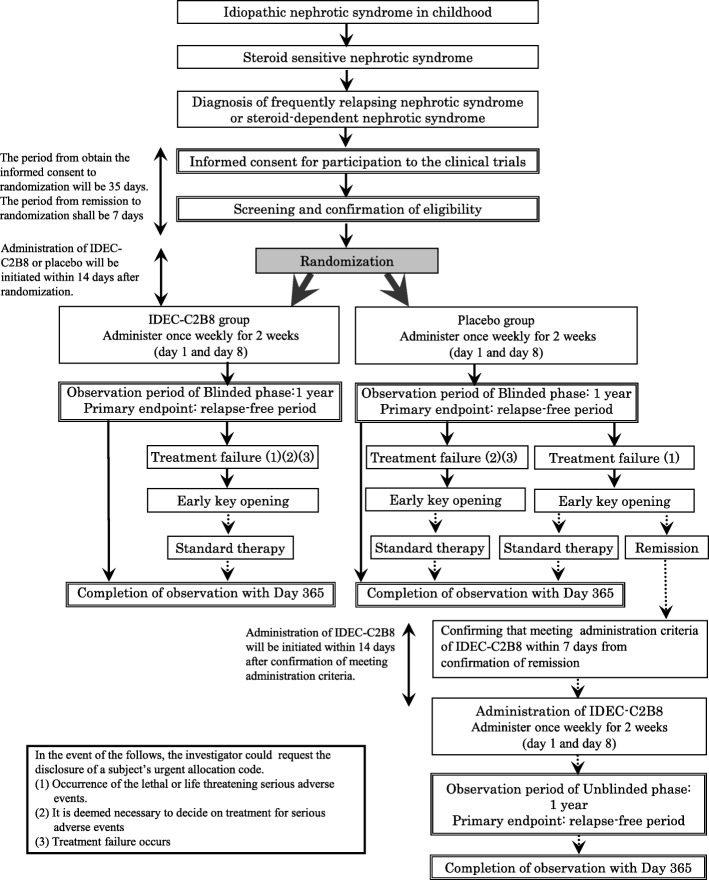
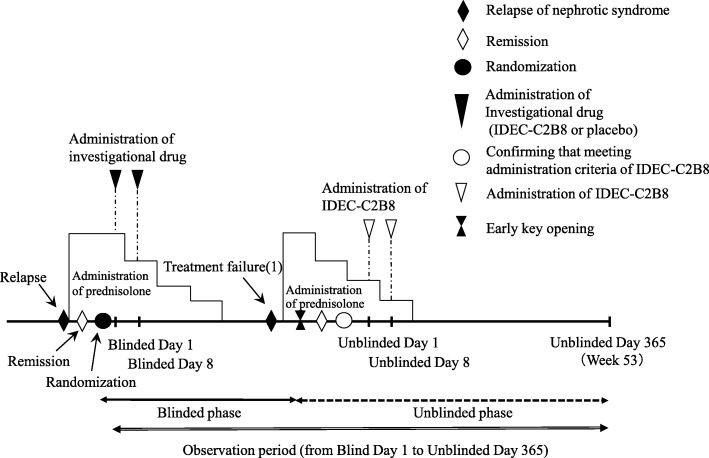
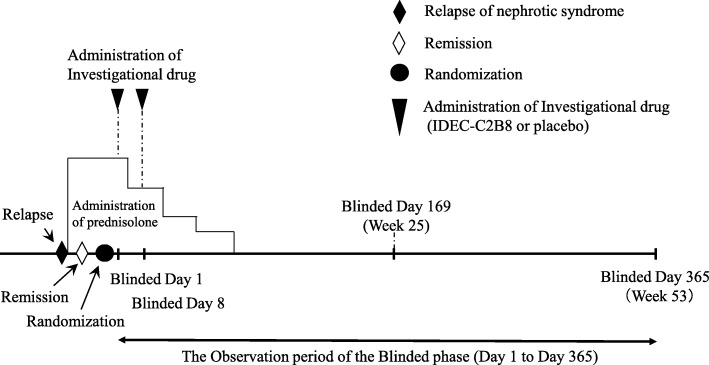
METHODS/DESIGN: We are conducting a multicenter, double-blind, randomized placebo controlled trial to investigate the efficacy and safety of rituximab for the treatment of childhood-onset early-stage uncomplicated FRNS/SDNS. Patients will be allocated to receive two 375 mg/m doses (maximum dose: 500 mg) of either rituximab or placebo. Investigators are permitted to request the disclosure of a subject's allocation code if he or she exhibits treatment failure. Additionally, if placebo-treated subjects display early relapse (a sign of treatment failure), they have the option to receive rituximab in an unblinded phase. The primary endpoint is relapse-free survival during the observation period.
The results will provide important data on the use of rituximab for patients with uncomplicated FRNS/SDNS. In the future, rituximab treatment will enable most patients with uncomplicated FRNS/SDNS to discontinue or reduce steroid therapy without relapse, and it is possible that rituximab could represent an immunosuppressive therapy for these diseases.
This trial was prospectively registered to the JMACCT Clinical Trials Registry on September 6, 2018 (Trial ID: JMA-IIA00380 ).
80%的特发性肾病综合征患儿对类固醇治疗有良好反应,但多达 50%的类固醇敏感肾病综合征患者表现为频繁复发(FRNS)或类固醇依赖性肾病综合征(SDNS)。几项研究发现嵌合抗 CD20 单克隆抗体利妥昔单抗是治疗复杂 FRNS/SDNS 患者的有效治疗方法。最近的研究表明,利妥昔单抗也可能是早期单纯 FRNS/SDNS 的一线治疗方法,尽管需要进一步研究来证实其疗效和安全性。
方法/设计:我们正在进行一项多中心、双盲、随机安慰剂对照试验,以研究利妥昔单抗治疗儿童早期单纯 FRNS/SDNS 的疗效和安全性。患者将被分配接受两次 375mg/m 的利妥昔单抗或安慰剂剂量(最大剂量:500mg)。如果研究者观察到治疗失败,他或她可以要求披露受试者的分配代码。此外,如果接受安慰剂治疗的受试者出现早期复发(治疗失败的迹象),他们可以选择在非盲阶段接受利妥昔单抗治疗。主要终点是观察期内无复发的生存。
研究结果将为利妥昔单抗治疗单纯 FRNS/SDNS 患者提供重要数据。未来,利妥昔单抗治疗将使大多数单纯 FRNS/SDNS 患者能够在不复发的情况下停止或减少类固醇治疗,并且利妥昔单抗可能成为这些疾病的免疫抑制治疗方法。
该试验于 2018 年 9 月 6 日前瞻性地在 JMACCT 临床试验注册处注册(试验 ID:JMA-IIA00380)。