Marie Curie Palliative Care Research Department, Division of Psychiatry, University College London, 6th Floor, Maple House, 149 Tottenham Court Road, London, W1T 7NF, UK.
Department of Psychology, City University of London, London, UK.
BMC Palliat Care. 2019 Aug 2;18(1):65. doi: 10.1186/s12904-019-0449-y.
Expressive writing involves writing about stressful or traumatic experiences. Despite trials in people with advanced disease, no systematic review to date has critiqued the evidence on expressive writing in this population. To synthesise the evidence of the effects of expressive writing on pain, sleep, depression and anxiety in people with advanced disease.
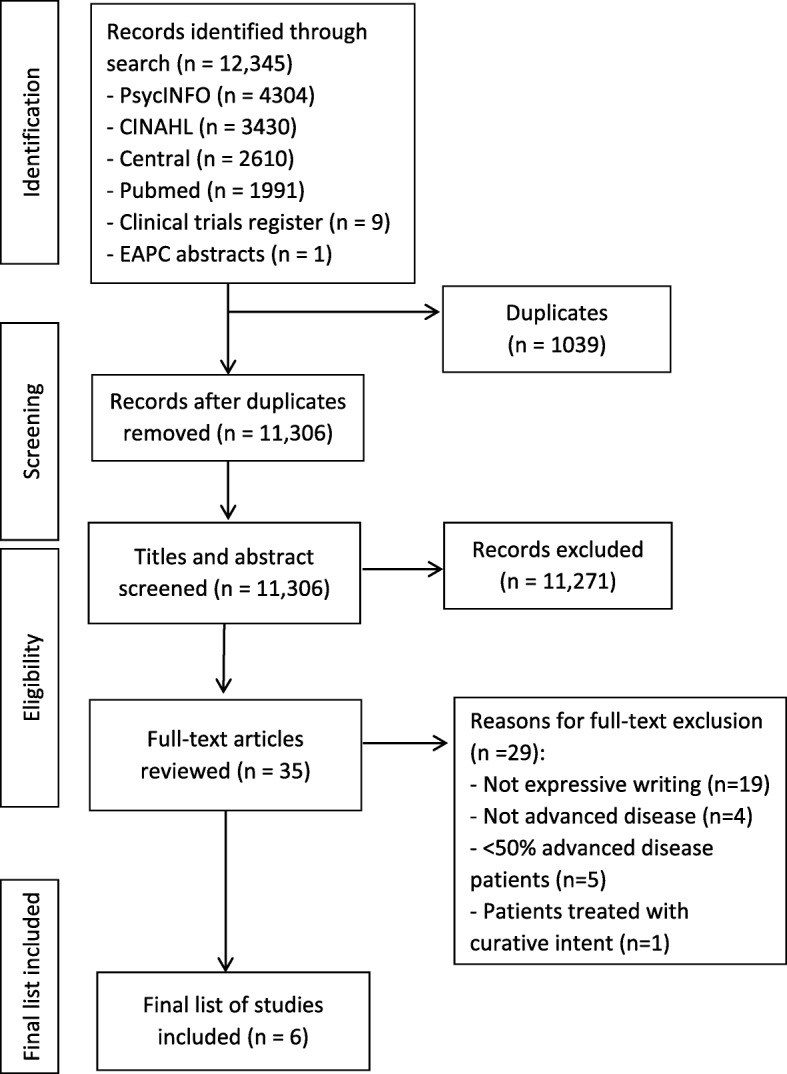
A systematic review according to the Preferred Reporting Items for Systematic Reviews and Meta-Analyses guidelines. CINAHL, CENTRAL, PsycINFO and PubMed were searched from January 1986 to March 2018. Other sources included clinical data registers and conference proceedings. Studies were included if they were randomised controlled trials that assessed the impact of an intervention involving expressive writing for adults with advanced disease and/or studies involving linguistic analysis on the expressive writing output. Methodological quality was assessed using the Cochrane risk of bias tool and the Mixed Methods Appraisal Tool. The Grading of Recommendations Assessment, Development and Evaluation tool was used to assess the level of evidence for the outcomes of interest. The protocol of this systematic review has been registered on PROSPERO (CRD42017058193).
Six eligible studies with a total of 288 participants were identified, including four randomised controlled trials. All of the trials were in cancer and recruited predominantly women. None of the interventions were tailored to the population. Studies had methodological shortcomings and evidence was generally of low quality. Combined analysis of the four trials, involving 214 participants in total, showed no clear difference in the effect of expressive writing on sleep, anxiety or depression compared to an active control. Pain was not evaluated in the trials. In contrast, analysis of the four studies that included linguistic analysis alluded to linguistic mechanisms for potential effects.
Although the trial results suggest there is no benefit in expressive writing for people with advanced disease, the current evidence is limited. There is a need for more rigorous trials. It would be of benefit first to undertake exploratory research in trial design including how best to measure impact and in tailoring of the intervention to address the specific needs of people with advanced disease.
The protocol of this systematic review has been registered on PROSPERO, which can be accessed here (registration number: CRD42017058193 ).
表达性写作涉及对压力或创伤经历的写作。尽管在晚期疾病患者中进行了试验,但迄今为止尚无系统评价对该人群中表达性写作的证据进行批判。旨在综合表达性写作对晚期疾病患者疼痛、睡眠、抑郁和焦虑影响的证据。
根据系统评价和荟萃分析的首选报告项目指南进行系统评价。从 1986 年 1 月到 2018 年 3 月,对 CINAHL、CENTRAL、PsycINFO 和 PubMed 进行了搜索。其他来源包括临床数据登记处和会议记录。如果研究是评估涉及晚期疾病成人表达性写作干预的影响的随机对照试验,或涉及表达性写作产出的语言分析的研究,则将其纳入研究。使用 Cochrane 偏倚风险工具和混合方法评估工具评估方法学质量。使用推荐评估、制定和评估工具(Grading of Recommendations Assessment, Development and Evaluation tool)评估感兴趣结局的证据水平。本系统评价的方案已在 PROSPERO(CRD42017058193)上注册。
确定了 6 项符合条件的研究,共 288 名参与者,包括 4 项随机对照试验。所有试验均在癌症中进行,主要招募女性。没有一项干预措施针对该人群进行了调整。研究存在方法学缺陷,证据质量普遍较低。对涉及 214 名参与者的四项试验的综合分析表明,与积极对照相比,表达性写作对睡眠、焦虑或抑郁的影响没有明显差异。试验中未评估疼痛。相比之下,对纳入语言分析的四项研究的分析暗示了潜在影响的语言机制。
尽管试验结果表明表达性写作对晚期疾病患者没有益处,但目前的证据有限。需要进行更严格的试验。首先,需要在试验设计方面进行探索性研究,包括如何最好地衡量影响,以及如何调整干预措施以满足晚期疾病患者的特定需求。
本系统评价的方案已在 PROSPERO 上注册,可在此处访问(注册编号:CRD42017058193)。