Department of Medical Sciences, Section of Internal and Cardiorespiratory Medicine, University of Ferrara, Italy.
Department of Medical Sciences, Section of Internal and Cardiorespiratory Medicine, University of Ferrara, Italy.
Nutr Metab Cardiovasc Dis. 2019 Oct;29(10):1061-1067. doi: 10.1016/j.numecd.2019.06.018. Epub 2019 Jun 28.
Increased uric acid levels correlate with cardiovascular disease and cardiovascular/overall mortality. To identify a uric acid threshold above which cardiovascular mortality rises, we studied the relationship between uric acid concentration and overall/cardiovascular mortality.
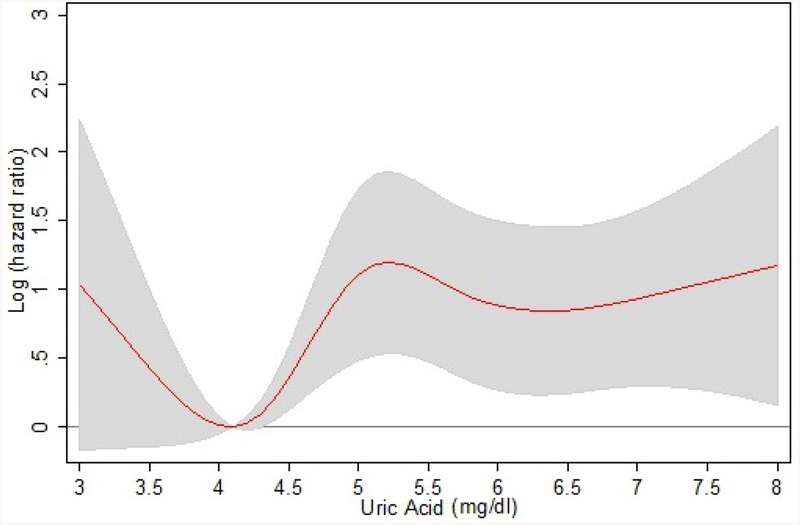
We analyzed data from the InCHIANTI study, a cohort study of Italian community-dwelling people with 9 years of follow-up. We selected a sample of 947 individuals over 64 years of age, free from cardio-cerebrovascular disease and with available uric acid measurement at baseline. The sample was divided according to plasma uric acid tertiles. The Hazard ratio (HR) for mortality was calculated by multivariate Cox proportional hazard model. Mean age of participants was 75.3 ± 7.3 years; the mean value of uric acid was 5.1 ± 1.4 mg/dl. Over 9-years of follow-up, 342 (36.1%) participants died, 143 deaths (15.1%) were due to cardiovascular disease. Subjects with higher uric acid concentrations presented a higher cardiovascular mortality [II (4.6-5.5 mg/dl) vs I (1.8-4.5 mg/dl) tertile HR: 1.98, 95%C.I. 1.22-3.23; III (≥5.6 mg/dl) vs I tertile HR: 1.87, 95%C.I. 1.13-3.09]. We found a non-linear association between uric acid concentrations and cardiovascular mortality with the lowest mortality for values of about 4.1 mg/dl and a significant risk increment for values above 4.3 mg/dl.
In community-dwelling older individuals free from cardio-cerebrovascular events, the lowest 9-year cardiovascular mortality was observed for uric acid values far below current target values. If confirmed, these data might represent the background for investigating the efficacy of uric acid levels reduction in similar populations.
尿酸水平升高与心血管疾病及心血管/全因死亡率相关。为明确尿酸升高与心血管死亡风险的关系,我们研究了尿酸浓度与全因/心血管死亡率的关系。
我们分析了 INCHIANTI 研究的数据,这是一项意大利社区居住人群的队列研究,随访时间为 9 年。我们选择了 947 名年龄在 64 岁以上、无心血管疾病且基线时可检测尿酸的个体作为样本。根据血浆尿酸三分位将样本进行分组。使用多变量 Cox 比例风险模型计算死亡率的风险比(HR)。参与者的平均年龄为 75.3±7.3 岁,尿酸的平均水平为 5.1±1.4mg/dl。在 9 年的随访期间,342 名(36.1%)参与者死亡,其中 143 例(15.1%)死于心血管疾病。尿酸浓度较高的受试者心血管死亡率更高[II(4.6-5.5mg/dl)与 I(1.8-4.5mg/dl)三分位 HR:1.98,95%CI:1.22-3.23;III(≥5.6mg/dl)与 I 三分位 HR:1.87,95%CI:1.13-3.09]。我们发现尿酸浓度与心血管死亡率之间呈非线性关系,尿酸值约为 4.1mg/dl 时死亡率最低,尿酸值高于 4.3mg/dl 时风险显著增加。
在无心血管-脑血管事件的社区居住的老年个体中,尿酸值远低于当前目标值时 9 年心血管死亡率最低。如果这些数据得到证实,可能为在类似人群中研究降低尿酸水平的疗效提供依据。