Senna Irene, Cardinali Lucilla, Farnè Alessandro, Brozzoli Claudio
Integrative Multisensory Perception Action and Cognition Team (ImpAct), Lyon Neuroscience Research Center, INSERM U1028, CNRS U5292, Lyon, France.
Department of Applied Cognitive Psychology, Ulm University, Ulm, Germany.
Front Psychol. 2019 Jul 17;10:1681. doi: 10.3389/fpsyg.2019.01681. eCollection 2019.
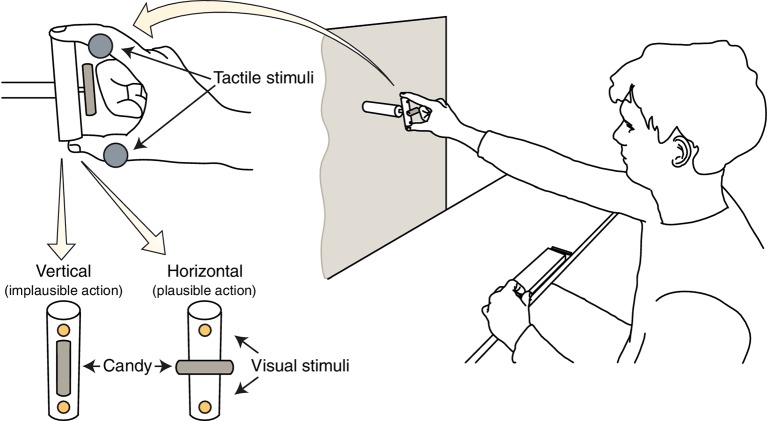
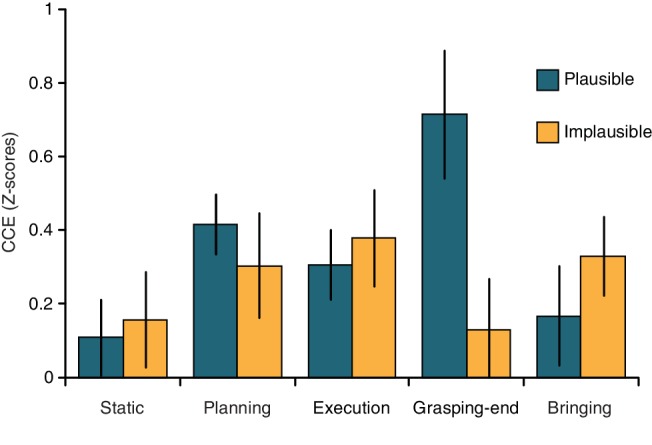
Successful interaction with objects in the peripersonal space requires that the information relative to current and upcoming positions of our body is continuously monitored and updated with respect to the location of target objects. Voluntary actions, for example, are known to induce an anticipatory remapping of the peri-hand space (PHS, i.e., the space near the acting hand) during the very early stages of the action chain: planning and initiating an object grasp increase the interference exerted by visual stimuli coming from the object on touches delivered to the grasping hand, thus allowing for hand-object position monitoring and guidance. Voluntarily grasping an object, though, is rarely performed in isolation. Grasping a candy, for example, is most typically followed by concatenated secondary action steps (bringing the candy to the mouth and swallowing it) that represent the agent's ultimate intention (to eat the candy). However, whether and when complex action chains remap the PHS remains unknown, just as whether remapping is conditional to goal achievability (e.g., candy-mouth fit). Here we asked these questions by assessing changes in visuo-tactile interference on the acting hand while participants had to grasp an object serving as a support for an elongated candy, and bring it toward their mouth. Depending on its orientation, the candy could potentially enter the participants' mouth (plausible goal), or not (implausible goal). We observed increased visuo-tactile interference at relatively late stages of the action chain, after the object had been grasped, and only when the action goal was plausible. These findings suggest that multisensory interactions during action execution depend upon the final aim and plausibility of complex goal-directed actions, and extend our knowledge about the role of peripersonal space in guiding goal-directed voluntary actions.
与个人周边空间中的物体成功互动,需要持续监测并更新与我们身体当前及即将到达位置相关的信息,以了解目标物体的位置。例如,已知在动作链的早期阶段,自愿行动会引发手部周边空间(PHS,即正在动作的手附近的空间)的预期重新映射:计划并开始抓取物体,会增加来自物体的视觉刺激对传递到抓握手上的触觉刺激的干扰,从而实现手部与物体位置的监测与引导。然而,自愿抓取物体很少单独进行。例如,抓取一块糖果之后,最典型的是紧接着一系列后续动作步骤(将糖果送到嘴边并吞咽),这些步骤代表了主体的最终意图(吃掉糖果)。然而,复杂动作链是否以及何时会重新映射手部周边空间仍不清楚,同样不清楚重新映射是否以目标可实现性为条件(例如,糖果能否放进嘴里)。在这里,我们通过评估参与者抓取一个作为细长糖果支撑物的物体并将其送到嘴边时,作用手上视觉触觉干扰的变化来探究这些问题。根据糖果的方向,它有可能进入参与者的口中(合理目标),也有可能无法进入(不合理目标)。我们观察到,在动作链相对较晚的阶段,即在物体被抓取之后,且只有当动作目标合理时,视觉触觉干扰才会增加。这些发现表明,动作执行过程中的多感官互动取决于复杂目标导向动作的最终目的和合理性,并扩展了我们对个人周边空间在引导目标导向自愿行动中作用的认识。