Tharmalingam Nagendran, Khader Rajamohammed, Fuchs Beth Burgwyn, Mylonakis Eleftherios
Department of Medicine, Division of Infectious Diseases, Warren Alpert Medical School of Brown University, Rhode Island Hospital, Providence, RI, United States.
Front Microbiol. 2019 Jul 17;10:1557. doi: 10.3389/fmicb.2019.01557. eCollection 2019.
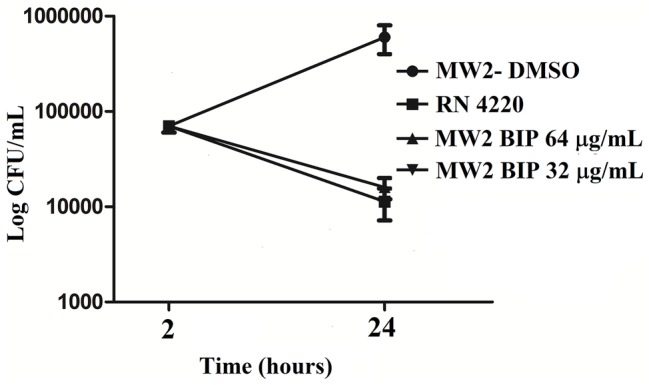
Antimicrobial drug discovery against drug-resistant bacteria is an urgent need. Beyond agents with direct antibacterial activity, anti-virulent molecules may also be viable compounds to defend against bacterial pathogenesis. Using a high throughput screen (HTS) that utilized infected with methicillin-resistant (MRSA) strain of MW2, we identified 4-(1,3-dimethyl-2,3-dihydro-1H-benzimidazol-2-yl)phenol (BIP). Interestingly, BIP had no inhibition activity against MW2, at least up to 64 μg/ml. The lack of direct antimicrobial activity suggests that BIP could inhibit bacterial virulence factors. To explore the possible anti-virulence effect of the identified molecule, we first performed real-time PCR to examine changes in virulence expression. BIP was highly active against MRSA virulence factors at sub-lethal concentrations and down-regulated virulence regulator genes, such as and . However, the benzimidazole derivatives omeprazole and pantoprazole did not down-regulate virulence genes significantly, compared to BIP. Moreover, the BIP-pretreated MW2 cells were more vulnerable to macrophage-mediated killing, as confirmed by intracellular killing and live/dead staining assays, and less efficient in establishing a lethal infection in the invertebrate host ( = 0.0131). We tested the cytotoxicity of BIP against human red blood cells (RBCs), and it did not cause hemolysis at the highest concentration tested (64 μg/ml). Taken together, our findings outline the potential anti-virulence activity of BIP that was identified through a -based, whole animal based, screen.
对抗耐药细菌的抗菌药物研发迫在眉睫。除了具有直接抗菌活性的药物外,抗毒力分子也可能是抵御细菌致病的可行化合物。我们利用感染耐甲氧西林金黄色葡萄球菌(MRSA)MW2菌株的高通量筛选(HTS),鉴定出了4-(1,3-二甲基-2,3-二氢-1H-苯并咪唑-2-基)苯酚(BIP)。有趣的是,BIP对MW2没有抑制活性,至少在高达64μg/ml的浓度下如此。缺乏直接抗菌活性表明BIP可能抑制细菌毒力因子。为了探究所鉴定分子可能的抗毒力作用,我们首先进行了实时PCR以检测毒力表达的变化。BIP在亚致死浓度下对MRSA毒力因子具有高度活性,并下调了毒力调节基因,如 和 。然而,与BIP相比,苯并咪唑衍生物奥美拉唑和泮托拉唑并未显著下调毒力基因。此外,经BIP预处理的MW2细胞更容易受到巨噬细胞介导的杀伤,这通过细胞内杀伤和活/死染色试验得到证实,并且在无脊椎动物宿主中建立致死性感染的效率较低(P = 0.0131)。我们测试了BIP对人红细胞(RBC)的细胞毒性,在测试的最高浓度(64μg/ml)下它并未引起溶血。综上所述,我们的研究结果概述了通过基于细胞、基于全动物的筛选鉴定出的BIP的潜在抗毒力活性。