Life Science Institute, Jinzhou Medical University, Jinzhou, China.
First Affiliated Hospital, China Medical University, Shenyang, China.
Front Immunol. 2019 Jul 19;10:1574. doi: 10.3389/fimmu.2019.01574. eCollection 2019.
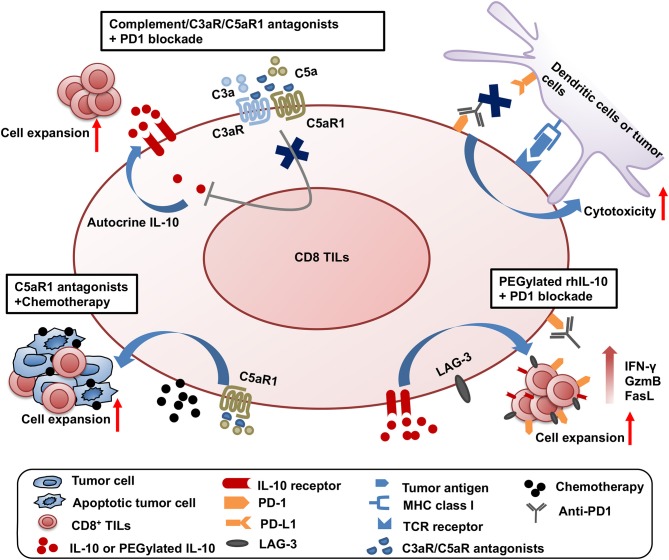
Cancer immunotherapy has made remarkable clinical advances in recent years. Antibodies targeting the immune checkpoint receptors PD-1 and CTLA-4 and adoptive cell therapy (ACT) based on expanded peripheral CTLs, tumor infiltrating lymphocytes (TILs), gene-engineered TCR- and chimeric antigen receptor (CAR)-T cells have all shown durable clinical efficacies in multiple types of cancers. However, these immunotherapeutic approaches only benefit a small fraction of cancer patients as various immune resistance mechanisms and limitations make their effective use a challenge in the majority of cancer patients. For example, adaptive resistance to therapeutic PD-1 blockade is associated with an upregulation of some additional immune checkpoint receptors. The efficacy of transferred tumor-specific T cells under the current clinical ACT protocol is often limited by their inefficient engraftment, poor persistence, and weak capability to attack tumor cells. Recent studies demonstrate that the complement receptor C3aR and C5aR function as a new class of immune checkpoint receptors. Complement signaling through C3aR and C5aR expressed on effector T lymphocytes prevent the production of the cytokine interleukin-10 (IL-10). Removing C3aR/C5aR-mediated transcriptional suppression of IL-10 expression results in endogenous IL-10 production by antitumor effector T cells, which drives T cell expansion and enhances T cell-mediated antitumor immunity. Importantly, preclinical, and clinical data suggest that a signaling axis consisting of complement/C3aR/C5aR/IL-10 critically regulates T cell mediated antitumor immunity and manipulation of the pathway and is an effective strategy for cancer immunotherapy. Furthermore, a combination of treatment strategies targeting the complement/C3aR/C5aR/IL-10 pathway with other treatment modalities may improve cancer therapeutic efficacy.
近年来,癌症免疫疗法取得了显著的临床进展。针对免疫检查点受体 PD-1 和 CTLA-4 的抗体以及基于外周 CTL、肿瘤浸润淋巴细胞 (TIL)、基因工程 TCR 和嵌合抗原受体 (CAR)-T 细胞扩增的过继细胞疗法 (ACT),在多种类型的癌症中均显示出持久的临床疗效。然而,由于各种免疫抵抗机制和局限性,这些免疫治疗方法仅使一小部分癌症患者受益,使其在大多数癌症患者中的有效应用成为挑战。例如,对治疗性 PD-1 阻断的适应性耐药与一些额外的免疫检查点受体的上调有关。当前临床 ACT 方案下转移的肿瘤特异性 T 细胞的疗效常常受到其低效植入、不良持久性和攻击肿瘤细胞的能力弱的限制。最近的研究表明,补体受体 C3aR 和 C5aR 作为一类新的免疫检查点受体发挥作用。表达在效应 T 淋巴细胞上的 C3aR 和 C5aR 通过补体信号传导可防止细胞因子白细胞介素-10 (IL-10)的产生。消除 C3aR/C5aR 介导的 IL-10 表达的转录抑制导致抗肿瘤效应 T 细胞产生内源性 IL-10,从而驱动 T 细胞扩增并增强 T 细胞介导的抗肿瘤免疫。重要的是,临床前和临床数据表明,由补体/C3aR/C5aR/IL-10 信号轴构成的一条关键调节 T 细胞介导的抗肿瘤免疫的信号轴,该途径的操控是癌症免疫治疗的有效策略。此外,与其他治疗方式相结合,靶向补体/C3aR/C5aR/IL-10 通路的治疗策略的组合可能会提高癌症治疗效果。