Faculty of Dentistry, Federal University of Goiás, Goiânia, Brazil.
Centre for Bone and Arthritis Research at Department of Internal Medicine and Clinical Nutrition, Institute for Medicine, Sahlgrenska Academy at University of Gothenburg, Gothenburg, Sweden.
Front Immunol. 2019 Jul 17;10:1663. doi: 10.3389/fimmu.2019.01663. eCollection 2019.
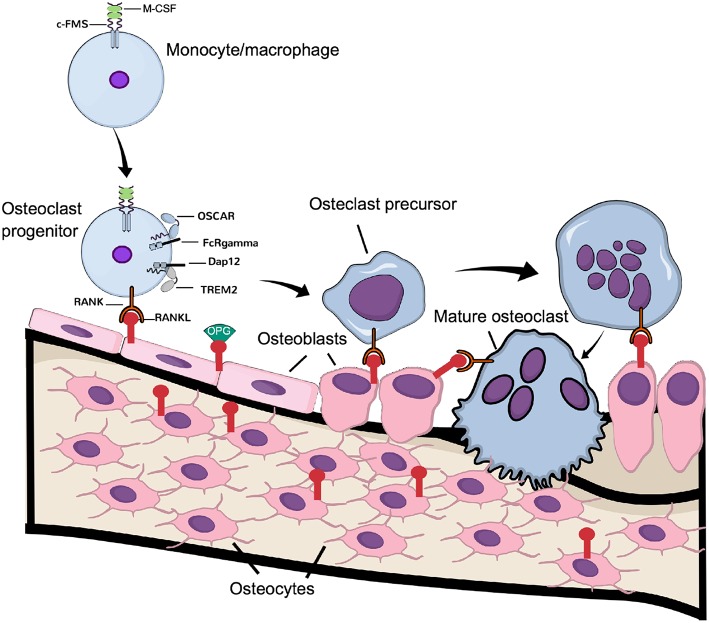
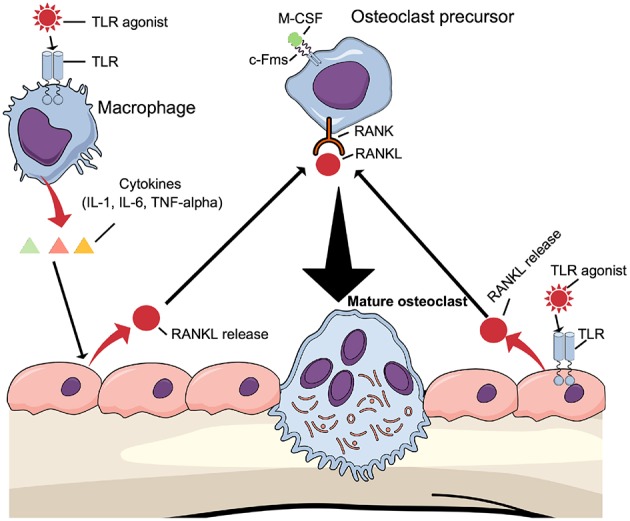
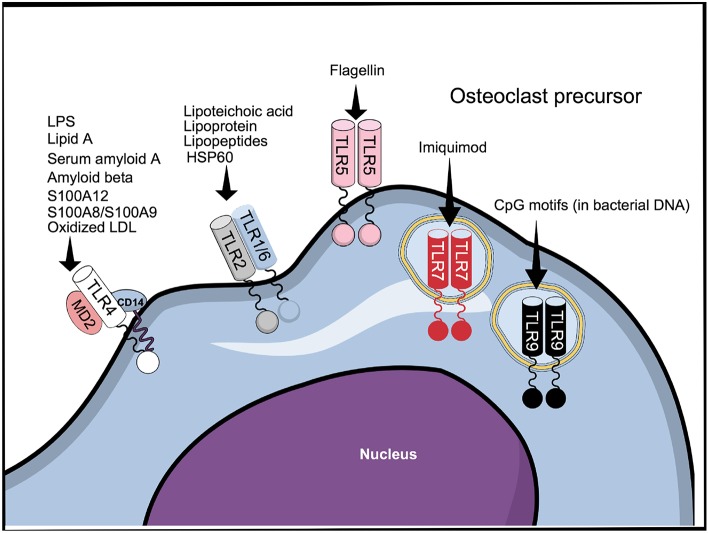
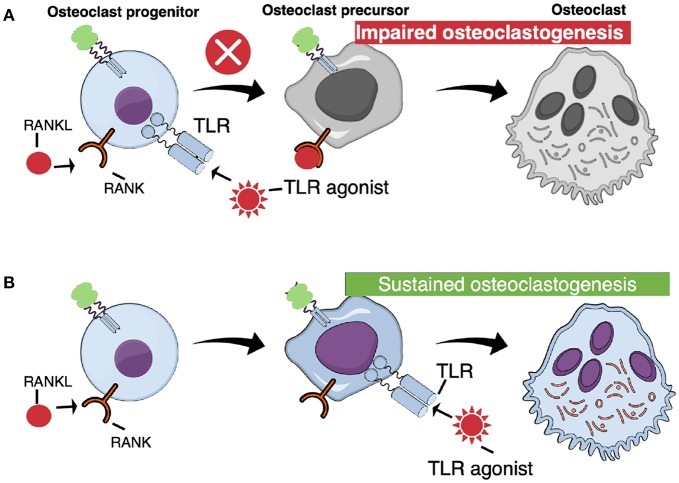
M-CSF and RANKL are two crucial cytokines stimulating differentiation of mature, bone resorbing, multinucleated osteoclasts from mononucleated progenitor cells in the monocyte/macrophage lineage. In addition to the receptors for M-CSF and RANKL, osteoclast progenitor cells express receptors for several other pro- and anti-osteoclastogenic cytokines, which also regulate osteoclast formation by affecting signaling downstream M-CSF and RANKL receptors. Similar to many other cells originating from myeloid hematopoetic stem cells, also osteoclast progenitors express toll-like receptors (TLRs). Nine murine TLRs are expressed in the progenitors and all, with the exception of TLR2 and TLR4, are downregulated during osteoclastogenesis. Activation of TLR2, TLR4, and TLR9, but not TLR5, in osteoclast progenitors stimulated with M-CSF and RANKL arrests differentiation along the osteoclastic lineage and keeps the cells at a macrophage stage. When the progenitors are primed with M-CSF/RANKL and then stimulated with agonists for TLR2, TLR4, or TLR9 in the presence of M-CSF, but in the absence of RANKL, the cells differentiate to mature, bone resorbing osteoclasts. TLR 2, 4, 5, and 9 are also expressed on osteoblasts and their activation increases osteoclast differentiation by an indirect mechanism through stimulation of RANKL. In mice, treatment with agonists for TLR2, 4, and 5 results in osteoclast formation and extensive bone loss. It remains to be shown the relative importance of inhibitory and stimulatory effects by TLRs on osteoclast progenitors and the role of RANKL produced by TLR stimulated osteoblasts, for the bone resorbing effects .
M-CSF 和 RANKL 是两种关键细胞因子,它们刺激单核细胞/巨噬细胞谱系中的单核细胞祖细胞分化为成熟的、具有骨吸收功能的多核破骨细胞。除了 M-CSF 和 RANKL 的受体外,破骨细胞祖细胞还表达几种其他的促破骨细胞生成和抗破骨细胞生成细胞因子的受体,这些细胞因子通过影响 M-CSF 和 RANKL 受体下游的信号转导,也调节破骨细胞的形成。与起源于髓系造血干细胞的许多其他细胞类似,破骨细胞祖细胞也表达 Toll 样受体 (TLR)。9 种鼠 TLR 在祖细胞中表达,除 TLR2 和 TLR4 外,在破骨细胞发生过程中均下调。在 M-CSF 和 RANKL 刺激下,TLR2、TLR4 和 TLR9 的激活,但 TLR5 的激活,在破骨细胞祖细胞中阻止沿着破骨细胞谱系的分化,并使细胞保持在巨噬细胞阶段。当祖细胞用 M-CSF/RANKL 预先刺激,然后在 M-CSF 存在但 RANKL 缺乏的情况下用 TLR2、TLR4 或 TLR9 的激动剂刺激时,细胞分化为成熟的、具有骨吸收功能的破骨细胞。TLR2、4、5 和 9 也表达在成骨细胞上,其通过刺激 RANKL 的间接机制增加破骨细胞分化。在小鼠中,TLR2、4 和 5 的激动剂治疗导致破骨细胞形成和广泛的骨丢失。TLR 对破骨细胞祖细胞的抑制和刺激作用以及 TLR 刺激的成骨细胞产生的 RANKL 对破骨细胞吸收作用的相对重要性仍有待证明。