Department of Biostatistics and Health Informatics, Institute of Psychiatry, Psychology and Neuroscience, King's College London, De Crespigny Park, London, SE5 8AF, UK.
MRC Centre for Transplantation, King's College London, Guy's Hospital, Great Maze Pond, London, SE1 9RT, UK.
Trials. 2019 Aug 5;20(1):476. doi: 10.1186/s13063-019-3602-2.
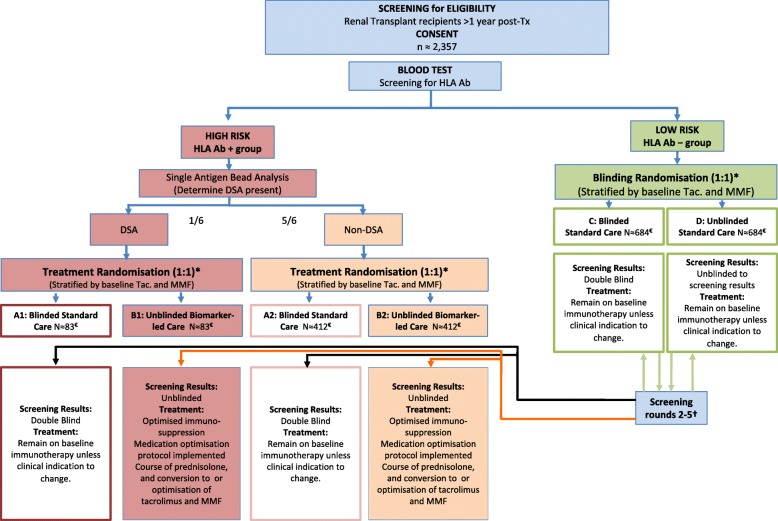
Chronic rejection is the single biggest cause of premature kidney graft failure. HLA antibodies (Ab) are an established prognostic biomarker for premature graft failure so there is a need to test whether treatment decisions based on the presence of the biomarker can alter prognosis. The Optimised TacrolimuS and MMF for HLA Antibodies after Renal Transplantation (OuTSMART) trial combines two elements. Firstly, testing whether a routine screening programme for HLA Ab in all kidney transplant recipients is useful by comparing blinding versus unblinding of HLA Ab status. Secondly, for those found to be HLA Ab+, testing whether the introduction of a standard optimisation treatment protocol can reduce graft failure rates.
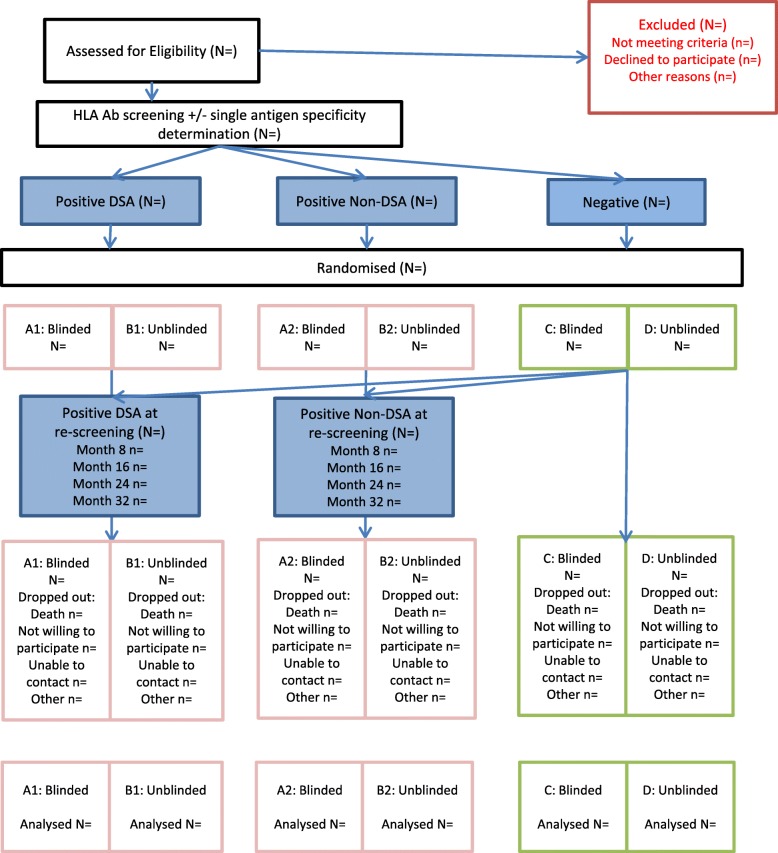
OuTSMART is a prospective, open-labelled, randomised biomarker-based strategy (hybrid) trial, with two arms stratified by biomarker (HLA Ab) status. The primary outcome was amended from graft failure rates at 3 years to time to graft failure to increase power and require fewer participants to be recruited. Length of follow-up subsequently is variable, with all participants followed up for at least 43 months up to a maximum of 89 months. The primary outcome will be analysed using Cox regression adjusting for stratification factors. Analyses will be according to the intention-to-treat using all participants as randomised. Outcomes will be analysed comparing standard care versus biomarker-led care groups within the HLA Ab+ participants (including those who become HLA Ab+ through re-screening) as well as between HLA-Ab-unblinded and HLA-Ab-blinded groups using all participants.
Changes to the primary outcome permit recruitment of fewer participants to achieve the same statistical power. Pre-stating the statistical analysis plan guards against changes to the analysis methods at the point of analysis that might otherwise introduce bias through knowledge of the data. Any deviations from the analysis plan will be justified in the final report.
ISRCTN registry, ID: ISRCTN46157828 . Registered on 26 March 2013; EudraCT 2012-004308-36 . Registered on 10 December 2012.
慢性排斥是导致肾移植早期失败的单一最大原因。HLA 抗体(Ab)是预测早期移植物失败的既定预后生物标志物,因此需要测试是否基于生物标志物的存在做出的治疗决策可以改变预后。优化他克莫司和 MMF 治疗肾移植后 HLA 抗体(Optimised TacrolimuS and MMF for HLA Antibodies after Renal Transplantation,OuTSMART)试验结合了两个元素。首先,通过比较 HLA Ab 状态的盲法和非盲法,测试对所有肾移植受者进行 HLA Ab 常规筛查的方案是否有用。其次,对于发现 HLA Ab+的患者,测试引入标准的优化治疗方案是否可以降低移植物失败率。
OuTSMART 是一项前瞻性、开放标签、基于生物标志物的策略(混合)试验,按生物标志物(HLA Ab)状态分层,分为两个组。主要结局从 3 年的移植物失败率修订为移植物失败时间,以增加效力并减少需要招募的参与者数量。随后的随访时间长短不一,所有参与者的随访时间至少为 43 个月,最长可达 89 个月。主要结局将使用 Cox 回归进行分析,调整分层因素。将根据意向治疗分析所有参与者随机分组的结果。将在 HLA Ab+的参与者中比较标准护理与生物标志物引导的护理组(包括通过重新筛查成为 HLA Ab+的参与者),以及在 HLA Ab 非盲和 HLA Ab 盲的参与者中分析所有参与者的结果。
改变主要结局可以减少参与者数量,以达到相同的统计效力。预先陈述统计分析计划可以防止在分析时对分析方法进行更改,否则可能会因了解数据而导致偏差。最终报告中会对任何偏离分析计划的情况进行合理说明。
ISRCTN 注册,编号:ISRCTN46157828;注册于 2013 年 3 月 26 日;EudraCT 2012-004308-36;注册于 2012 年 12 月 10 日。