Departamento de Biologia Estrutural, Molecular e Genética, Programa de Pós-Graduação em Biologia Evolutiva, Universidade Estadual de Ponta Grossa, Ponta Grossa, PR, Brazil.
Depto Física, Química e Matemática, Graduate School of Biotechnology and Environmental Monitoring (UFSCar), Sorocaba, SP, Brazil.
Sci Rep. 2019 Aug 5;9(1):11291. doi: 10.1038/s41598-019-47753-w.
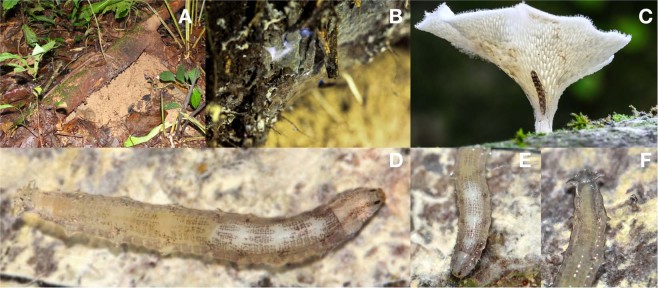
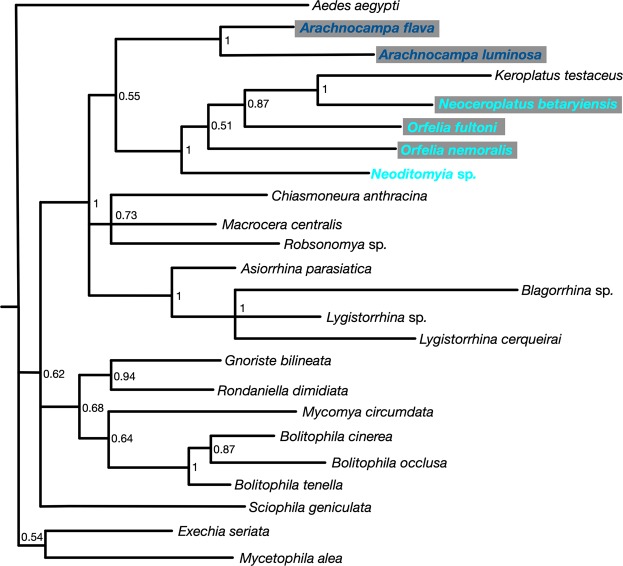
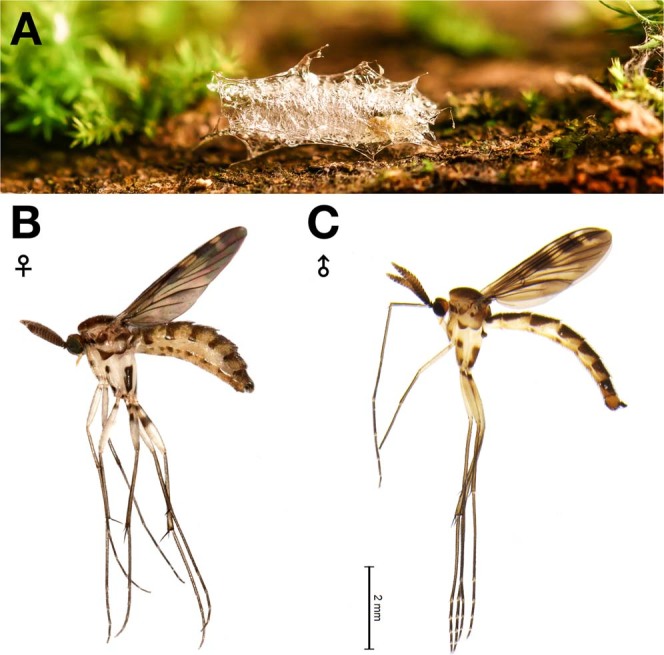
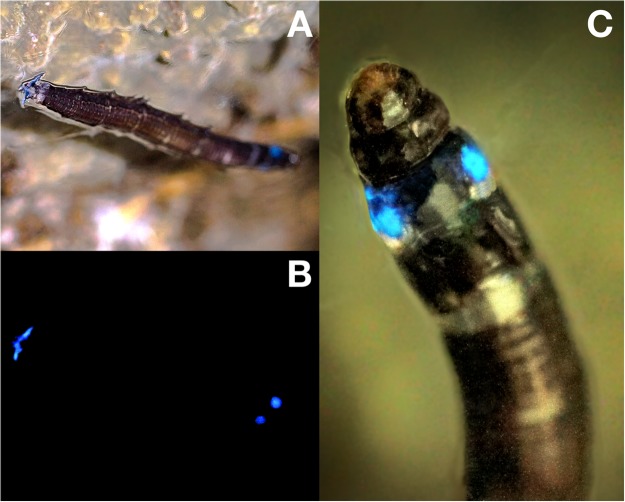
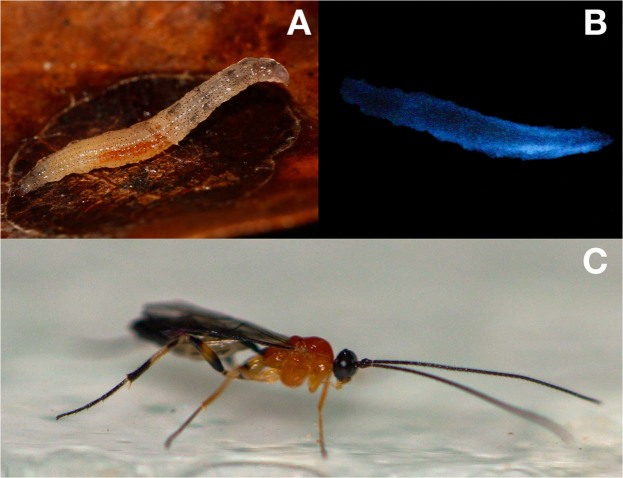
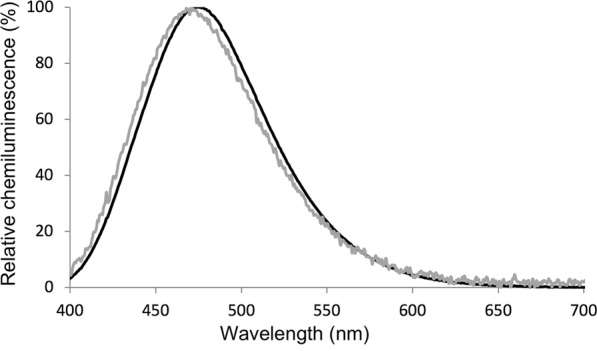
Blue shining fungus gnats (Diptera) had been long reported in the Waitomo caves of New Zealand (Arachnocampa luminosa Skuse), in stream banks of the American Appalachian Mountains (Orfelia fultoni Fisher) in 1939 and in true spore eating Eurasiatic Keroplatus Bosc species. This current report observes that similar blue light emitting gnat larvae also occur nearby the Betary river in the buffer zone of High Ribeira River State Park (PETAR) in the Atlantic Forest of Brazil, where the larvae were found when on fallen branches or trunks enveloped in their own secreted silk. The new species is named Neoceroplatus betaryiensis nov. sp. (Diptera: Keroplatidae: Keroplatinae: Keroplatini) based on a morphological analysis. Neoceroplatus betaryiensis nov. sp. larvae emit blue bioluminescence that can be seen from their last abdominal segment and from two photophores located laterally on the first thoracic segment. When touched, the larvae can actively stop its luminescence, which returns when it is no longer being agitated. The in vitro bioluminescence spectrum of N. betaryiensis nov. sp. peaks at 472 nm, and cross-reactivity of hot and cold extracts with the luciferin-luciferase from Orfelia fultoni indicate significant similarity in both enzyme and substrate of the two species, and that the bioluminescence system in the subfamily Keroplatinae is conserved.
蓝色发光蕈蚊(双翅目)长期以来一直被报道存在于新西兰怀托摩洞穴(Arachnocampa luminosa Skuse)、1939 年美国阿巴拉契亚山脉的溪流岸边(Orfelia fultoni Fisher)以及真正的食孢子欧亚大陆 Keroplatus Bosc 物种中。本报告观察到,类似的发蓝光的蕈蚊幼虫也出现在巴西大西洋森林的里贝里拉河高保护区(PETAR)的贝塔里亚河附近,当幼虫在包裹在自己分泌的丝中的落叶树枝或树干上时,就可以发现它们。新物种被命名为 Neoceroplatus betaryiensis nov. sp.(双翅目:Keroplatidae:Keroplatinae:Keroplatini),基于形态分析。Neoceroplatus betaryiensis nov. sp. 幼虫发出蓝色生物发光,可以从最后一个腹部节段和位于第一个胸节侧面的两个光感器看到。当被触摸时,幼虫可以主动停止发光,当不再受到干扰时,发光会恢复。N. betaryiensis nov. sp. 的体外生物发光光谱在 472nm 处达到峰值,热提取物和冷提取物与 Orfelia fultoni 的荧光素-荧光酶的交叉反应表明,两种酶和底物在两种酶和底物中都具有显著的相似性,并且 Keroplatinae 亚科的生物发光系统是保守的。