Satarug Soisungwan, Boonprasert Kanyarat, Gobe Glenda C, Ruenweerayut Ronnatrai, Johnson David W, Na-Bangchang Kesara, Vesey David A
Centre for Kidney Disease Research, Faculty of Medicine, Translational Research Institute, University of Queensland, Brisbane, Australia.
Chulabhorn International College of Medicine, Thammasat University, Pathumthani, Thailand.
Clin Kidney J. 2018 Nov 21;12(4):468-475. doi: 10.1093/ckj/sfy113. eCollection 2019 Aug.
Urinary 20-hydroxyeicosatetraenoic acid (20-HETE) has been associated with hypertension in women with elevated urinary cadmium (Cd) excretion rates. The present study investigates the urinary Cd and 20-HETE levels in relation to the estimated glomerular filtration rate (eGFR) and albumin excretion in men and women.
A population-based, cross-sectional study, which included 225 women and 84 men aged 33-55 years, was conducted in a rural area known to be polluted with Cd.
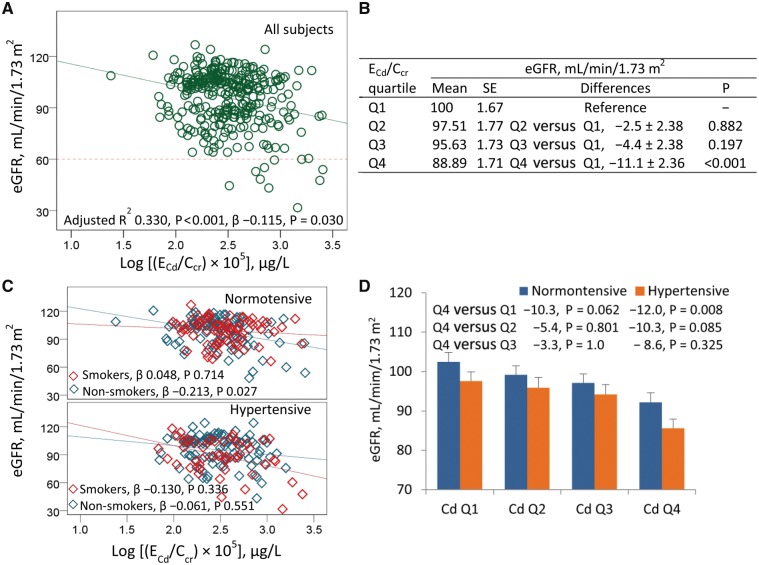
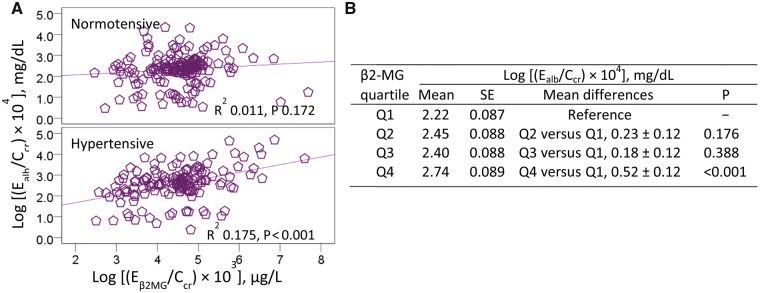
In all subjects, lower eGFR values were associated with higher urinary Cd excretion (P = 0.030), and tubulopathy markers -acetyl-β-d-glucosaminidase (P < 0.001) and β2-microglobulin (β2-MG) (P < 0.001). On average, the hypertensive subjects with the highest quartile of urinary Cd had eGFR values of 12 and 17 mL/min/1.73 m lower than that in the hypertensive (P = 0.009) and normotensive subjects (P < 0.001) with the lowest quartile of urinary Cd, respectively. In men, urinary albumin was inversely associated with 20-HETE (β = -0.384, P < 0.001), while showing a moderately positive association with systolic blood pressure (SBP) (β = 0.302, P = 0.037). In women, urinary albumin was not associated with 20-HETE (P = 0.776), but was associated with tubulopathy, reflected by elevated urinary excretion of β2-MG (β = 0.231, P = 0.002).
Tubulopathy is a determinant of albumin excretion in women, while 20-HETE and SBP are determinants of urinary albumin excretion in men. Associations of chronic exposure to Cd with marked eGFR decline and renal tubular injury seen in both Cd-exposed men and women add to mounting research data that links Cd to the risk of developing chronic kidney disease.
尿20-羟基二十碳四烯酸(20-HETE)与尿镉(Cd)排泄率升高的女性高血压有关。本研究调查了男性和女性尿镉和20-HETE水平与估计肾小球滤过率(eGFR)和白蛋白排泄的关系。
在一个已知受镉污染的农村地区进行了一项基于人群的横断面研究,纳入了225名年龄在33至55岁之间的女性和84名男性。
在所有受试者中,较低的eGFR值与较高的尿镉排泄相关(P = 0.030),以及肾小管病变标志物——乙酰-β-D-氨基葡萄糖苷酶(P < 0.001)和β2-微球蛋白(β2-MG)(P < 0.001)。平均而言,尿镉处于最高四分位数的高血压受试者的eGFR值分别比尿镉处于最低四分位数的高血压(P = 0.009)和血压正常受试者(P < 0.001)低12和17 mL/min/1.73m²。在男性中,尿白蛋白与20-HETE呈负相关(β = -0.384,P < 0.001),而与收缩压(SBP)呈中度正相关(β = 0.302,P = 0.037)。在女性中,尿白蛋白与20-HETE无关(P = 0.776),但与肾小管病变相关,表现为尿β2-MG排泄升高(β = 0.231,P = 0.002)。
肾小管病变是女性白蛋白排泄的决定因素,而20-HETE和SBP是男性尿白蛋白排泄的决定因素。镉暴露的男性和女性中慢性镉暴露与显著的eGFR下降和肾小管损伤之间的关联,增加了将镉与慢性肾病发生风险联系起来的研究数据。