Merck & Co., Inc., Kenilworth, NJ, USA.
Merck & Co., Inc., UG 4C-06, P.O. Box 1000, North Wales, PA, 19454-1099, USA.
Alzheimers Res Ther. 2019 Aug 7;11(1):68. doi: 10.1186/s13195-019-0520-1.
Verubecestat, a BACE1 inhibitor that reduces Aβ levels in the cerebrospinal fluid of humans, was not effective in a phase 3 trial (EPOCH) of mild-to-moderate AD and was associated with adverse events. To assist in the development of BACE1 inhibitors, we report detailed safety findings from EPOCH.
EPOCH was a randomized, double-blind, placebo-controlled 78-week trial evaluating verubecestat 12 mg and 40 mg in participants with mild-to-moderate AD diagnosed clinically. The trial was terminated due to futility close to its scheduled completion. Of 1957 participants who were randomized and took treatment, 652 were assigned to verubecestat 12 mg, 652 to verubecestat 40 mg, and 653 to placebo. Adverse events and relevant laboratory, vital sign, and ECG findings were assessed.
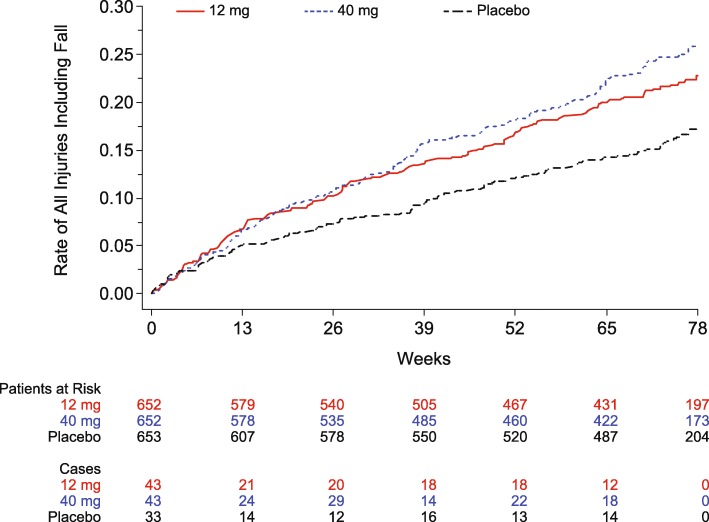
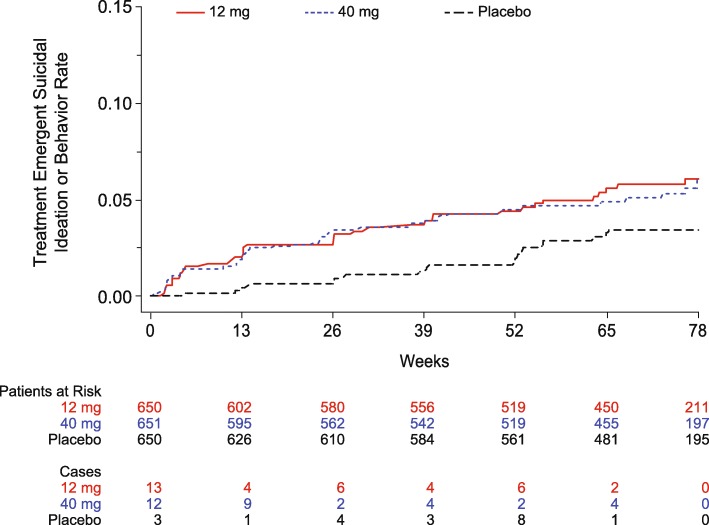
Verubecestat 12 mg and 40 mg were associated with an increase in the percentage of participants reporting adverse events versus placebo (89 and 92% vs. 82%), although relatively few participants discontinued treatment due to adverse events (8 and 9% vs. 6%). Adverse events that were increased versus placebo included falls and injuries, suicidal ideation, weight loss, sleep disturbance, rash, and hair color change. Most were mild to moderate in severity. Treatment differences in suicidal ideation emerged within the first 3 months but did not appear to increase after 6 months. In contrast, treatment differences in falls and injuries continued to increase over time.
Verubecestat was associated with increased risk for several types of adverse events. Falls and injuries were notable for progressive increases over time. While the mechanisms underlying the increased adverse events are unclear, they may be due to BACE inhibition and should be considered in future clinical development programs of BACE1 inhibitors.
ClinicalTrials.gov NCT01739348 , registered on 29 November 2012.
贝伐单抗,一种 BACE1 抑制剂,可降低人类脑脊液中的 Aβ 水平,在轻度至中度 AD 的 3 期试验(EPOCH)中无效,并与不良事件相关。为了协助 BACE1 抑制剂的开发,我们报告了 EPOCH 的详细安全性发现。
EPOCH 是一项随机、双盲、安慰剂对照的 78 周试验,评估了贝伐单抗 12mg 和 40mg 在临床诊断为轻度至中度 AD 的患者中的应用。由于接近预定完成时间的无效性,该试验提前终止。在 1957 名接受随机治疗的参与者中,652 名被分配到贝伐单抗 12mg 组,652 名被分配到贝伐单抗 40mg 组,653 名被分配到安慰剂组。评估了不良事件以及相关的实验室、生命体征和心电图发现。
与安慰剂相比,贝伐单抗 12mg 和 40mg 组报告不良事件的参与者比例增加(89%和 92% vs. 82%),尽管由于不良事件而停止治疗的参与者相对较少(8%和 9% vs. 6%)。与安慰剂相比,增加的不良事件包括跌倒和伤害、自杀意念、体重减轻、睡眠障碍、皮疹和头发颜色改变。大多数为轻度至中度。在最初的 3 个月内,贝伐单抗组和安慰剂组之间出现了自杀意念的差异,但在 6 个月后似乎没有增加。相比之下,跌倒和伤害的治疗差异随着时间的推移而持续增加。
贝伐单抗与多种类型的不良事件风险增加有关。跌倒和伤害随着时间的推移逐渐增加。虽然导致不良事件增加的机制尚不清楚,但它们可能与 BACE 抑制有关,在未来的 BACE1 抑制剂临床开发项目中应予以考虑。
ClinicalTrials.gov NCT01739348,于 2012 年 11 月 29 日注册。