Aslanian Harry R, Sethi Amrita, Bhutani Manoop S, Goodman Adam J, Krishnan Kumar, Lichtenstein David R, Melson Joshua, Navaneethan Udayakumar, Pannala Rahul, Parsi Mansour A, Schulman Allison R, Sullivan Shelby A, Thosani Nirav, Trikudanathan Guru, Trindade Arvind J, Watson Rabindra R, Maple John T
Section of Digestive Diseases, Department of Internal Medicine, Yale University, New Haven, Connecticut.
Division of Digestive and Liver Diseases, Columbia University Medical Center/New York-Presbyterian, New York, New York.
VideoGIE. 2019 Jun 29;4(8):343-350. doi: 10.1016/j.vgie.2019.03.010. eCollection 2019 Aug.
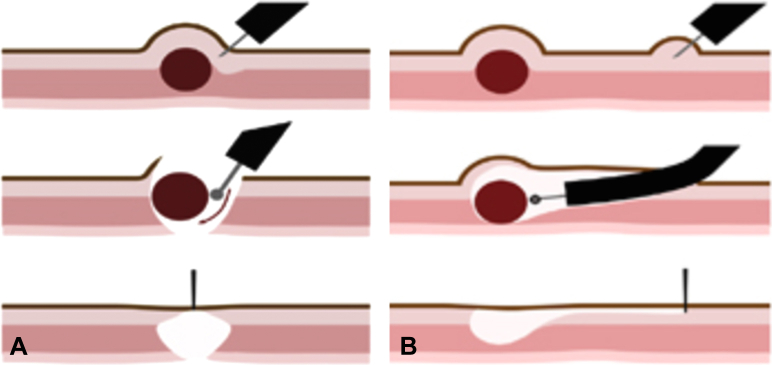
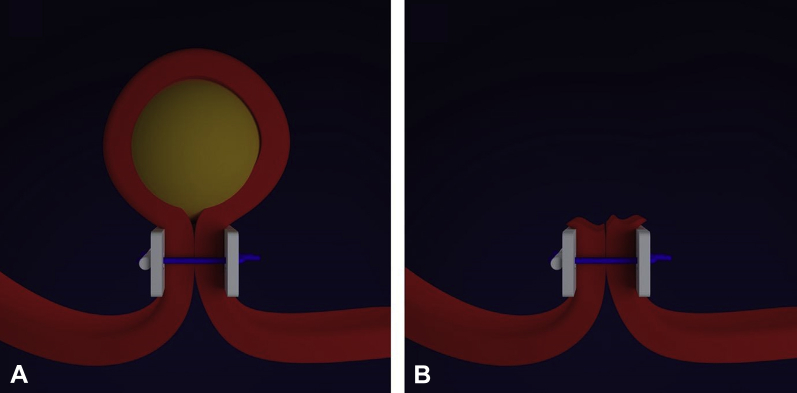
With the development of reliable endoscopic closure techniques and tools, endoscopic full-thickness resection (EFTR) is emerging as a therapeutic option for the treatment of subepithelial tumors and epithelial neoplasia with significant fibrosis. EFTR may be categorized as "exposed" and "nonexposed." In exposed EFTR, the full-thickness resection is undertaken with a tunneled or nontunneled technique, with subsequent closure of the defect. In nonexposed EFTR, a secure serosa-to-serosa apposition is achieved before full-thickness resection of the isolated lesion. This document reviews current techniques and devices used for EFTR and reviews clinical applications and outcomes.
随着可靠的内镜闭合技术和工具的发展,内镜全层切除术(EFTR)正在成为治疗伴有明显纤维化的上皮下肿瘤和上皮性肿瘤的一种治疗选择。EFTR可分为“暴露型”和“非暴露型”。在暴露型EFTR中,采用隧道式或非隧道式技术进行全层切除,随后封闭缺损。在非暴露型EFTR中,在对孤立病变进行全层切除之前实现安全的浆膜对浆膜贴合。本文回顾了用于EFTR的当前技术和设备,并回顾了临床应用和结果。