Women's College Research Institute, Toronto, Ontario, Canada.
Dalla Lana School of Public Health, University of Toronto, Toronto, Ontario, Canada.
JAMA Netw Open. 2019 Aug 2;2(8):e198420. doi: 10.1001/jamanetworkopen.2019.8420.
Preventive surgery is strongly recommended for individuals with a BRCA mutation at a young age to prevent ovarian cancer and improve overall survival. The overall effect of early surgical menopause on various health outcomes, including bone health, has not been clearly elucidated.
To evaluate the association of prophylactic bilateral salpingo-oophorectomy with bone mineral density (BMD) loss among individuals with a BRCA mutation.
DESIGN, SETTING, AND PARTICIPANTS: This retrospective cohort study of participants with a BRCA mutation who underwent oophorectomy through the University Health Network, Toronto, Ontario, Canada, recruited participants from January 2000 to May 2013. Eligibility criteria included having a BRCA mutation, at least 1 ovary intact prior to surgery, and no history of any cancer other than breast cancer. Bone mineral density was measured using dual-energy x-ray absorptiometry before and after surgery. Data analysis began in December 2018 and finished in January 2019.
The annual change in BMD from baseline to follow-up was calculated for the following 3 anatomical locations: (1) lumbar spine, (2) femoral neck, and (3) total hip.
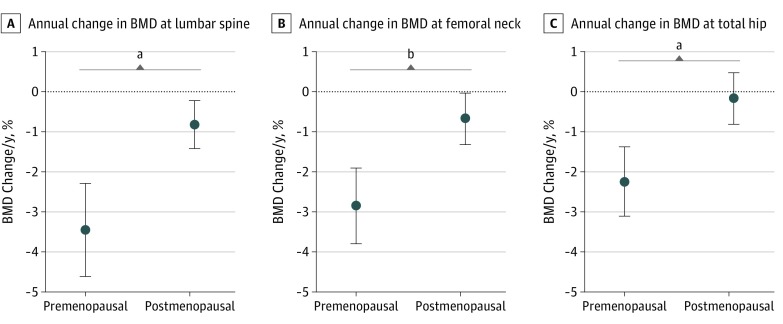
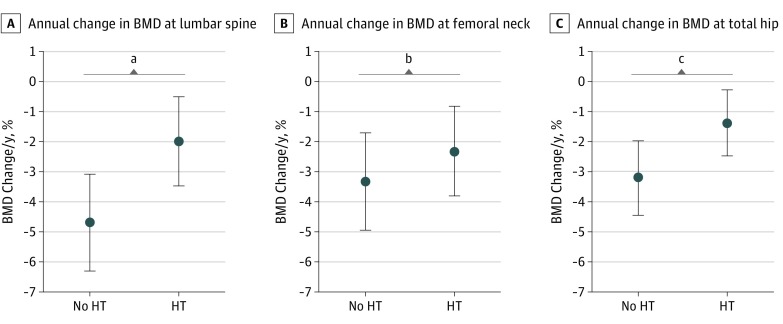
A total of 95 women had both a baseline and postsurgery BMD measurement with a mean (SD) follow-up period of 22.0 (12.7) months. The mean (SD) age at oophorectomy was 48.0 (7.4) years. Among women who were premenopausal at time of surgery (50 [53%]), there was a decrease in BMD from baseline to follow-up across the lumbar spine (annual change, -3.45%; 95% CI, -4.61% to -2.29%), femoral neck (annual change, -2.85%; 95% CI, -3.79% to -1.91%), and total hip (annual change, -2.24%; 95% CI, -3.11% to -1.38%). Self-reported hormone therapy use was associated with significantly less bone loss at the lumbar spine (-2.00% vs -4.69%; P = .02) and total hip (-1.38% vs -3.21; P = .04) compared with no hormone therapy use. Among postmenopausal women at time of surgery (45 [47%]), there was also a significant decrease in BMD across the lumbar spine (annual change, -0.82%; 95% CI, -1.42% to -0.23%) and femoral neck (annual change, -0.68%; 95% CI, -1.33% to -0.04%) but not total hip (annual change, -0.18%; 95% CI, -0.82% to 0.46%).
This study found that oophorectomy was associated with postoperative bone loss, especially among women who were premenopausal at the time of surgery. Targeted management strategies should include routine BMD assessment and hormone therapy use to improve management of bone health in this population.
对于携带 BRCA 突变且年龄较小的个体,预防性手术强烈推荐用于预防卵巢癌和提高总体生存率。早期手术绝经对各种健康结果的总体影响,包括骨骼健康,尚未明确阐明。
评估预防性双侧输卵管卵巢切除术与携带 BRCA 突变个体的骨密度(BMD)丧失之间的关联。
设计、设置和参与者:这项回顾性队列研究纳入了通过加拿大安大略省多伦多大学健康网络进行卵巢切除术的携带 BRCA 突变的个体,招募参与者的时间为 2000 年 1 月至 2013 年 5 月。纳入标准包括携带 BRCA 突变、手术前至少有一侧卵巢完整且无乳腺癌以外的任何癌症史。在手术前后使用双能 X 射线吸收法测量骨密度。数据分析于 2018 年 12 月开始,于 2019 年 1 月结束。
计算以下 3 个解剖部位的基线到随访期间 BMD 的年度变化:(1)腰椎、(2)股骨颈和(3)全髋。
共有 95 名女性具有基线和术后 BMD 测量值,平均(SD)随访时间为 22.0(12.7)个月。卵巢切除术时的平均(SD)年龄为 48.0(7.4)岁。在手术时处于绝经前的女性中(50 名[53%]),腰椎(年度变化,-3.45%;95%CI,-4.61%至-2.29%)、股骨颈(年度变化,-2.85%;95%CI,-3.79%至-1.91%)和全髋(年度变化,-2.24%;95%CI,-3.11%至-1.38%)的 BMD 从基线到随访均有下降。报告的激素治疗使用与腰椎(-2.00%比-4.69%;P=0.02)和全髋(-1.38%比-3.21%;P=0.04)相比,骨丢失明显减少。在手术时处于绝经后的女性中(45 名[47%]),腰椎(年度变化,-0.82%;95%CI,-1.42%至-0.23%)和股骨颈(年度变化,-0.68%;95%CI,-1.33%至-0.04%)的 BMD 也显著下降,但全髋(年度变化,-0.18%;95%CI,-0.82%至 0.46%)则不然。
本研究发现卵巢切除术与术后骨丢失有关,尤其是在手术时处于绝经前的女性。靶向管理策略应包括常规 BMD 评估和激素治疗的使用,以改善该人群的骨骼健康管理。