Bowers E Keith, Thompson Charles F, Bowden Rachel M, Sakaluk Scott K
Physiol Biochem Zool. 2019 Sep/Oct;92(5):496-504. doi: 10.1086/705123.
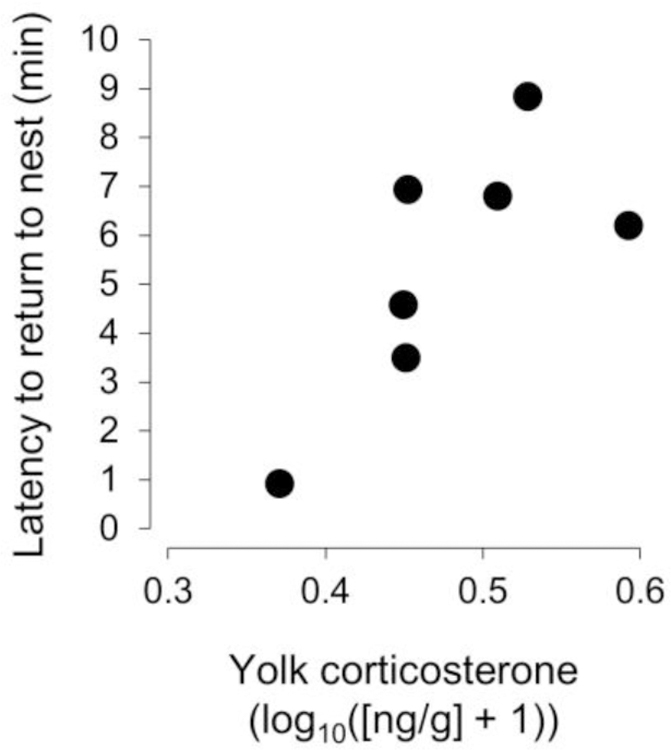
Corticosterone is the primary metabolic steroid in birds and is vital for maintaining homeostasis. However, the relationship between baseline corticosterone and reproduction is unclear, and we lack an understanding of how differences in baseline corticosterone at one stage of the breeding cycle influence reproductive effort at later stages. In a wild population of house wrens, we quantified the concentration of corticosterone in yolks of freshly laid eggs as an integrated measure of maternal physiology and related this to a behavioral measure of stress reactivity made during the nestling period, namely, the latency with which females resumed parental activities following a standardized disturbance at their nest (setting up a camera to record provisioning). Females that recently produced eggs containing higher corticosterone concentrations, which were significantly repeatable within females, took longer to resume activity related to parental care (i.e., feeding and brooding young) following the disturbance. Moreover, a female's latency to resume parental activities negatively predicted her provisioning of nestlings with food and the condition of these young at fledging but did not predict the number fledged. We cross-fostered offspring prior to hatching so these effects on maternal behavior are independent of any prenatal maternal effects on nestlings via the egg. These results are consistent with earlier findings, suggesting that females with higher baseline corticosterone during egg laying or early incubation tend to prioritize self-maintenance over reproduction compared with females with lower baseline corticosterone and suggest that a female's latency to return to her nest and resume parental care following a disturbance might represent a simple, functional measure of maternal stress reactivity.
皮质酮是鸟类主要的代谢类固醇,对维持体内平衡至关重要。然而,基础皮质酮与繁殖之间的关系尚不清楚,而且我们并不了解繁殖周期某一阶段基础皮质酮的差异如何影响后期的繁殖投入。在野生家鹪鹩种群中,我们对新产下的卵黄中皮质酮的浓度进行了量化,以此作为母体生理状态的综合指标,并将其与雏鸟期应激反应性的行为指标相关联,即雌性在巢穴受到标准化干扰(设置摄像机记录育雏行为)后恢复亲代活动的潜伏期。近期产下的卵中皮质酮浓度较高的雌性,其体内该浓度在个体间具有显著的重复性,在干扰后恢复与亲代抚育相关活动(即喂养和孵育雏鸟)所需的时间更长。此外,雌性恢复亲代活动的潜伏期对其给雏鸟提供食物的行为以及雏鸟离巢时的状况具有负面预测作用,但对雏鸟离巢数量没有预测作用。我们在孵化前对雏鸟进行了交叉寄养,因此这些对母体行为的影响独立于任何通过卵传递的产前母体对雏鸟的影响。这些结果与早期研究结果一致,表明与基础皮质酮水平较低的雌性相比,产卵期或早期孵化期基础皮质酮水平较高的雌性往往将自我维持置于繁殖之上,并且表明雌性在干扰后返回巢穴并恢复亲代抚育的潜伏期可能是母体应激反应性的一种简单而有效的指标。