Loiseau Oriane, Olivares Ingrid, Paris Margot, de La Harpe Marylaure, Weigand Anna, Koubínová Darina, Rolland Jonathan, Bacon Christine D, Balslev Henrik, Borchsenius Finn, Cano Angela, Couvreur Thomas L P, Delnatte César, Fardin Frédérique, Gayot Marc, Mejía Fabian, Mota-Machado Talita, Perret Mathieu, Roncal Julissa, Sanin Maria José, Stauffer Fred, Lexer Christian, Kessler Michael, Salamin Nicolas
Department of Computational Biology, University of Lausanne, Lausanne, Switzerland.
Department for Systematic and Evolutionary Botany, University of Zurich, Zurich, Switzerland.
Front Plant Sci. 2019 Jul 12;10:864. doi: 10.3389/fpls.2019.00864. eCollection 2019.
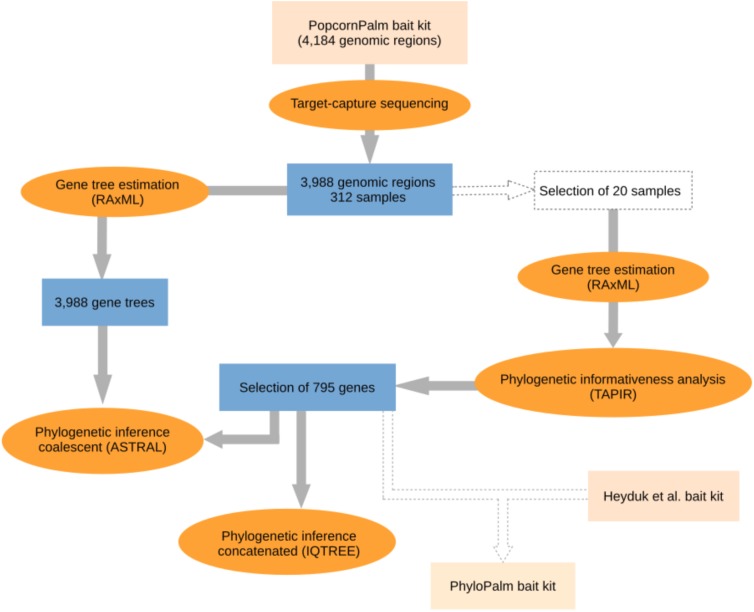
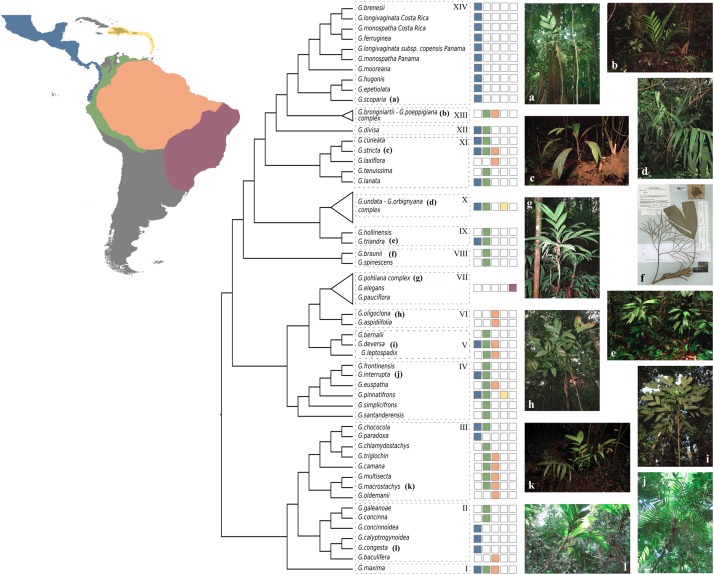
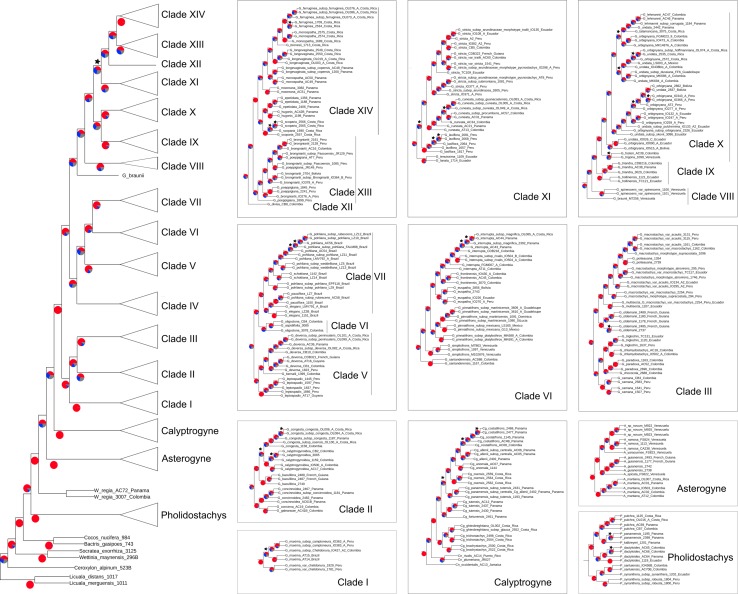
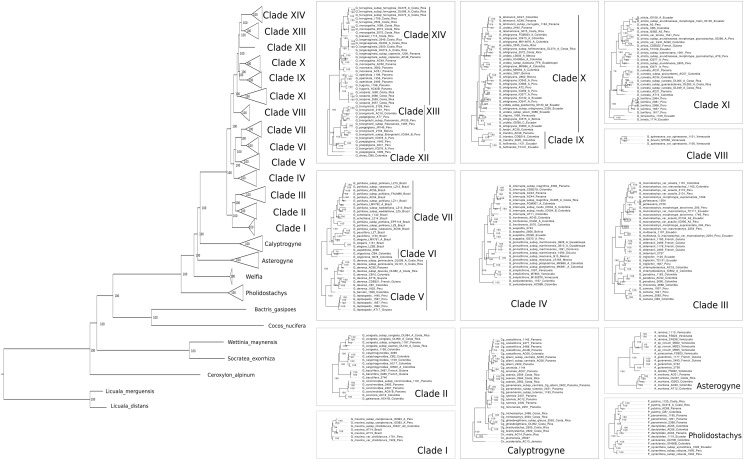
The tribe Geonomateae is a widely distributed group of 103 species of Neotropical palms which contains six ecologically important understory or subcanopy genera. Although it has been the focus of many studies, our understanding of the evolutionary history of this group, and in particular of the taxonomically complex genus , is far from complete due to a lack of molecular data. Specifically, the previous Sanger sequencing-based studies used a few informative characters and partial sampling. To overcome these limitations, we used a recently developed Arecaceae-specific target capture bait set to undertake a phylogenomic analysis of the tribe Geonomateae. We sequenced 3,988 genomic regions for 85% of the species of the tribe, including 84% of the species of the largest genus, . Phylogenetic relationships were inferred using both concatenation and coalescent methods. Overall, our phylogenetic tree is highly supported and congruent with taxonomic delimitations although several morphological taxa were revealed to be non-monophyletic. It is the first time that such a large genomic dataset is provided for an entire tribe within the Arecaceae. Our study lays the groundwork not only for detailed macro- and micro-evolutionary studies within the group, but also sets a workflow for understanding other species complexes across the tree of life.
Geonomateae族是一个广泛分布的新热带棕榈科植物类群,包含103个物种,其中有6个在生态方面具有重要意义的林下或亚冠层属。尽管它一直是许多研究的焦点,但由于缺乏分子数据,我们对该类群进化历史的理解,尤其是对分类复杂的属的理解还远未完整。具体而言,先前基于桑格测序的研究使用的信息特征较少且采样不完整。为克服这些限制,我们使用了最近开发的棕榈科特异性目标捕获诱饵组对Geonomateae族进行系统基因组分析。我们对该族85%的物种的3988个基因组区域进行了测序,其中包括最大属84%的物种。使用串联法和合并法推断系统发育关系。总体而言,我们的系统发育树得到了高度支持,并且与分类界定一致,尽管有几个形态分类群被发现是非单系的。这是首次为棕榈科内的整个族提供如此大的基因组数据集。我们的研究不仅为该类群内详细的宏观和微观进化研究奠定了基础,也为理解生命之树上的其他物种复合体设定了工作流程。