Hu Xinjie, Zheng Weisheng, Zhu Qianshu, Gu Liang, Du Yanhua, Han Zhe, Zhang Xiaobai, Carter Daniel R, Cheung Belamy B, Qiu Andong, Jiang Cizhong
Institute of Translational Research, Tongji Hospital, the School of Life Sciences and Technology, Shanghai Key Laboratory of Signaling and Disease Research, Tongji University, Shanghai, China.
Children's Cancer Institute Australia, Lowy Cancer Research Centre, UNSW Sydney, Kensington, NSW, Australia.
Front Genet. 2019 Jul 24;10:684. doi: 10.3389/fgene.2019.00684. eCollection 2019.
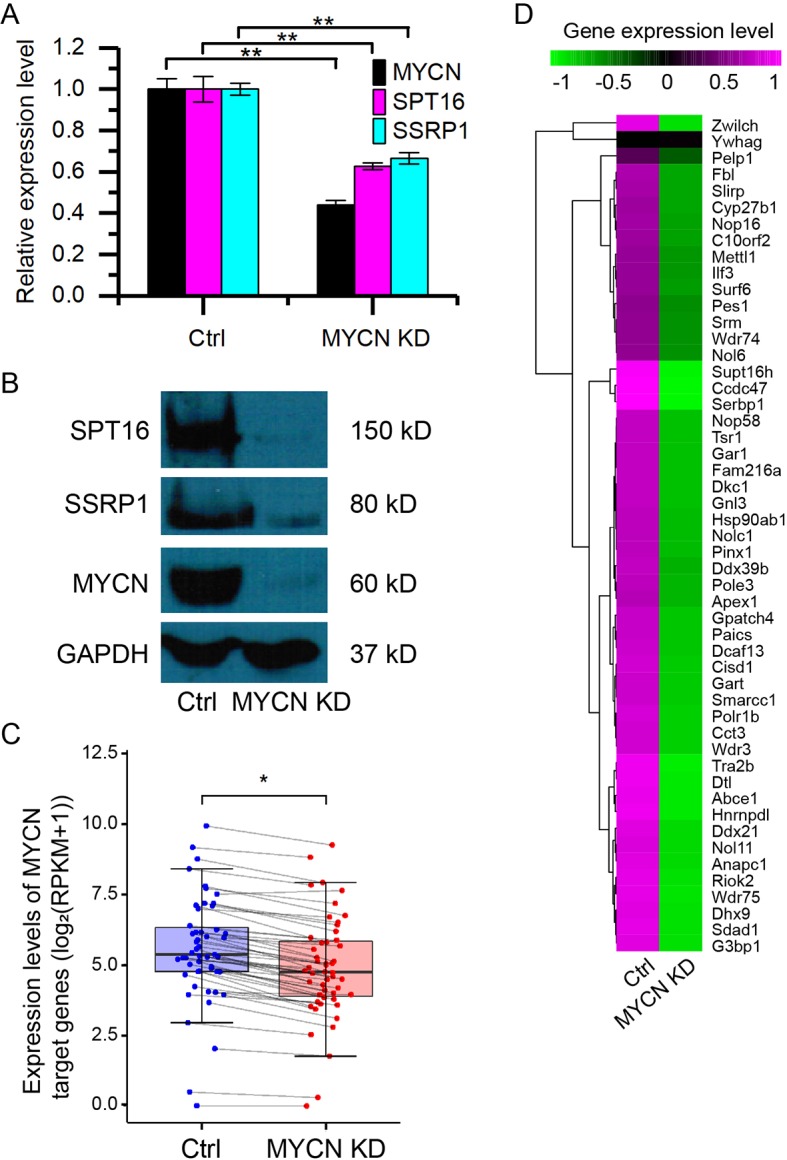
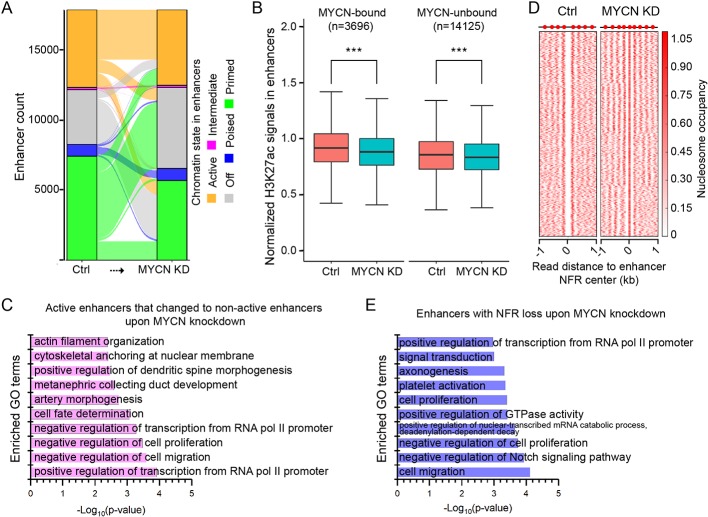
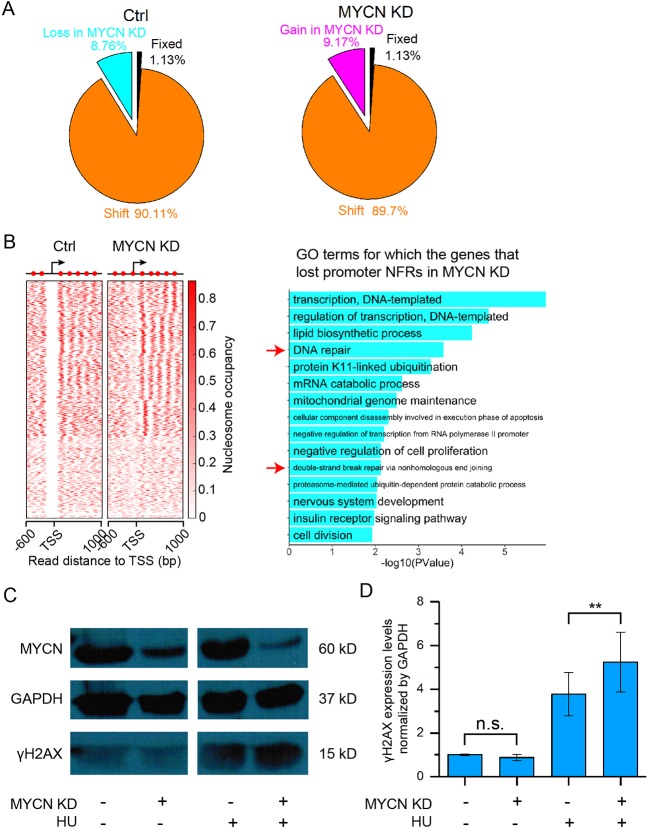
As a transcription factor, MYCN regulates myriad target genes including the histone chaperone FACT. Moreover, FACT and MYCN expression form a forward feedback loop in neuroblastoma. It is unclear whether MYCN is involved in chromatin remodeling in neuroblastoma through regulation of its target genes. We showed here that MYCN knockdown resulted in loss of the nucleosome-free regions through nucleosome assembly in the promoters of genes functionally enriched for DNA repair. The active mark H3K9ac was removed or replaced by the repressive mark H3K27me3 in the promoters of double-strand break repair-related genes upon MYCN knockdown. Such chromatin state alterations occurred only in MYCN-bound promoters. Consistently, MYCN knockdown resulted in a marked increase in DNA damage in the treatment with hydroxyurea. In contrast, nucleosome reorganization and histone modification changes in the enhancers largely included target genes with tumorigenesis-related functions such as cell proliferation, cell migration, and cell-cell adhesion. The chromatin state significantly changed in both MYCN-bound and MYCN-unbound enhancers upon MYCN knockdown. Furthermore, MYCN knockdown independently regulated chromatin remodeling in the promoters and the enhancers. These findings reveal the novel epigenetic regulatory role of MYCN in chromatin remodeling and provide an alternative potential epigenetic strategy for MYCN-driven neuroblastoma treatment.
作为一种转录因子,MYCN可调控包括组蛋白伴侣FACT在内的众多靶基因。此外,FACT和MYCN的表达在神经母细胞瘤中形成正向反馈环。尚不清楚MYCN是否通过调控其靶基因参与神经母细胞瘤中的染色质重塑。我们在此表明,MYCN敲低通过在功能上富集于DNA修复的基因启动子中进行核小体组装导致无核小体区域的丧失。在MYCN敲低后,双链断裂修复相关基因启动子中的活性标记H3K9ac被去除或被抑制性标记H3K27me3取代。这种染色质状态改变仅发生在MYCN结合的启动子中。一致地,MYCN敲低导致在用羟基脲处理时DNA损伤显著增加。相反,增强子中的核小体重组和组蛋白修饰变化主要包括具有细胞增殖、细胞迁移和细胞间粘附等肿瘤发生相关功能的靶基因。在MYCN敲低后,MYCN结合和未结合的增强子中的染色质状态均发生显著变化。此外,MYCN敲低独立调控启动子和增强子中的染色质重塑。这些发现揭示了MYCN在染色质重塑中的新型表观遗传调控作用,并为MYCN驱动的神经母细胞瘤治疗提供了一种潜在的表观遗传替代策略。