1Mouse Genomics Resource Laboratory, National Institute of Genetics, 1111 Yata, Mishima, Shizuoka 411-8540 Japan.
Present Address: Laboratory for Mouse Genetic Engineering, RIKEN Center for Biosystems Dynamics Research, 1-3 Yamadaoka, Suita, Osaka 565-0871 Japan.
Commun Biol. 2019 Aug 2;2:283. doi: 10.1038/s42003-019-0539-7. eCollection 2019.
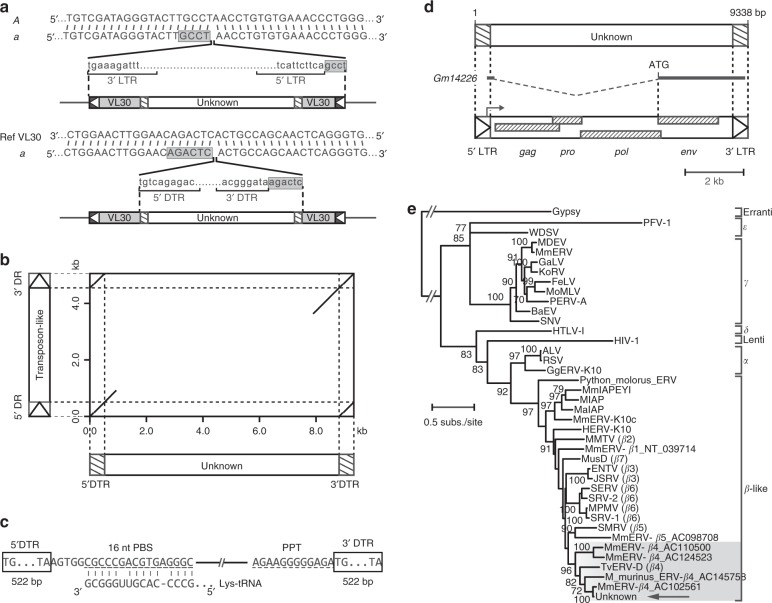
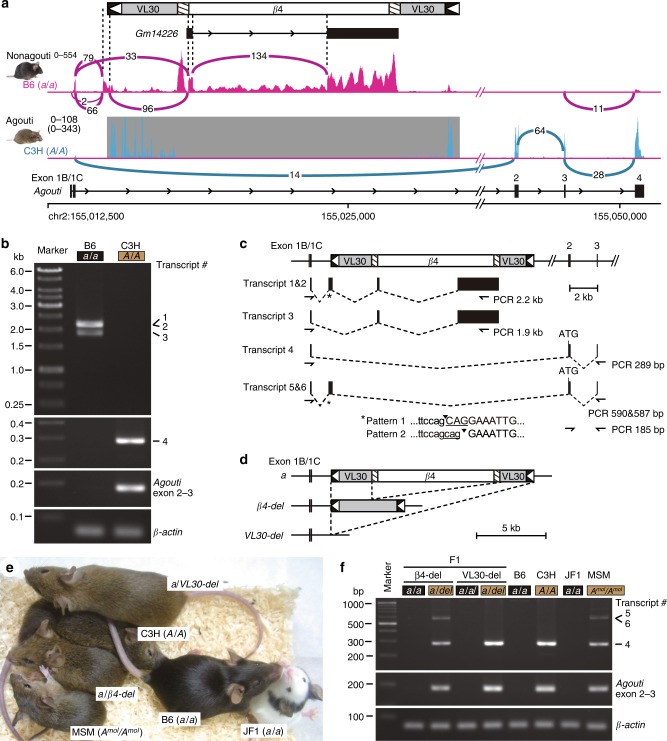
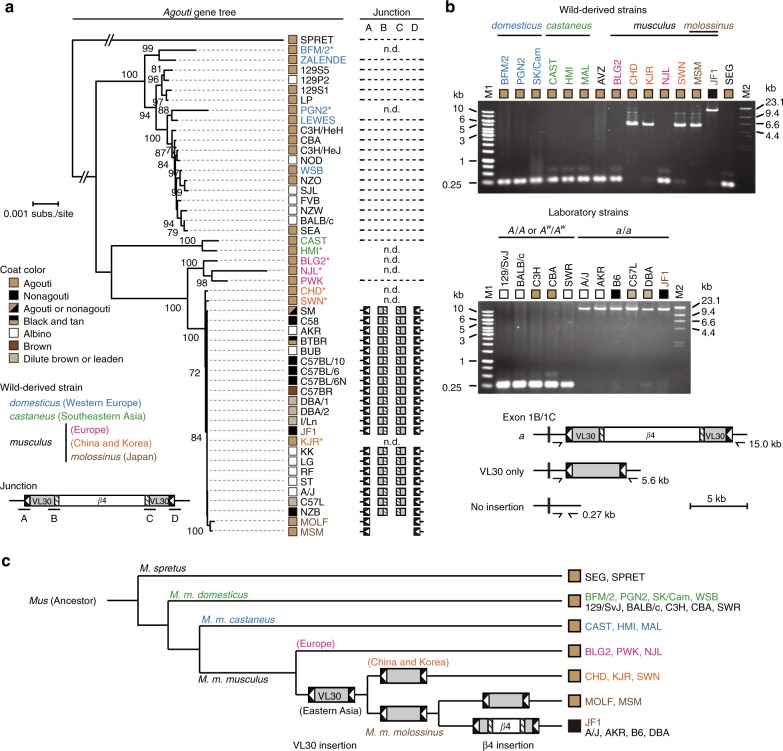
Black coat color (nonagouti) is a widespread classical mutation in laboratory mouse strains. The intronic insertion of endogenous retrovirus VL30 in the () allele of gene was previously reported as the cause of the nonagouti phenotype. Here, we report agouti mouse strains from East Asia that carry the VL30 insertion, indicating that VL30 alone does not cause the nonagouti phenotype. We find that a rare type of endogenous retrovirus, β4, was integrated into the VL30 region at the allele through nested retrotransposition, causing abnormal splicing. Targeted complete deletion of the β4 element restores gene expression and agouti coat color, whereas deletion of β4 except for a single long terminal repeat results in black-and-tan coat color. Phylogenetic analyses show that the allele and the β4 retrovirus originated from an East Asian mouse lineage most likely related to Japanese fancy mice. These findings reveal the causal mechanism and historic origin of the classical mutation.
黑色被毛(非鼠灰色)是实验室小鼠品系中广泛存在的经典突变。先前的研究表明,内源性逆转录病毒 VL30 在内源性基因()等位基因的内含子插入是导致非鼠灰色表型的原因。在这里,我们报告了来自东亚的携带 VL30 插入的鼠灰色品系,这表明 VL30 单独不会引起非鼠灰色表型。我们发现一种罕见的内源性逆转录病毒β4 通过嵌套逆转录整合到等位基因的 VL30 区域,导致异常剪接。靶向完全缺失β4 元件可恢复基因表达和鼠灰色被毛,而缺失β4 除了单个长末端重复序列则导致黑褐色被毛。系统发育分析表明,等位基因和β4 逆转录病毒起源于东亚鼠种系,最有可能与日本观赏鼠有关。这些发现揭示了经典突变的因果机制和历史起源。