Division of Biokinesiology and Physical Therapy, University of Southern California, Los Angeles, CA, USA.
Massachusetts General Hospital Institute of Health Professions, Boston, MA, USA.
Sci Rep. 2019 Aug 9;9(1):11574. doi: 10.1038/s41598-019-47959-y.
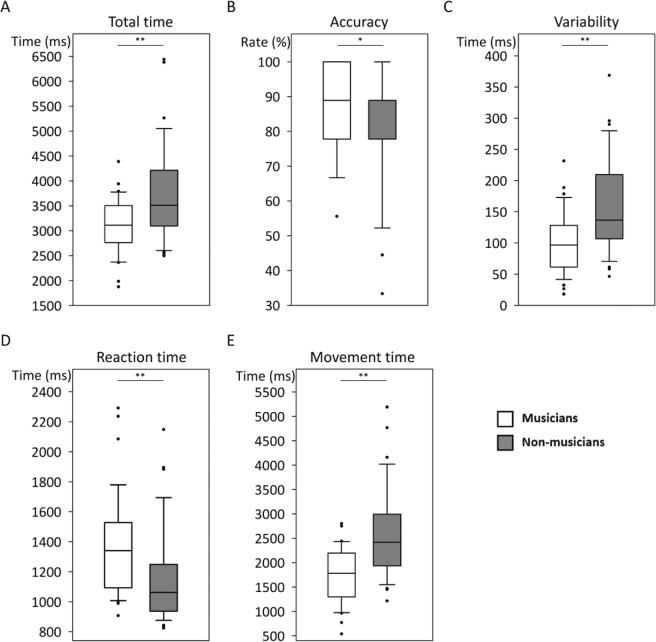
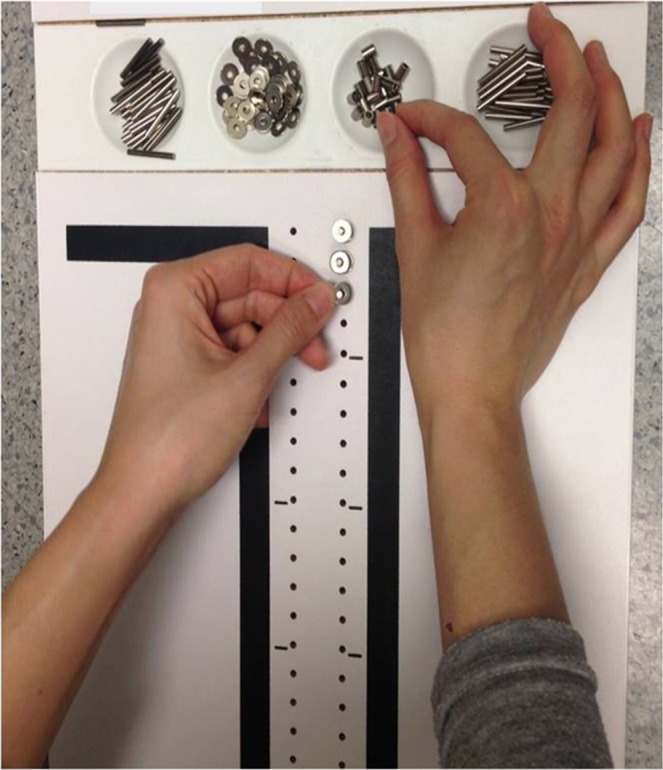
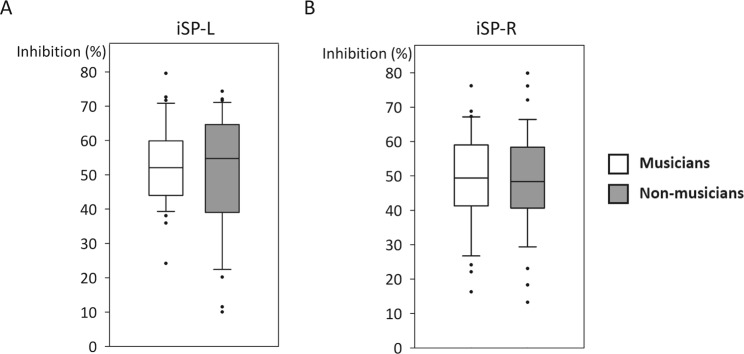
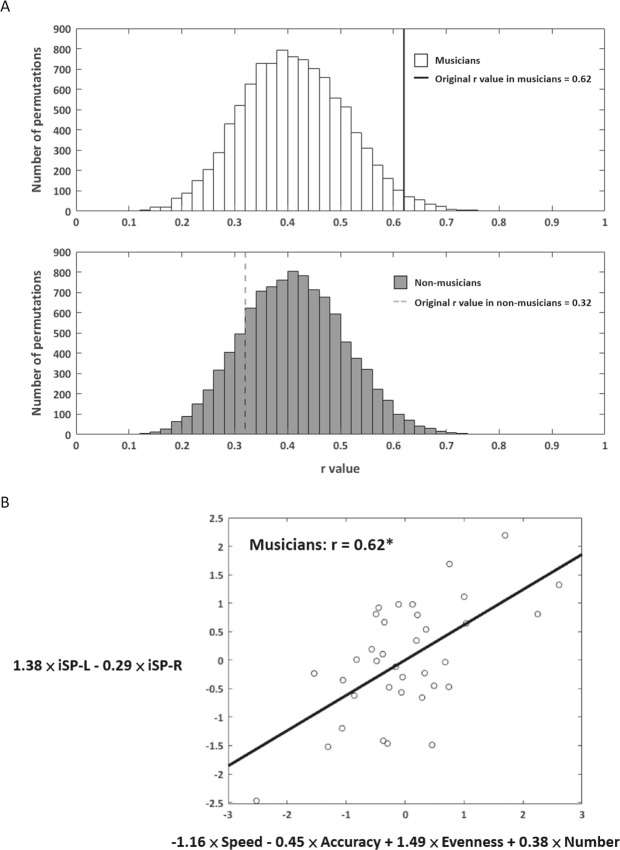
Interhemispheric inhibition (IHI) is essential for dexterous motor control. Small previous studies have shown differences in IHI in musicians compared to non-musicians, but it is not clear whether these differences are robustly linked to musical performance. In the largest study to date, we examined IHI and comprehensive measures of dexterous bimanual performance in 72 individuals (36 musicians and 36 non-musicians). Dexterous bimanual performance was quantified by speed, accuracy, and evenness derived from a series of hand tasks. As expected, musicians significantly outperformed non-musicians. Surprisingly, these performance differences could not be simply explained by IHI, as IHI did not significantly differ between musicians and non-musicians. However, canonical correlation analysis revealed a significant relationship between combinations of IHI and performance variables in the musician group. Specifically, we identified that IHI may contribute to the maintenance of evenness regardless of speed, a feature of musical performance that may be driven by practice with a metronome. Therefore, while IHI changes by themselves may not be sufficient to explain superior hand dexterity exhibited by musicians, IHI may be a potential neural correlate for specific features of musical performance.
半球间抑制(IHI)对于灵巧的运动控制至关重要。之前的一些小型研究表明,音乐家与非音乐家之间的 IHI 存在差异,但尚不清楚这些差异是否与音乐表现有明显联系。在迄今为止最大的研究中,我们在 72 名个体(36 名音乐家和 36 名非音乐家)中检查了 IHI 以及灵巧双手表现的综合衡量标准。灵巧双手表现通过一系列手部任务得出的速度、准确性和均匀性来量化。正如预期的那样,音乐家的表现明显优于非音乐家。令人惊讶的是,这些表现差异不能简单地用 IHI 来解释,因为音乐家和非音乐家之间的 IHI 没有显著差异。然而,典型相关分析揭示了音乐家组中 IHI 与表现变量组合之间的显著关系。具体而言,我们确定 IHI 可能有助于维持均匀性,而与速度无关,这是音乐表现的一个特征,可能是由节拍器的练习驱动的。因此,尽管 IHI 的自身变化可能不足以解释音乐家表现出的卓越手部灵巧性,但 IHI 可能是音乐表现特定特征的潜在神经关联。