School of Life Sciences, Arizona State University, Tempe, AZ, USA.
School of Life Sciences, École Polytechnique Fédérale de Lausanne, Lausanne, Switzerland.
Heredity (Edinb). 2020 Jan;124(1):1-14. doi: 10.1038/s41437-019-0257-4. Epub 2019 Aug 9.
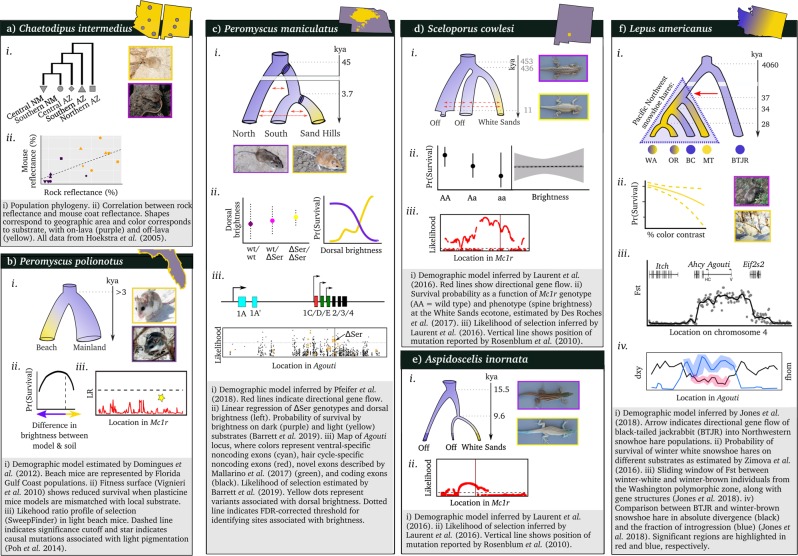
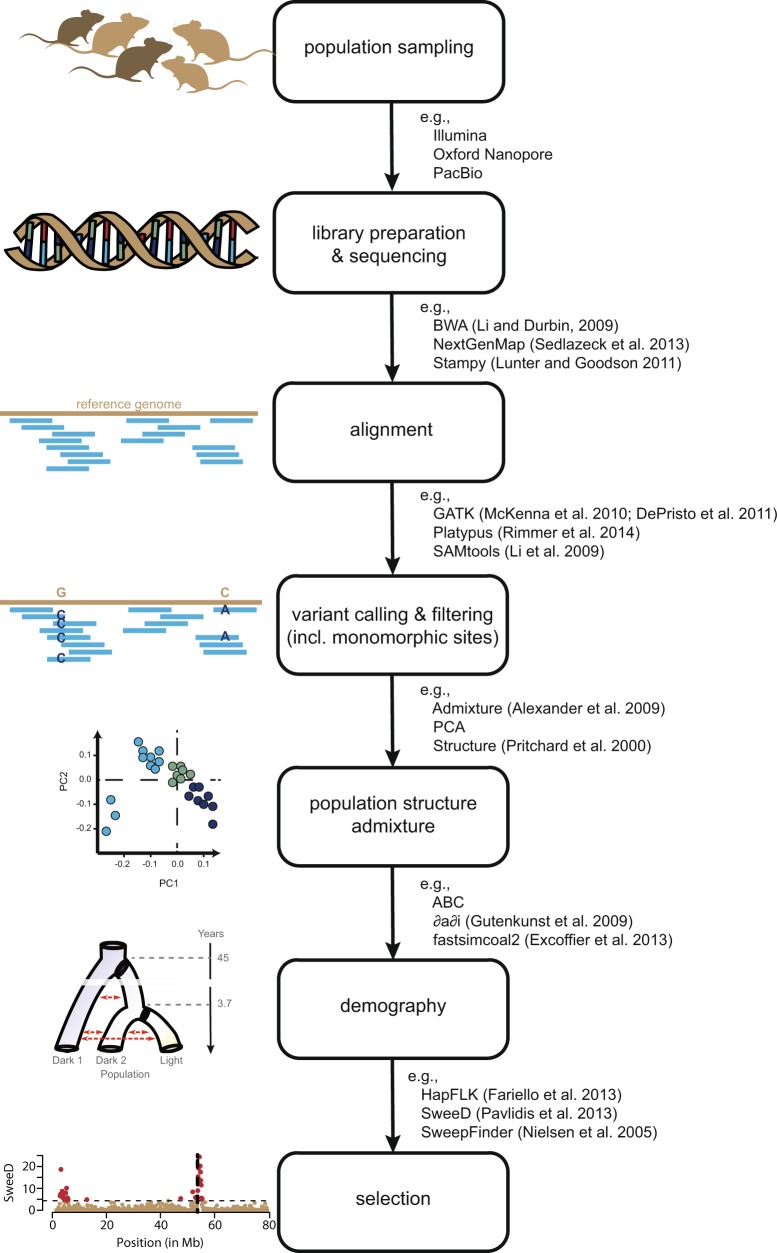
By combining well-established population genetic theory with high-throughput sequencing data from natural populations, major strides have recently been made in understanding how, why, and when vertebrate populations evolve crypsis. Here, we focus on background matching, a particular facet of crypsis that involves the ability of an organism to conceal itself through matching its color to the surrounding environment. While interesting in and of itself, the study of this phenotype has also provided fruitful population genetic insights into the interplay of strong positive selection with other evolutionary processes. Specifically, and predicated upon the findings of previous candidate gene association studies, a primary focus of this recent literature involves the realization that the inference of selection from DNA sequence data first requires a robust model of population demography in order to identify genomic regions which do not conform to neutral expectations. Moreover, these demographic estimates provide crucial information about the origin and timing of the onset of selective pressures associated with, for example, the colonization of a novel environment. Furthermore, such inference has revealed crypsis to be a particularly useful phenotype for investigating the interplay of migration and selection-with examples of gene flow constraining rates of adaptation, or alternatively providing the genetic variants that may ultimately sweep through the population. Here, we evaluate the underlying evidence, review the strengths and weaknesses of the many population genetic methodologies used in these studies, and discuss how these insights have aided our general understanding of the evolutionary process.
通过将成熟的群体遗传学理论与自然种群的高通量测序数据相结合,人们最近在理解脊椎动物群体如何、为何以及何时进化出拟态方面取得了重大进展。在这里,我们专注于背景匹配,这是拟态的一个特定方面,涉及生物体通过将自身颜色与周围环境相匹配来隐藏自身的能力。虽然这种表型本身很有趣,但对这种表型的研究也为强正选择与其他进化过程相互作用提供了富有成效的群体遗传学见解。具体来说,并且基于先前候选基因关联研究的发现,这一近期文献的主要重点是认识到,从 DNA 序列数据推断选择首先需要一个稳健的群体人口统计学模型,以便识别不符合中性预期的基因组区域。此外,这些人口统计学估计提供了有关与例如新环境殖民化相关的选择压力起源和时间的关键信息。此外,这种推断表明,拟态是一个特别有用的表型,可以研究迁移和选择的相互作用——例如,基因流动限制了适应的速度,或者提供了最终可能席卷整个种群的遗传变异。在这里,我们评估了潜在的证据,回顾了这些研究中使用的许多群体遗传学方法的优缺点,并讨论了这些见解如何帮助我们更好地理解进化过程。