Crespi Bernard, Dinsdale Natalie
Department of Biological Sciences, Simon Fraser University, 8888 University Drive, Burnaby, BC, Canada.
Department of Psychology, University of Saskatchewan, Saskatoon, SK, Canada.
Evol Med Public Health. 2019 Jul 15;2019(1):121-138. doi: 10.1093/emph/eoz021. eCollection 2019.
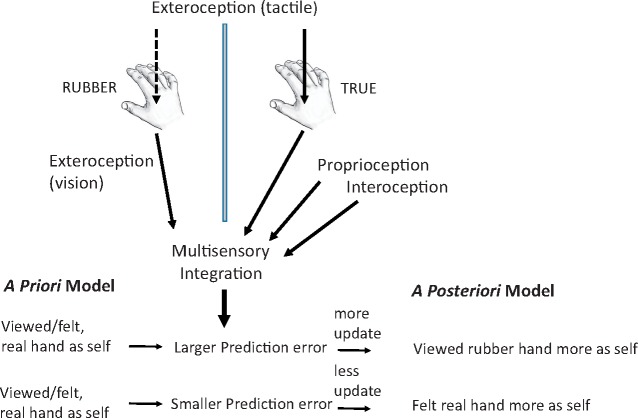
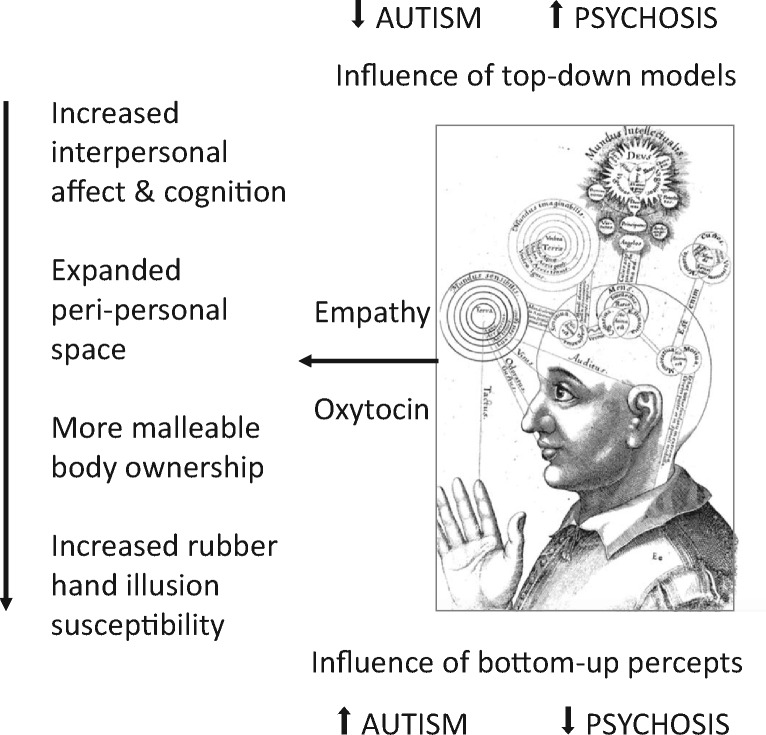
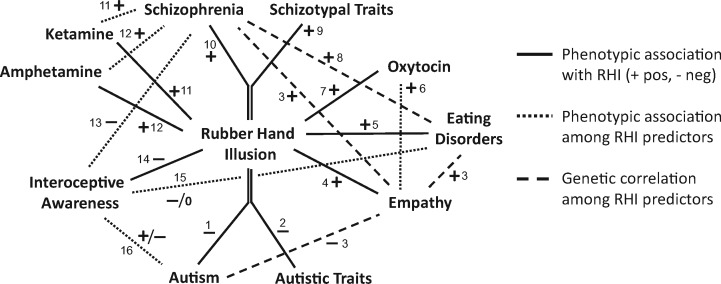
Humans have evolved an elaborate system of self-consciousness, self-identity, self-agency, and self-embodiment that is grounded in specific neurological structures including an expanded insula. Instantiation of the bodily self has been most-extensively studied via the 'rubber hand illusion', whereby parallel stimulation of a hidden true hand, and a viewed false hand, leads to the felt belief that the false hand is one's own. Autism and schizophrenia have both long been regarded as conditions centrally involving altered development of the self, but they have yet to be compared directly with regard to the self and embodiment. Here, we synthesize the embodied cognition literature for these and related conditions, and describe evidence that these two sets of disorders exhibit opposite susceptibilities from typical individuals to the rubber hand illusion: reduced on the autism spectrum and increased in schizophrenia and other psychotic-affective conditions. Moreover, the opposite illusion effects are mediated by a consilient set of associated phenomena, including empathy, interoception, anorexia risk and phenotypes, and patterns of genetic correlation. Taken together, these findings: (i) support the diametric model of autism and psychotic-affective disorders, (ii) implicate the adaptive human system of self-embodiment, and its neural bases, in neurodevelopmental disorders, and suggest new therapies and (iii) experimentally ground Bayesian predictive coding models with regard to autism compared with psychosis. Lay summary: Humans have evolved a highly developed sense of self and perception of one's own body. The 'rubber hand illusion' can be used to test individual variation in sense of self, relative to connection with others. We show that this illusion is reduced in autism spectrum disorders, and increased in psychotic and mood disorders. These findings have important implications for understanding and treatment of mental disorders.
人类已经进化出一套复杂的自我意识、自我认同、自我能动性和自我体现系统,该系统基于包括扩大的脑岛在内的特定神经结构。身体自我的实例化主要通过“橡皮手错觉”进行了广泛研究,即对隐藏的真实手和看到的假手进行平行刺激,会导致一种感觉上的信念,即假手是自己的。长期以来,自闭症和精神分裂症都被视为主要涉及自我发展改变的病症,但它们在自我和体现方面尚未直接进行比较。在这里,我们综合了这些病症及相关病症的具身认知文献,并描述了证据表明这两组病症与典型个体相比,对橡皮手错觉表现出相反的易感性:自闭症谱系中降低,而精神分裂症和其他精神病性情感病症中增加。此外,相反的错觉效应由一系列相关现象介导,包括同理心、内感受、厌食风险和表型以及遗传相关模式。综上所述,这些发现:(i)支持自闭症和精神病性情感障碍的 diametric 模型,(ii)表明适应性的人类自我体现系统及其神经基础与神经发育障碍有关,并提出了新的疗法,(iii)在与精神病相比的自闭症方面,通过实验为贝叶斯预测编码模型奠定了基础。通俗总结:人类已经进化出高度发达的自我意识和对自己身体的感知。“橡皮手错觉”可用于测试自我意识相对于与他人联系的个体差异。我们表明,这种错觉在自闭症谱系障碍中降低,而在精神病性和情绪障碍中增加。这些发现对精神障碍的理解和治疗具有重要意义。