Carlà Tommaso, Macciotta Renato, Hendry Michael, Martin Derek, Edwards Tom, Evans Trevor, Farina Paolo, Intrieri Emanuele, Casagli Nicola
1Regional Doctoral School of Earth Sciences, University of Firenze, Via La Pira 4, 50121 Florence, Italy.
2Department of Earth Sciences, University of Firenze, Via La Pira 4, 50121 Florence, Italy.
Landslides. 2018;15(3):489-505. doi: 10.1007/s10346-017-0887-7. Epub 2017 Sep 5.
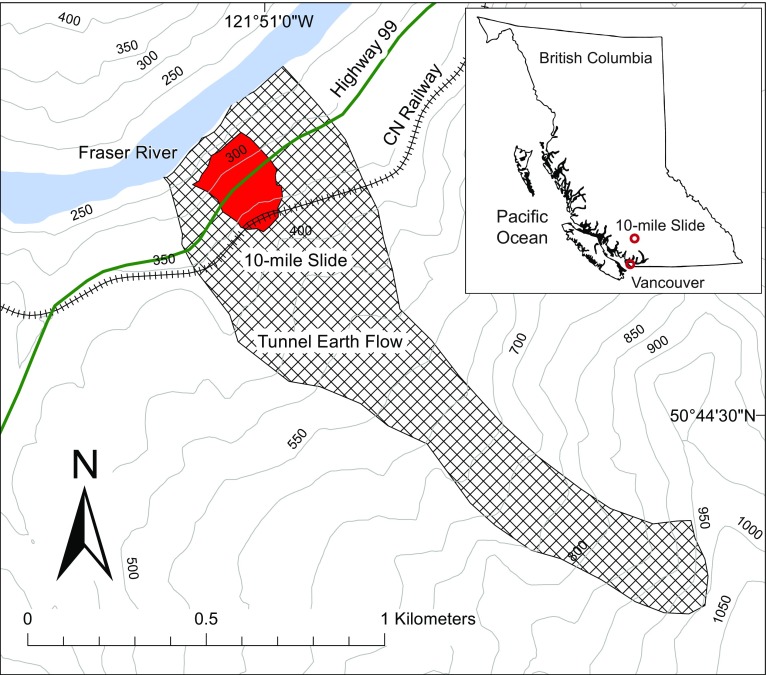
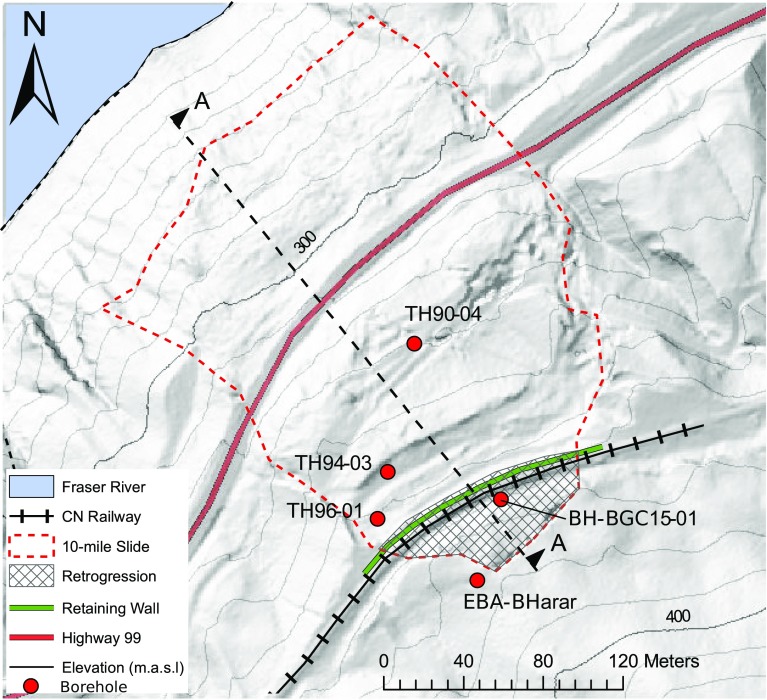
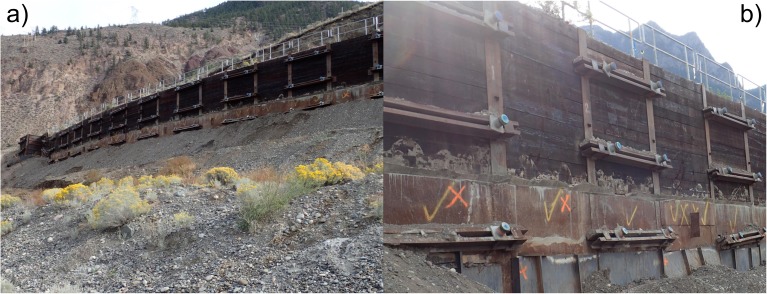
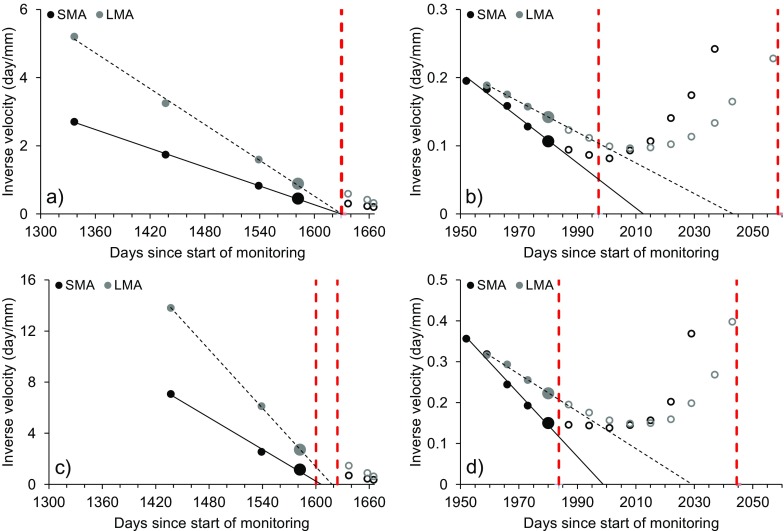
The 10-mile Slide is contained within an ancient earthflow located in British Columbia, Canada. The landslide has been moving slowly for over 40 years, requiring regular maintenance work along where a highway and a railway track cross the sliding mass. Since 2013, the landslide has shown signs of retrogression. Monitoring prisms were installed on a retaining wall immediately downslope from the railway alignment to monitor the evolution of the retrogression. As of September 2016, cumulative displacements in the horizontal direction approached 4.5 m in the central section of the railway retaining wall. After an initial phase of acceleration, horizontal velocities showed a steadier trend between 3 and 9 mm/day, which was then followed by a second acceleration phase. This paper presents an analysis of the characteristics of the surface displacement vectors measured at the monitoring prisms. Critical insight on the behavior and kinematics of the 10-mile Slide retrogression was gained. An advanced analysis of the trends of inverse velocity plots was also performed to assess the potential for a slope collapse at the 10-mile Slide and to obtain further knowledge on the nature of the sliding surface.
“10英里滑坡”位于加拿大不列颠哥伦比亚省一处古老的泥石流区域内。该滑坡已经缓慢移动了40多年,因此需要定期对横穿滑坡体的公路和铁轨进行维护作业。自2013年以来,滑坡出现了后退迹象。在铁路线路正下方的挡土墙处安装了监测棱镜,以监测滑坡后退的演变情况。截至2016年9月,铁路挡土墙中部的水平累积位移接近4.5米。在经历了最初的加速阶段后,水平速度呈现出3至9毫米/天的较为稳定的趋势,随后进入了第二个加速阶段。本文对监测棱镜处测量的地表位移矢量特征进行了分析。对“10英里滑坡”后退的行为和运动学有了关键的认识。还对反向速度图的趋势进行了深入分析,以评估“10英里滑坡”发生边坡坍塌的可能性,并进一步了解滑动面的性质。