Murata Kosuke, Uchida Kentaro, Takano Shotaro, Shoji Shintaro, Iwase Dai, Inoue Gen, Aikawa Jun, Yokozeki Yuji, Sekiguchi Hiroyuki, Takaso Masashi
Department of Orthopedic Surgery, Kitasato University School of Medicine, Sagamihara City, Kanagawa 252-0374, Japan.
Shonan University of Medical Sciences Research Institute, Chigasaki City, Kanagawa 253-0083, Japan.
Diabetes Metab Syndr Obes. 2019 Jul 16;12:1151-1159. doi: 10.2147/DMSO.S209677. eCollection 2019.
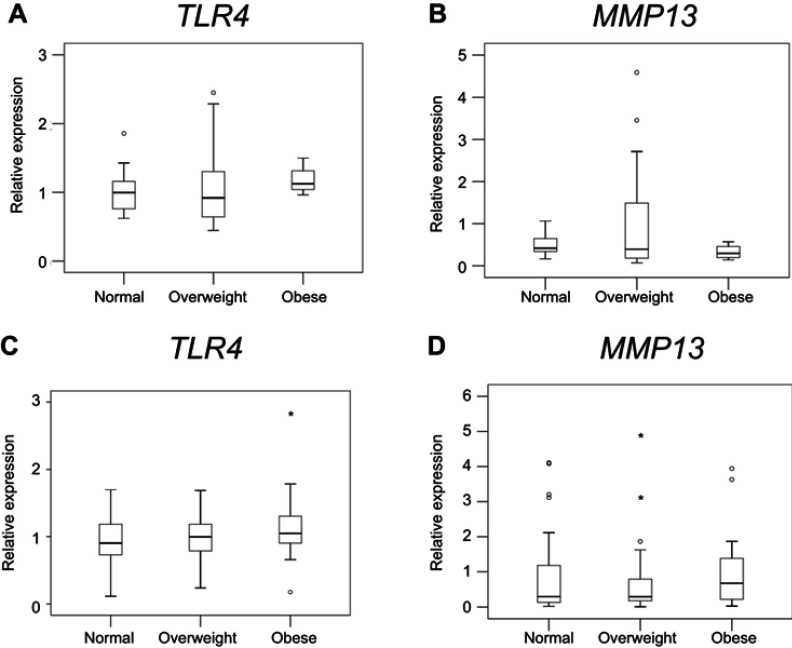
While research has identified diabetes mellitus (DM) as a risk factor for knee osteoarthritis (KOA), the underlying mechanisms are not fully understood. Studies suggest that Toll-like receptor 4 (TLR4) expression is elevated in osteoarthritic lesions of OA patients and in target tissues of insulin resistance such as adipose tissue and skeletal muscle in patients with DM. TLR4 is associated with inflammation and catabolic response via regulation of matrix metalloproteases (MMPs). We hypothesized that and expression may be increased in the synovial tissue (SYN) of KOA patients with diabetic pathology. We therefore investigated and expression in the SYN of KOA patients with and without high haemoglobin A1c concentrations.
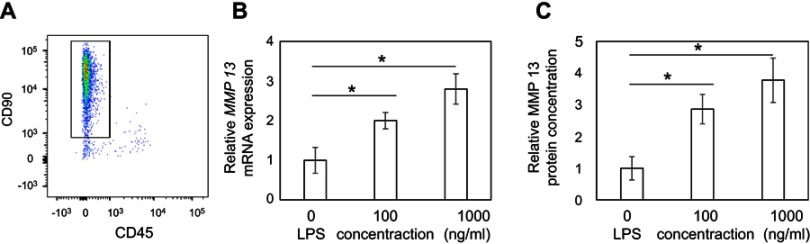
A total of 171 patients radiographically diagnosed with KOA were grouped based on their HbA1c concentration (HbA1c ≥6.5 and HbA1c <6.5). We used real-time polymerase chain reaction to compare the expression of TLRs () and MMPs ( and ) in patients' SYN between the two groups. MMP13 regulation by the TLR4 ligand, lipopolysaccharide (LPS), in SYN cells was examined in culture by stimulating SYN cells with LPS or vehicle (culture medium) for 24 h.
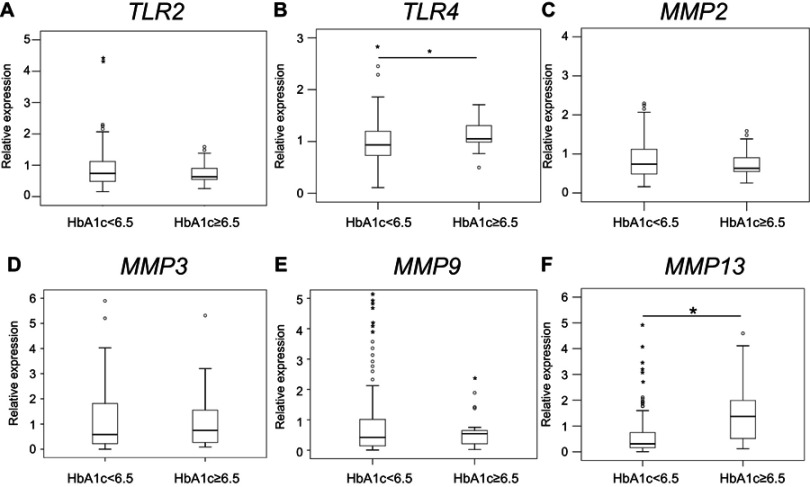
The expression of and in the HbA1c ≥6.5 group was significantly elevated compared to that in the HbA1c <6.5 group. In contrast, and expression levels were similar between the groups. mRNA and MMP13 protein levels in SYN cells were significantly higher following stimulation with LPS compared to vehicle.
and expression were elevated in the synovium of osteoarthritis patients with high HbA1c concentrations. Our results may provide insight into the pathology of OA patients with DM.
虽然研究已将糖尿病(DM)确定为膝关节骨关节炎(KOA)的一个危险因素,但其潜在机制尚未完全明确。研究表明,Toll样受体4(TLR4)在骨关节炎患者的骨关节炎病变以及糖尿病患者胰岛素抵抗的靶组织(如脂肪组织和骨骼肌)中表达升高。TLR4通过调节基质金属蛋白酶(MMPs)与炎症和分解代谢反应相关。我们假设,在有糖尿病病理特征的KOA患者的滑膜组织(SYN)中,[此处原文缺失两个基因名称]和[此处原文缺失两个基因名称]的表达可能会增加。因此,我们研究了糖化血红蛋白A1c浓度高和不高的KOA患者滑膜组织中[此处原文缺失两个基因名称]和[此处原文缺失两个基因名称]的表达情况。
总共171例经影像学诊断为KOA的患者根据糖化血红蛋白A1c浓度(糖化血红蛋白A1c≥6.5和糖化血红蛋白A1c<6.5)进行分组。我们使用实时聚合酶链反应比较两组患者滑膜组织中Toll样受体([此处原文缺失两个基因名称])和基质金属蛋白酶([此处原文缺失两个基因名称]和[此处原文缺失两个基因名称])的表达。通过用脂多糖(LPS)或溶剂(培养基)刺激滑膜细胞24小时,在培养中检测LPS对滑膜细胞中基质金属蛋白酶13(MMP13)的调节作用。
与糖化血红蛋白A1c<6.5组相比,糖化血红蛋白A1c≥6.5组中[此处原文缺失两个基因名称]和[此处原文缺失两个基因名称]的表达显著升高。相比之下,两组之间[此处原文缺失两个基因名称]和[此处原文缺失两个基因名称]的表达水平相似。与溶剂相比,用LPS刺激后滑膜细胞中的[此处原文缺失两个基因名称]信使核糖核酸和MMP13蛋白水平显著更高。
糖化血红蛋白A1c浓度高的骨关节炎患者滑膜中[此处原文缺失两个基因名称]和[此处原文缺失两个基因名称]的表达升高。我们的结果可能为了解糖尿病KOA患者的病理情况提供见解。