Department of Medicine, University of Minnesota, Minneapolis, MN, USA; Department of Gastroenterology and Hepatology, Erasmus MC, University Medical Center, Rotterdam, The Netherlands.
Department of Gastroenterology and Hepatology, Erasmus MC, University Medical Center, Rotterdam, The Netherlands.
Int J Infect Dis. 2019 Oct;87:39-42. doi: 10.1016/j.ijid.2019.08.006. Epub 2019 Aug 10.
We report the immune response during a case of acute HEV response in a patient with an acute hepatitis E virus (HEV) genotype 3 infection in the Netherlands.
Cytokine evaluation was performed via multiplex cytokine array for 65 immune markers in plasma during the different phases of hepatitis.
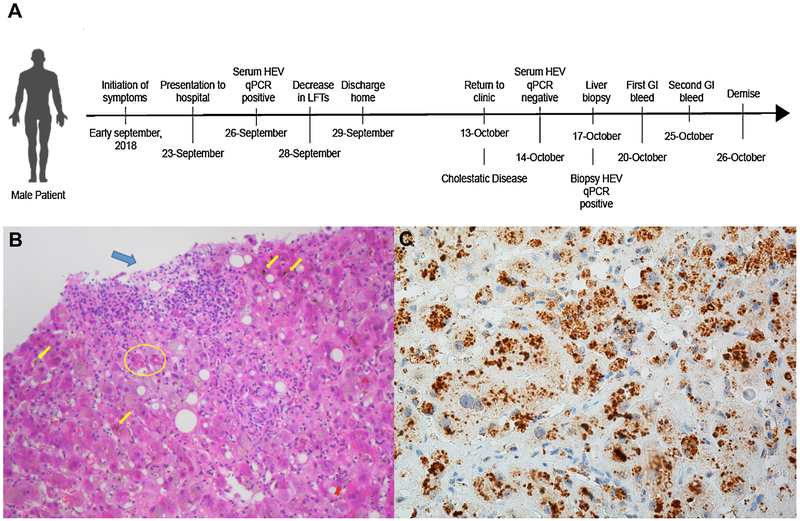
The patient initially presented with features typical of acute viral hepatitis, with detectable HEV RNA in blood. This evolved into a cholestatic disease following peripheral clearance of the virus, leading to the demise of the patient. Real time PCR revealed the presence of HEV in liver tissue, suggestive of active intrahepatic infection despite clearance in blood. During the phase of detectable HEV RNA in serum, there was a surge in T-cell-related immune mediators, as well as interferon alpha and interferon gamma-induced protein 10 (IP-10), characteristic of a viral infection. After clearance of the virus in the blood and development of cholestatic hepatitis, several inflammatory markers subsided, followed by an increase in immune factors related to anti-inflammatory activity, as well as monocyte/macrophage-related markers, likely due to the intrahepatic presence of the virus.
This report describes the dissociation of intra- and extra-hepatic immune responses during acute HEV infection. As shedding of the virus became solely intrahepatic, an immune profile reflective of the activity of hepatic resident cells was observed.
我们报告了在荷兰一名急性戊型肝炎病毒(HEV)基因型 3 感染患者的急性 HEV 反应期间的免疫反应。
通过多指标细胞因子阵列对肝炎不同阶段的 65 种血浆免疫标志物进行细胞因子评估。
患者最初表现为急性病毒性肝炎的特征,血液中可检测到 HEV RNA。病毒在外周清除后,疾病进展为胆汁淤积性,导致患者死亡。实时 PCR 显示肝组织中存在 HEV,尽管血液中清除,但提示存在活跃的肝内感染。在血清中可检测到 HEV RNA 的阶段,T 细胞相关免疫介质以及干扰素 alpha 和干扰素 gamma 诱导蛋白 10(IP-10)大量增加,这是病毒感染的特征。血液中病毒清除并发生胆汁淤积性肝炎后,几种炎症标志物下降,随后与抗炎活性相关的免疫因子以及单核细胞/巨噬细胞相关标志物增加,可能是由于肝内存在病毒。
本报告描述了急性 HEV 感染期间肝内和肝外免疫反应的分离。随着病毒的脱落仅发生在肝内,观察到反映肝固有细胞活性的免疫谱。