Department of Immunology and Rheumatology, Division of Advanced Preventive Medical Sciences, Nagasaki University Graduate School of Biomedical Sciences, 1-7-1 Sakamoto, Nagasaki, 852-8501, Japan.
Nagasaki University Hospital, Clinical Research Center, 1-7-1 Sakamoto, Nagasaki, 852-8501, Japan.
Trials. 2019 Aug 13;20(1):494. doi: 10.1186/s13063-019-3589-8.
Rheumatoid arthritis (RA) is a chronic inflammatory disease of the joints, causes joint destruction, and leads to physical disability. Advances in the treatment of RA, such as biologic disease-modifying anti-rheumatic drugs (DMARDs), have provided better clinical outcomes, including the achievement of remission for patients with RA, but some patients cannot receive these treatments because of their side effects and high cost, and not all patients achieve remission. Although the efficacy of denosumab, which is a human IgG2 monoclonal antibody with a high affinity for the receptor activator of nuclear factor kappa B (RANK) ligand (RANKL), in the treatment of RA has been reported in clinical trials, the efficacy of denosumab in both preventing joint destruction and improving disease activity has not been evaluated in a real-world setting.
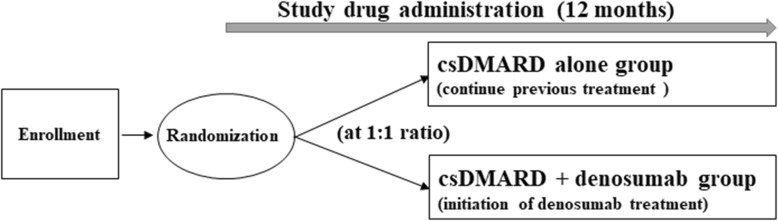
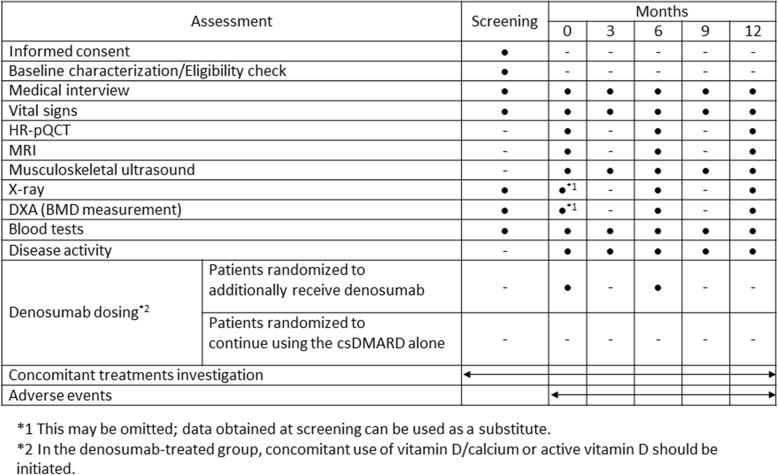
METHODS/DESIGN: This open-label, randomized, parallel-group study will compare the continued use of conventional synthetic DMARDs (csDMARDs) alone with the combined use of csDMARDs and denosumab in patients whose RA is treated with csDMARDs. In total, 44 patients with RA will be randomly assigned to receive additional treatment with denosumab or to continue RA treatment without additional denosumab. The duration of the intervention will be 12 months. To analyze bone erosion and bone micro-architecture precisely, high-resolution peripheral quantitative computed tomography (HR-pQCT) will be performed every 6 months. The primary endpoint is changes in the depth of bone erosion as measured by HR-pQCT from baseline to 6 months. Important secondary endpoints are the changes from baseline in the width and volume of bone erosion as measured by HR-pQCT and changes from baseline in the depth of bone erosion at 12 months. Changes in bone micro-architecture will also be analyzed as an exploratory endpoint.
The results of this study are expected to provide strong evidence regarding the usefulness of denosumab for the treatment of RA. Moreover, by using HR-pQCT, this study will also reveal the effect of denosumab not only on bone erosion but also on bone micro-architecture.
This study was registered with the University Hospital Medical Information Network Clinical Trials Registry as UMIN000030575 on December 26, 2017.
类风湿关节炎(RA)是一种慢性关节炎症,可导致关节破坏,并导致身体残疾。生物改善病情抗风湿药物(DMARDs)等 RA 治疗方法的进步提供了更好的临床结果,包括使 RA 患者达到缓解,但由于其副作用和高成本,一些患者无法接受这些治疗,并非所有患者都能达到缓解。虽然临床试验已经报道了针对核因子κB 受体激活剂(RANK)配体(RANKL)的人 IgG2 单克隆抗体 denosumab 在 RA 治疗中的疗效,但在真实环境中,denosumab 预防关节破坏和改善疾病活动的疗效尚未得到评估。
方法/设计:这是一项开放标签、随机、平行组研究,将比较单独使用常规合成 DMARDs(csDMARDs)与 csDMARDs 联合 denosumab 在接受 csDMARDs 治疗的 RA 患者中的疗效。共有 44 名 RA 患者将被随机分配接受 denosumab 额外治疗或继续无 denosumab 治疗。干预时间为 12 个月。为了精确分析骨侵蚀和骨微结构,每 6 个月进行一次高分辨率外周定量计算机断层扫描(HR-pQCT)。主要终点是 HR-pQCT 从基线到 6 个月时骨侵蚀深度的变化。重要的次要终点是 HR-pQCT 测量的骨侵蚀宽度和体积从基线的变化以及 12 个月时骨侵蚀深度的变化。骨微结构的变化也将作为探索性终点进行分析。
该研究的结果有望为 denosumab 治疗 RA 的有效性提供有力证据。此外,通过使用 HR-pQCT,该研究还将揭示 denosumab 不仅对骨侵蚀而且对骨微结构的影响。
该研究于 2017 年 12 月 26 日在大学医院医疗信息网络临床试验注册中心登记,注册号为 UMIN000030575。