Department of Biomedical Engineering, Rutgers University, Piscataway, NJ, 08854, USA.
Department of Medicine, Rutgers Biomedical and Health Sciences, Piscataway, NJ, 08854, USA.
J Transl Med. 2019 Aug 13;17(1):263. doi: 10.1186/s12967-019-2000-6.
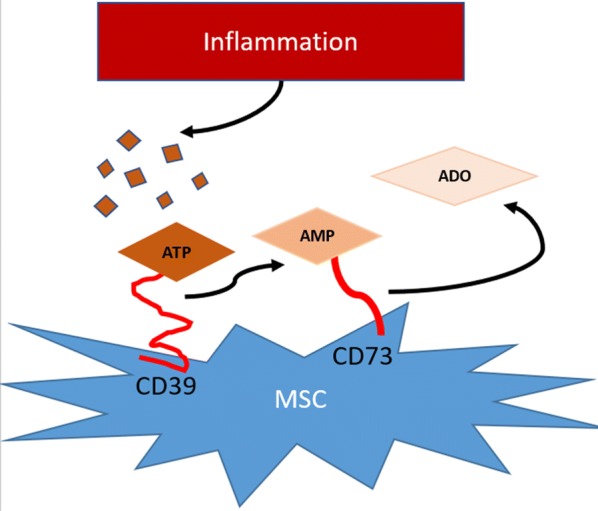
Mesenchymal stromal cells (MSC) demonstrate innate and regulatory immunologic functions and have been widely explored for cell therapy applications. Mechanisms by which MSCs achieve therapeutic effects are theorized, though appropriate dosing and duration of these mechanisms in vivo warrant deeper investigation. One, rapid immunosuppressive function of MSCs is through ectoenzyme expression of CD73 and CD39 which cooperatively hydrolyze inflammatory, extracellular adenosine triphosphate (ATP) to anti-inflammatory adenosine. Extracellular ATP has a key role in autoimmune and inflammatory diseases, which administered MSCs have the potential to modulate in a timescale that is befitting of shorter acting therapeutic function.
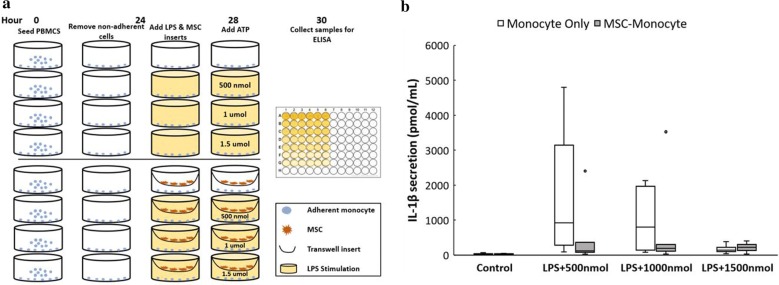
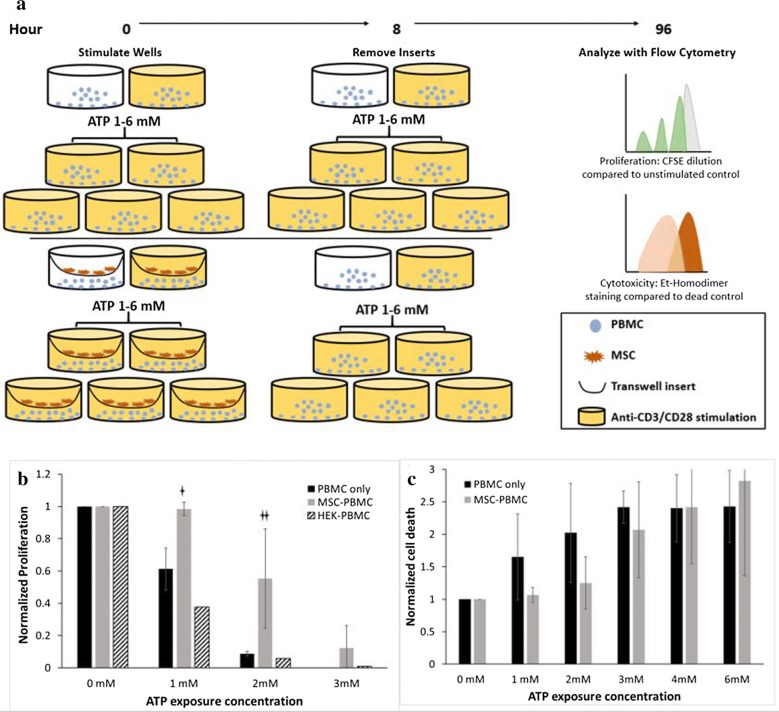
In vitro experiments were performed to determine the hydrolysis rates of ATP by MSCs. Through kinetic modeling from experimental results, the rate at which a single cell can metabolize ATP was determined. Based on these rates, the ability of MSCs to downregulate inflammatory signaling pathways was prospectively validated using model system parameters with respect to two different mechanisms: extracellular ATP stimulates lymphocytes to suppress proliferation and induce apoptosis and with co-stimulation, it stimulates monocytes to release pro-inflammatory IL-1β. MSCs were co-cultured with immune cells using transwell inserts and compared to immune cell only groups.
Hydrolysis of ATP was efficiently modeled by first-order enzyme kinetics. For in vitro culture, the rate at which a single cell can hydrolyize ATP is 8.9 nmol/min. In the presence of extracellular ATP, cocultures of MSCs reduced cytotoxicity and allows for proliferation of lymphocytes while limiting IL-1β secretion from monocytes.
Such use of these models may allow for better dosing predictions for MSCs to be used therapeutically for chronic inflammatory diseases such as rheumatoid arthritis, diabetes, pancreatitis, and other systemic inflammatory response syndromes. For the first time, the effect of MSCs on ATP hydrolysis in immune cell response is quantitatively analyzed on a cell-molecule basis by modeling the hydrolysis as an enzyme-substrate reaction. The results also give insight into MSCs' dynamic response mechanisms to ameliorate effects of extracellular ATP whether it be through positive or negative regulation.
间充质基质细胞 (MSC) 表现出先天和调节性免疫功能,并已广泛探索用于细胞治疗应用。MSC 实现治疗效果的机制虽然理论上存在,但在体内这些机制的适当剂量和持续时间仍需要更深入的研究。一种机制是 MSC 的快速免疫抑制功能是通过表达 CD73 和 CD39 的细胞外酶实现的,这两种酶共同水解炎症性细胞外三磷酸腺苷 (ATP),产生抗炎性腺苷。细胞外 ATP 在自身免疫和炎症性疾病中起着关键作用,给予 MSC 有潜力在更适合更短作用治疗功能的时间尺度上进行调节。
进行了体外实验以确定 MSC 对 ATP 的水解速率。通过从实验结果得出的动力学模型,确定了单个细胞代谢 ATP 的速率。基于这些速率,使用模型系统参数针对两种不同的机制前瞻性验证了 MSC 下调炎症信号通路的能力:细胞外 ATP 刺激淋巴细胞抑制增殖并诱导细胞凋亡,并且在共刺激下,它刺激单核细胞释放促炎 IL-1β。将 MSC 与免疫细胞通过 Transwell 插入物共培养,并与仅免疫细胞组进行比较。
通过一级酶动力学有效地模拟了 ATP 的水解。对于体外培养,单个细胞水解 ATP 的速率为 8.9 nmol/min。在细胞外 ATP 的存在下,MSC 共培养降低了细胞毒性,并允许淋巴细胞增殖,同时限制了单核细胞中 IL-1β 的分泌。
此类模型的使用可以更好地预测 MSC 的剂量,以便将其用于治疗类风湿关节炎、糖尿病、胰腺炎和其他全身性炎症反应综合征等慢性炎症性疾病。首次通过将水解模拟为酶-底物反应,从细胞-分子基础上定量分析了 MSC 对免疫细胞反应中 ATP 水解的影响。结果还深入了解了 MSC 对细胞外 ATP 的动态响应机制,无论是通过正调节还是负调节来改善其作用。